Showing posts with label HBCU. Show all posts

Tuesday, July 15, 2014

FAMU Alumnus John W Thompson Named Chairman of Microsoft

Today, Florida A&M University (FAMU) alumnus John W. Thompson was appointed the independent chairman of computer software giant Microsoft Corp., replacing company founder Bill Gates.

Thompson, a 1971 graduate of the School of Business and Industry (SBI), first joined Microsoft's board of directors in February 2012, serving as a lead independent director, a role he will continue in tandem with the appointment.

“Florida A&M University celebrates this achievement with John as he continues to excel in the world of business,” said FAMU Interim President Larry Robinson. “This is an excellent example of how the education our students receive at FAMU will propel them from the classroom to the boardroom and beyond.”

Thompson was inducted into the FAMU SBI Hall of Fame in 2011.

“John’s selection as chairman of Microsoft, one of the world’s most accomplished software companies, is a testament to the preparation that students receive at FAMU,” said Shawnta Friday-Stroud, dean of SBI. “He has been a major supporter of SBI through both his time and resources. We are extremely proud.”

In addition to chairman of the Microsoft board, Thompson is the chief executive officer of privately held Virtual Instruments. He is the former chairman and CEO of Symantec where he served for 10 years. Previously, he held a number of leadership positions at IBM, including sales, marketing, software development and general manager of IBM Americas.

“One of my key contributions, I hope, will be to engage with shareholders and keep focus on how together we can bring great innovation to the marketplace and drive strong long term shareholder value,” said Thompson in a video statement from Microsoft.

Thompson received his bachelor's degree in business administration from FAMU. He earned a master's degree in management from the Sloan Fellows program of the MIT Sloan School of Management.

According to Microsoft, Gates will assume a new role on the Board as founder and technology advisor. Thompson was named chairman of the Board and Satya Nadella was named chief executive officer, taking over for Steve Ballmer.


Watch FAMU SBI Dean Shawnta Friday-Stroud discuss Thompson's appointment on WTXL Sunrise:

http://www.wtxl.com/news/local/update-famu-graduate-named-chairman-of-microsoft-corporation/article_9f2fce20-8dc0-11e3-8175-001a4bcf6878.html

Source: http://www.famu.edu/index.cfm?a=headlines&p=display&news=2947

Saturday, February 1, 2014

Dr. Herbert Smitherman

Dr. Herbert Smitherman was a pioneering executive and professional chemist at Proctor & Gamble who led the way for other African-Americans at the prestigious company in the 1960s. He was the first black person with a doctorate hired at Proctor & Gamble.

With a Ph.D in physical organic chemistry, Dr. Smitherman developed a number of incredibly popular patents, including Crest toothpaste, Safeguard soap, Bounce fabric softeners, Biz, Folgers Coffee and Crush soda, to name a few. Not only are they still on the shelves, but many of them are on display at the Cincinnati Museum Center in the featured exhibit, “America I AM: The African-American Imprint.”

Nicknamed the “Jackie Robinson of Proctor & Gamble,” Dr. Smitherman spent 29 years there before turning in his labcoat to work as a professor at Wilberforce University. But after serving at the historically black college, Smitherman turned his attention to starting a high school called the Western Hills Design Technology School to help black students perform better in math and science.

A child of the south, Dr. Smitherman’s family lived in Birmingham, Alabama, where his father served as a reverend. A young Smitherman would see his father’s church burn down twice during their push for voting registration and voting rights.

He died this year on Oct. 9.

Dr. Smitherman’s legacy was left in his association with HBCUs, specifically his alma mater, Tuskegee Institute, where he met his wife of 51 years; Howard University, where he got his PH.D, and Wilberforce University, where he enlightened many students on his world of historical innovation.

Source: http://blackhistorymonth.blackamericaweb.com/index.php?option=com_content&view=article&id=562%3Adr-herbert-smitherman&catid=112%3Ageneral&Itemid=292

Friday, August 9, 2013

Homeless Teen Graduates Valedictorian & Will Enter Spelman As A Junior


Homeless teen Chelsea Pearce is the type of girl who’s tragic, yet triumphant life is the thing tear-jerking movies are made of. Spending most of her teen years living in her mother’s car, Chelsea has managed to do the damn near impossible–graduate from high school…at the top of her class.

That’s not all! The impressive Charles Drew High School senior will be going to college at Spelman College, where she will bypass freshman and sophomore year to start as a junior!

Fearce spent her last two high school years taking college courses and her 1900 SAT score made her an academic star at her school.

How does one do this, especially under the circumstances of poverty Fearce faced? With a 4.466 GPA in her grasp, Fearce simply states, “I just did what I had to do.”

Fearce is a part of a family of five and there were many times where they would have a place to live, but those times were few and far between. Fearce’s mother, Reenita Shepherd says they “ended up back in another shelter because I got laid off from my job maybe about four or five times.”

Reenita may be facing poverty head on, but her children are over-achievers! Pearce’s sister is graduating from George Washington Carver High School as salutatorian. Shepherd attributes their academic achievements to the amount of reading she would do for them growing up.

As if this story couldn’t get any more heart-warming, Fearce offers some motivational words to those who come from her similar situation, “Don’t give up. Do what you have to do right now so that you can have the future that you want.”

Tuesday, May 14, 2013

Twins to Graduate With Identical Honors – Valedictorian


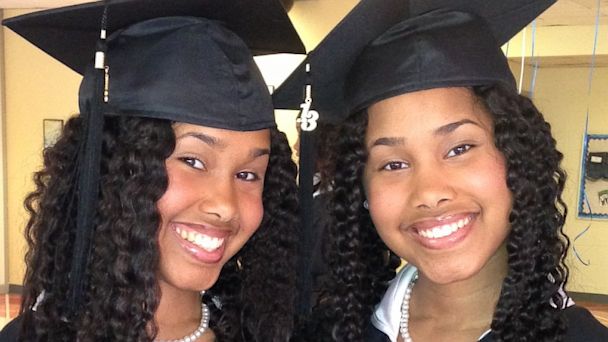
Identical twins Kirstie and Kristie Bronner share practically everything: hobbies, favorite colors, favorite foods, and clothes.  But now they can share the title of valedictorian.

Kirstie and Kristie, both 22, from Atlanta, Ga., will graduate May 19 as the first co-valedictorians who are also identical twins at Spelman College, in Atlanta.

“I don’t think we even thought about the possibility of it,” Kristie told ABCNews.com.

“We actually have prayed about it,” Kirstie said.  “Lord help us to make 4.0s all the way through college.”

The two have the same major—music—and both have perfect 4.0 GPAs.  The sisters managed to keep up their grades while juggling Spelman College’s glee club and volunteering at their father’s church, Word of Faith Family Worship Cathedral.

“I am extremely proud of them.  They have gotten that particular status the old fashion way,” their father, Bishop Dale Bronner, told ABCNews.com. “Their greatest asset is their discipline. They got their brilliance from the mother, but they got their discipline from their father.”
“We prayed harder than everybody else and worked harder,” Kirstie said.

For the twins, their achievement meant having to sacrifice going out on the weekends occasionally. “Our friends kind of just stopped asking,” Kristie said.

The sisters attribute most of their achievements to their relationship and their similarities. “Our values are the same,” Kristie said. “Our drive is the same. We spend a lot of time together so we always studied together.”

In fact, their personalities are so similar that the two said that they’ve had many occurrences where they’ve written papers or taken tests and had the same thesis points or wrong answers.

Identical twins Kirstie and Kristie Bronner are graduating as co-valedictorians with identical 4.0 GPAs from Spelman College in Atlanta, GA. (Courtesy Kirstie Bronner)

Kirstie and Kristie have one distinction that helps tell them apart. Kirstie said, “I’m a little more direct. She’s a little more sugarcoating.”

While Kristie admits that sharing so much may get on their nerves at times, it’s their teamwork that makes their dynamic successful.  ”In college, we discovered how different we are,” Kristie said.  ” Our differences actually compliment each other.  It helps us to get things done faster.”

Kirstie added, ” I think of of the biggest things that comes between twins is competition.  Although we have our arguments, I think that one way that we help to eliminate competition is to be mindful of it and be secure in our individual identities.”

One way the twins eliminate getting compared is by dressing alike. “You can’t say one twin is the more stylish twin if we have on the same thing,” Kirstie said.

After graduating, Kirstie and Kristie plan on continuing on the same path as youth counselors, youth event coordinators, and directors of music at the Word of Faith Family Worship Cathedral.  Achieving the title of valedictorian wasn’t enough for the girls.  They also plan on writing a book with scheduling tips and releasing a gospel album.

“We don’t think we achieved it based upon genius, but based upon strategy,” Kirstie said.

http://abcnews.go.com/blogs/headlines/2013/05/twins-to-graduate-with-identical-honors-valedictorian/

Wednesday, November 7, 2012

Infor: Charles Phillips, Chief Executive Officer


Prior to Infor, Phillips was President of Oracle Corporation and a member of its Board of Directors. During his seven and a half year tenure, the company tripled in size and successfully acquired 70 companies. Prior to Oracle, Phillips was a Managing Director at Morgan Stanley in the Technology Group. Before his 18-year career on Wall Street, Phillips was a Captain in the U.S. Marine Corps in the 2nd Battalion, 10th Marines.

Phillips holds a B.S. in Computer Science from the U.S. Air Force Academy, a JD from New York Law School, and an MBA from Hampton University and is a member of the Georgia State Bar.

Phillips serves on the Boards of Viacom Corporation, Jazz at Lincoln Center, New York Law School, the American Museum of Natural History, the United States Air Force Academy Endowment Fund, and Phillips Charitable Organizations. Phillips also served on the Obama Administration's Economic Recovery Board, led by Paul Volcker.

Source: http://www.infor.com/

Sunday, July 15, 2012

Keenen Ivory Wayans

The trail-blazing linchpin of a sprawling African-American family of comic entertainers, it was multi-talented writer/director/producer Keenen Ivory Wayans (born June 8, 1958, in New York City) who was the first to achieve national prominence by successfully creating, launching and hosting a landmark 1990s black-oriented comedy satire on Fox TV. That, in turn, ignited and/or advanced the careers of not only his younger siblings Damon Wayans, Kim Wayans, Shawn Wayans and Marlon Wayans, but others of his extended family as well.

The second of ten children of Howell Wayans, a grocery store manager, and Elvira Wayans, a social worker, Keenan attended Seward Park High School, then majored in engineering at Alabama's Tuskegee University. He dropped out during his senior year when the comedy bug hit him full force. Heavily influenced by Richard Pryor, he found only lukewarm success on the New York standup stage, deciding later to relocate to Los Angeles in order to pursue film and TV opportunities. After being glimpsed in bit parts in such TV shows as "CHiPs" (1977) and "Cheers" (1982) and movies as Star 80 (1983), in which he played a standup comic, he found his first real break in a sudsy TV drama--the short-lived military series "For Love and Honor" (1983), in which he had a recurring role as Pvt. Duke Johnson, who aspired to become a professional boxer.

After hooking up with comedian Eddie Murphy and earning writing credit on the star's raunchy live performance feature Eddie Murphy Raw (1987), Keenen's visibility rose. Partnering with actor/director Robert Townsend, he had his first film hit with Hollywood Shuffle (1987), a pointed satire highlighting the plight of the black actor in Hollywood. Done in hilariously stereotypical fashion, one great bit had detective Townsend battling a blaxploitation villain named Jerry Curl (Wayans). Following this came another similar 1970s blaxploitation parody, the even bigger hit I'm Gonna Git You Sucka (1988) in which Keenen had the starring role and made his directorial debut. He played the revenge-minded, but not particularly macho Jack Spade alongside such icons of 1970s blaxploitation cinema as Jim Brown, Isaac Hayes and Bernie Casey. The film also featured several members of his family.

The sketch-oriented, Emmy-winning variety series "In Living Color" (1990) was Keenen's creative baby and ultimate pièce de résistance. He also turned the show into a family act as well with Damon, Kim, Marlon and Shawn all appearing on the irreverent series that showcased the deviously scathing social humor Keenen was infamous for. As host of the show he graciously spotlighted the comedy ensemble more than himself. Not only did the show introduce the public to a number of terrific black comedians, it made superstars out of brother Damon, as well as Jamie Foxx and Jim Carrey, the latter being one of the show's few white regulars. Jennifer Lopez also got her start as one of the original hip-hop dancing, sexy "Fly Girls." Ironically, Keenen would be one of the first of the cast to leave the show over creative issues and contract disputes with the network. He felt Fox was overexposing the show, which would have reduced its monetary value once it turned to syndication. He abruptly left in 1992 and, by next season's end, the rest of the Wayans clan had bailed as well. Nearly half of the regular cast on the show's final season were white.

This unfortunately bitter and acrimonious incident led the one-time driving force to become more selective in his projects, while retreating more and more behind the scenes. In 1997, however, he produced "The Keenen Ivory Wayans Show" (1997), a party-themed talk show in which he served as the cool, urban-styled host. The set resembled a nightclub and the atmosphere was rowdy and jaunty. The show wasn't cool enough, apparently, as it was canceled before year's end. Keenen also tried to turn buff action star with the films A Low Down Dirty Shame (1994), which he wrote and directed, The Glimmer Man (1996), pairing up with Steven Seagal, and Most Wanted (1997), but the attempt backfired and he dropped, big time, out of the limelight.

When it comes to outrageous satire Keenen has few peers. Come the millennium he directed the hilarious horror spoof Scary Movie (2000), which prominently displayed brothers Shawn and Marlon and is one of the most successful feature films ever directed by an African-American. He also directed its first sequel, Scary Movie 2 (2001). Keeping things more or less a family affair these days, he recently directed Shawn and Marlon in White Chicks (2004), and is helming Damon's upcoming feature _Homey the Clown (2007)_, based on Damon's famous mean-spirited ghetto character from the "In Living Color" days.

On the personal side, Keenen married wife Daphne in June 2001, and had five children, but the couple have been separated since 2004. Older brother Dwayne Wayans is a composer/musician who served as a production assistant on "In Living Color," while various nephews and cousins have since gotten into the act thanks to Keenen and his groundbreaking accomplishments.

Source: http://www.imdb.com/name/nm0005540/bio

Friday, July 13, 2012

Morehouse College

A Proud Tradition of Producing Outstanding Leaders

Although times change, Morehouse’s mission remains steadfast: to produce academically superior, morally conscious leaders for the conditions and issues of today, whether “today” is post-Civil War or turn of the new millennium.

Martin Luther King Jr. led the country through one of its most transforming civic movements; David Satcher resuscitated the issues of health care disparity and access; Maynard Jackson taught the world the value of diversity and equal access as the first African American mayor of Atlanta; Donn Clendenon scored in the history annals and was part of a miracle when he was named a World Series MVP; and Shelton “Spike” Lee continues to challenge how the world views blacks in life with critically acclaimed films.

All helped change the world. All are Morehouse men.

Preparing Young Men to Change the World

With the right resources, politicking or posturing, anyone can be a leader. Right?

Wrong. At Morehouse, we are redefining the meaning of leadership. It’s not about attaining the highest title or position, but about attaining skills such as compassion, civility, integrity and even listening. Morehouse is poised to become the epicenter of ethical leadership as we continue to develop leaders who are spiritually disciplined, intellectually astute and morally wise.

And leadership first begins at home. Nearly three-fourths of our students volunteer within the community. This volunteerism connects them to their communities and helps them see that, as individuals and as a squadron of educated black men, they can make a difference.

Many Morehouse students also travel or study abroad, awakening them to the complexities of a global community. In today’s age, ethical leaders must have an appreciation of different perspectives and customs, and must also be prepared to negotiate the discordant views that are converging from the four corners of the globe.

Morehouse is committed to training the leaders who will change their communities, the nation and the world.

The College of Choice for Black Men
There is a world of professions and universities to choose from, and today, black men have access to them all. But many of the best and brightest choose Morehouse.

Most people—even the students themselves—are awestruck by the sight of so many talented, studious and highly motivated young black men seeking knowledge and fulfillment. New Student Orientation, when hundreds of fresh-faced freshmen march into King Chapel for the first time, is just as moving as Commencement, when they emerge, queued in a line 500-members strong, as well-trained scholars and leaders. Nowhere else in America, or the world, does this happen. Morehouse has traditionally graduated more black men than other school, anywhere.

So, why do black men still choose Morehouse? No doubt, it is the excellent liberal arts education and an environment that is conducive to academic, social and spiritual growth. But there are many great schools out there, so there must be something more?

We call that something the “Morehouse Mystique.” The phrase is not easily defined or understood, but it’s also not just a clever slogan. The Mystique is joining a brotherhood like none other. And after being ignored, stereotyped or marginalized, it’s about finally finding that “home” that, deep inside, you always knew existed, where you are the heart, soul and hope of the community. And where you are not alone.

This is what makes Morehouse unique. No other institution in the world can match the Morehouse experience. Other colleges and universities may call, but African American men continue to choose the ‘House.

Source: http://www.morehouse.edu/

Tuesday, July 10, 2012

Morgan State University

Morgan State University is by designation of the Maryland General Assembly the State’s public urban university. Its mission is to provide a comprehensive array of programs and services to the citizens and organizations of the Baltimore metropolitan area. Its three major mission components are:

to educate citizens from diverse academic and socioeconomic backgrounds
to carry out research, giving priority to that applicable to the problems of the region and its residents
provide cultural opportunities for the region and offer programs of service to the community and the general public
The University has a long tradition of educating the very best prepared students as well as many others from disadvantaged backgrounds. It is strongly committed to continuing this tradition. At the same time the University is making a transition to a campus that will: award more advanced degrees, particularly in programs of importance to the region; carry out more research on topics important to the local community; and, share its resources with the general public and become a center of social and cultural life for the residents of metropolitan Baltimore. This document provides a blueprint by which the University intends to develop over the next several years.

Vision for the Future
The University will continue to emphasize and strengthen its historic mission; that of providing an excellent undergraduate education to a broad segment of the population, including many of the best prepared as well as some who might not otherwise have the opportunity to enroll in college but who have the potential to complete a degree. At the same time, Morgan plans to place additional emphasis on graduate study in selected disciplines as well as on research in these fields. These programs will be in fields of importance to the economy and will provide the foundation for an increased emphasis by the University on service to the City of Baltimore and the Baltimore region.

Source: http://www.morgan.edu

Sunday, July 8, 2012

Thurgood Marshall

Born in Baltimore, Maryland on July 2, 1908, Thurgood Marshall was the grandson of a slave. His father, William Marshall, instilled in him from youth an appreciation for the United States Constitution and the rule of law. After completing high school in 1925, Thurgood followed his brother, William Aubrey Marshall, at the historically black Lincoln University in Chester County, Pennsylvania. His classmates at Lincoln included a distinguished group of future Black leaders such as the poet and author Langston Hughes, the future President of Ghana, Kwame Nkrumah, and musician Cab Calloway. Just before graduation, he married his first wife, Vivian "Buster" Burey. Their twenty-five year marriage ended with her death from cancer in 1955.

In 1930, he applied to the University of Maryland Law School, but was denied admission because he was Black. This was an event that was to haunt him and direct his future professional life. Thurgood sought admission and was accepted at the Howard University Law School that same year and came under the immediate influence of the dynamic new dean, Charles Hamilton Houston, who instilled in all of his students the desire to apply the tenets of the Constitution to all Americans. Paramount in Houston's outlook was the need to overturn the 1898 Supreme Court ruling, Plessy v. Ferguson which established the legal doctrine called, "separate but equal." Marshall's first major court case came in 1933 when he successfully sued the University of Maryland to admit a young African American Amherst University graduate named Donald Gaines Murray. Applauding Marshall's victory, author H.L. Mencken wrote that the decision of denial by the University of Maryland Law School was "brutal and absurd," and they should not object to the "presence among them of a self-respecting and ambitious young Afro-American well prepared for his studies by four years of hard work in a class A college."

Thurgood Marshall followed his Howard University mentor, Charles Hamilton Houston to New York and later became Chief Counsel for the National Association for the Advancement of Colored People (NAACP). During this period, Mr. Marshall was asked by the United Nations and the United Kingdom to help draft the constitutions of the emerging African nations of Ghana and what is now Tanzania. It was felt that the person who so successfully fought for the rights of America's oppressed minority would be the perfect person to ensure the rights of the White citizens in these two former European colonies. After amassing an impressive record of Supreme Court challenges to state-sponsored discrimination, including the landmark Brown v. Board decision in 1954, President John F. Kennedy appointed Thurgood Marshall to the U.S. Court of Appeals for the Second Circuit. In this capacity, he wrote over 150 decisions including support for the rights of immigrants, limiting government intrusion in cases involving illegal search and seizure, double jeopardy, and right to privacy issues. Biographers Michael Davis and Hunter Clark note that, "none of his (Marshall's) 98 majority decisions was ever reversed by the Supreme Court." In 1965 President Lyndon Johnson appointed Judge Marshall to the office of U.S. Solicitor General. Before his subsequent nomination to the United States Supreme Court in 1967, Thurgood Marshall won 14 of the 19 cases he argued before the Supreme Court on behalf of the government. Indeed, Thurgood Marshall represented and won more cases before the United States Supreme Court than any other American.

Until his retirement from the highest court in the land, Justice Marshall established a record for supporting the voiceless American. Having honed his skills since the case against the University of Maryland, he developed a profound sensitivity to injustice by way of the crucible of racial discrimination in this country. As an Associate Supreme Court Justice, Thurgood Marshall leaves a legacy that expands that early sensitivity to include all of America's voiceless. Justice Marshall died on January 24, 1993.

Source: http://chnm.gmu.edu/courses/122/hill/marshall.htm

Saturday, June 30, 2012

Spike Lee

SPIKE LEE is a notable writer, director, producer, actor, and author who revolutionized both the landscape of independent cinema and the role of black talent in film. Widely regarded as a premiere African-American filmmaker, Lee is a forerunner in the ‘do it yourself’ school of filmmaking.

Spike’s latest endeavor is the follow-up documentary If God is Willing and Da Creek Don’t Rise, which revisits the recently storm-ravaged GulfCoast region as residents attempt to rebuild in their cities while also demanding assistance and accountability from their political leaders. This film comes on the heels of When the Levees Broke: A Requiem in Four Acts, the groundbreaking first documentary that followed the plight of Americans stranded in New Orleans after Hurricane Katrina. The release of If God is Willing and Da Creek Don’t Rise will coincide with the fifth anniversary of Hurricane Katrina in the summer of 2010.

Lee’s recent theatrical release Miracle at St. Anna is set in 1944 and chronicles the story of four black American soldiers who are members of the US Army as part of the all-black 92nd "Buffalo Soldier" Division, trapped behind enemy lines in Tuscany, Italy during World War II. An avid sports enthusiast, Lee also completed a one day 18 camera documentary shoot focusing on NBA standout Kobe Bryant of the Los Angeles Lakers. Produced for ESPN, the unique piece is entitled Kobe Doin’ Work. Another recent project, Passing Strange: The Movie – showcases the critically acclaimed Broadway musical, which explores the travels of a young African American musician in search of himself. Passing Strange debuted at the Sundance Film Festival.

Other critical and box office successes have included such films as Inside Man, 25th Hour, The Original Kings of Comedy, Bamboozled and Summer of Sam. Lee’s films Girl 6, Get On the Bus, Do the Right Thing and Clockers display his ability to showcase a series of outspoken and provocative socio-political critiques that challenge cultural assumptions, not only about race, but class and gender identity as well. His debut film, the independently produced comedy She’s Gotta Have It earned him the Prix de Jeunesse Award at the Cannes Film festival in 1986 and set him at the forefront of the Black New Wave in American Cinema. His second feature, the very profitable and critically acclaimed School Daze, helped launch the careers of several young Black actors. Lee’s timely 1989 film, Do the Right Thing, garnered an Academy Award® nomination for Best Original Screenplay, and Best Film and Director awards from the Los Angeles Film Critics Association. Lee’s Jungle Fever, Mo’ Better Blues, Clockers and Crooklyn were also well received by critics and fans alike. His epic drama Malcolm X starring Denzel Washington, received two Academy Award® nominations.

Born in Atlanta, Georgia, and raised in Brooklyn, Lee returned south to attend Morehouse College. After graduation, he returned to Brooklyn to continue his education at New YorkUniversity’s Tisch School of Arts in Manhattan, where he received his Master of Fine Arts Degree in film production. He founded 40 Acres and a Mule Filmworks, based in the FortGreene section of Brooklyn, where he has resided since childhood.

In addition to his film achievements, Lee has produced and directed numerous music videos for diverse artists including Chaka Khan, Tracy Chapman, Anita Baker, Public Enemy, Bruce Hornsby and Michael Jackson. His other music videos include work for the late Miles Davis and Phyllis Hyman, Naughty by Nature and Arrested Development.

Lee’s commercial work began in 1988 with his Nike Air Jordan campaign. Collaborating with basketball great Michael Jordan on several commercials, Lee resurrected his popular character, Mars Blackmon from She’s Gotta Have It. He has also completed a PSA for UNCF entitled Two Michaels, which also features Michael Jordan. Lee is also well known for his Levi’s Button-Fly 501, AT&T and ESPN television commercials. His other commercial ventures include TV spots for Philips, Nike, American Express, Snapple and Taco Bell. Lee has also directed several Art Spot Shorts for MTV and a short film featuring Branford Marsalis and Diahnne Abbott for Saturday Night Live.

Lee is also involved in documentaries and sports programs. He completed the Emmy and Oscar®-nominated documentary 4 Little Girls for HBO and received an Emmy Award for his piece on Georgetown’s John Thompson for HBO/Real Sports.

Additionally, Lee has authored six books on the making of his films. The fifth book, Five For Five served as a pictorial reflection of his first five features. He then followed up with Best Seat in the House, authored with Ralph Wiley. Lee and his wife Tonya Lewis Lee co-authored two children's books entitled Please, Baby, Please and Please, Puppy, Please. Most recently he authored a retrospective book about his film career entitled That's My Story and I'm Sticking to It.

Ever moving into new areas, Spike Lee has combined his extensive creative experience into yet another venture: partnering with DDB Needham, he created Spike/DDB, a full-service advertising agency.

During the 1980s, Spike Lee began creating feature films that have gone on to separate him from other filmmakers. In 1986, Lee directed his independently produced comedy She’s Gotta Have It. This film garnered him the Prix de Jeunesse Award at the Cannes Film festival. Mr. Lee’s feature films would go on to be nominated and for some, win many highly competitive and well respected awards. His film Do the Right Thing, released in 1989, is considered to be timely by many within the industry including critics and even by many of the film’s overall viewers. Do the Right Thing reaped an Academy Award nomination for Best Original Screenplay and won Best Picture and Best Director awards from the Los Angeles Film Critics Association.

Spike’s feature films are famous for shining the light on controversial topics such as race, class and a variety of relationships that many other directors may choose to shy away from. Jungle Fever, released in 1991, was one of Lee’s most controversial films. It brought to the forefront some of the reactions and feelings that people may feel towards interracial relationships. The following year would be a huge one for Spike when he released Malcolm X, which chronicled the life, career, and tragic death of one of America’s greatest Civil Rights Activists. This film garnered Denzel Washington, who played the title role, an Academy Award Nomination for Best Actor. In 2006, Lee’s Inside Man was a box office hit. Marking a pivotal moment in this acclaimed Director’s career. It is Spike’s highest grossing film to date. On SEPTEMBER 26, 2008, Lee released Miracle at St. Anna, an epic film telling the story of four African American soldiers and their heart wrenching experiences while stationed in Italy during World War II. Currently, Passing Strange The Movie is available on DVD.

Source: http://www.40acres.com/

Thursday, May 31, 2012

JJ Smith

JJ Smith is a nutritionist and certified weight-management specialist, passionate relationship/life coach, and inspirational speaker. She has been featured on The Steve Harvey Morning Show, The Montel Williams Show, The Jamie Foxx Show, and The Michael Baisden Show. JJ has made appearances on the NBC, FOX, CBS, CNBC and CW Network television stations, as well as in the pages of Glamour, Essence, Heart and Soul, and Ladies Home Journal. Since reclaiming her health, losing weight, and discovering a “second youth” in her forties, bestselling author JJ Smith has become the voice of inspiration to women who want to lose weight, be healthy, and get their sexy back! JJ Smith provides lifestyle solutions for losing weight, getting healthy, looking younger and improving your love life!

JJ has dedicated her life to the field of healthy eating and living. JJ’s passion is to educate others and share with them the natural remedies to stay slim, restore health, and look and feel younger. JJ has studied many philosophies of natural healing and learned from some of the great teachers of our time. After studying and applying knowledge about how to heal the body and lose weight, JJ went on to receive several certifications—one as a certified nutritionist and another as a certified weight-management expert. JJ received her certification as Nutritionist from the International Institute of Holistic Healing. JJ received her certification as a Weight-Management Specialist from the National Exercise and Sports Trainers Association (NESTA). She is also a member of the American Nutrition Association (ANA).

JJ's current work, Lose Weight: Without Dieting or Working Out!, is a revolutionary system that teaches proven methods for permanent weight loss that anyone can follow, no matter their size, income level, or educational level. And the end result is a healthy, sexy, slim body. JJ's breakthrough weight-loss solution can help you shed pounds fast by detoxifying the body, balancing your hormones, and speeding up your metabolism. You'll also learn which foods help you stay slim and which foods cause you to get fat. If you have been on a roller-coaster ride of weight loss, you will finally be able to get off that ride, lose weight and stay slim for life!

JJ is also the author of the bestseller, Why I Love Men: The Joys of Dating. It contains compelling and funny stories she cultivated over the past 15 years of relationships that included three marriage proposals. In a sister-to-sister, woman-to-woman approach, the author shares her heartfelt story of her joys, pains and lessons learned from dating. She also provides scores of tips on how women can improve their relationships with men and have more fun while dating. Why I Love Men is ultimately a tribute to men and how they shaped her life and helped her grow and develop as a woman.

JJ holds a B.A. in Mathematics from Hampton University in Virginia. She continued her education by completing The Wharton Business School Executive Management Certificate program. She currently serves as Vice President and Partner in an IT Consulting firm, Intact Technology, Inc. in Greenbelt, Maryland. JJ was also the youngest African-American to receive a Vice President position at a Fortune 500 company. Her hobbies include reading, writing and deejaying.

Source: http://jjsmithonline.com

Sunday, May 20, 2012

Black Entrepreneur Pencils Herself Into Silicon Valley

I’m Tiffani Ashley Bell and I founded Pencil You In as a way to allow hairstylists and makeup artists to accept appointments online and by extension, grow their clientele.

I’ve been programming since I was a kid, but at some point, I realized it was more important to use my technical ability to solve real problems. This all came to a head back in 2008 during my senior year as a computer science major at Howard University.

As graduation loomed closer, I occasionally eschewed track pants and a headscarf thanks to job interviews, presentations, etc. My hairstylist and I played these lovely games of phone tag as I forgot to call him or I’d call him and his appointment book wasn’t at hand. When we finally were in sync, I sometimes ended up with appointments at awkward times (7am, once), if one at all. One could say that I needed to just make my appointments at the end of visits, but this asked too much of the schedule of someone weeks away from graduation. Pencil You In was then conceived as my solution to my hair appointment scheduling woes.

Pencil You In was one project out of several I was working on at one time, but it became evident that it should get 100% of my attention. With that realization, however, came a flood of questions: should I raise money? How does the customer in Tampa’s feedback fit into the vision? Whose advice should I take with a grain of salt and for whose should I go back for seconds?

Eager for answers, I quit my job at the beginning of June to come to the Bay area two weeks later thanks to the NewME Accelerator. After being here for just a month, many of my questions have gotten awesome answers. For others, the answers are revealing themselves as the countdown to Demo Day winds down. I couldn’t have expected more out of being here.

The NewME Accelerator is shifting my entire thought process on running a company (and by extension, living). I’ve met one brilliant person after another (the likes of Navarrow Wright, Jay Jamison, etc.), talked to investors I may have never had the chance to speak to otherwise (Mitch Kapor, for example), and built out my company in an environment where it’s clear everybody appreciates ambition and wants to see success.

Check out Pencil You In to book your look online 24/7/365.

Source: http://newsone.com/nation/technology-nation/tiffanibell/tiffani-bell-pencil-you-in/

Monday, May 7, 2012

Alcorn named HBCU of the Year

Alcorn State University has won the top honor of HBCU of the Year at the annual HBCU Awards hosted by The Center for HBCU Media Advocacy. The awards ceremony honors excellence at historically black colleges and universities, the HBCU Awards is one of the most prominent and keenly contested awards.

“Alcorn appreciates the work and leadership of the Center for HBCU Media Advocacy,” says 18th President M. Christopher Brown II as he accepted the award last night (April 21) in Washington, D.C.

“This award would not be possible without the hard work and dedication to excellence of our faculty, students, alumni, and staff. We thank all of our friends and supporters of the nation’s oldest public historically black land-grant institution. We are Alcorn – always excellent without excuse.”

Other institutions vying for the HBCU of the Year Award who also demonstrated extraordinary community outreach initiatives, comprehensive research, and measurable student engagement by way of enrollment, retention and institutional morale included Tuskegee University, Bennett College for Women, Florida A & M University, and Southern University Law Center.

Alcorn was nominated for nine awards: Best Research Center – The Center for Ecology and Natural Resources; Best Fine Arts Program – ASU Fine Arts Department; National Alumni Association of the Year – ASU National Alumni Association; Male Alumnus of the Year – Dr. Shelby R. Wilkes; Female Coach of the Year – Coach Tonya Edwards; Best HBCU Choir – ASU Concert Choir; Best Alumni Publication – Alcorn, the University’s Magazine; Male President/Chancellor of the Year – Dr. M. Christopher Brown II; and for the HBCU of the Year.

Alcorn also captured the title for Best Alumni Publication. “Winning the Best Alumni Publication Award represents another major achievement for Alcornites,” says Associate Vice President for Marketing and University Relations Clara Ross Stamps who serves as the editor of the award-winning publication. “It’s the great work of our students, alumni, faculty, and staff that gives Alcorn a powerful voice – we thank them for allowing us to share their stories with the world.”

Vice President for Institutional Affairs and Interim Executive Director of the ASU Foundation Marcus D. Ward accepted the award for Dr. Shelby Wilkes as Male Alumnus of the Year, “Like so many distinguished Alcornites, Dr. Wilkes has served Alcorn well for many years. He is an active member of the Alcorn State University Foundation, Inc. Board of Directors and is a great role model and mentor for our students. I am honored to accept this award on his behalf.”

In recognizing Alcorn’s tremendous achievements, Jarrett L. Carter Sr., founder and executive director of the Center for HBCU Media Advocacy, cited that “great things – outstanding research, high-quality teaching and public engagement – are happening at Alcorn State University and you are {Alcorn} as the nation’s first historically black land-grant institution, an elite institution, that embodies the spirit of the HBCU community.”

Source: http://hbcuconnect.com/

Friday, May 4, 2012

Ed Bradley

Ed Bradley, one of journalism's brightest stars whose name was synonymous with the CBS News magazine 60 Minutes on which he reported for the past 25 years, died Thursday, Nov. 9, 2006, in Mt. Sinai Hospital in New York City. He was 65 and died of complications from chronic lymphocytic leukemia. Bradley lived in New York, but also had homes in Woody Creek, Colo. and East Hampton, N.Y.

Bradley spent nearly his entire 39-year career with CBS News, where he rose to the pinnacle of journalistic achievement, at first on the CBS Evening News and on CBS News documentaries and then on 60 Minutes, where he compiled an extraordinary body of work that featured a keen talent for the interview and an intense curiosity shown in his investigative work. He was an elegant gentleman who was also known for his impeccable clothing and style, which included a small earring in his left ear that he wore since the late 1980s, and a short, distinctive beard.

Bradley was among the first black journalists to make a name for himself on national television when his battlefield reporting from the Vietnam War - in which he was wounded in 1973 - pushed him onto the national stage. He never forgot his roots, and spent many hours of his scarce free time talking to young minority journalists. A few years ago, he provided a significant amount of money to seed an annual $10,000 award given each year in his name by the Radio and Television News Directors' Association to a promising minority journalist.

His career gradually built with reporting stints on Capitol Hill, then as White House reporter and then as the principle reporter for the renowned documentary series "CBS Reports." Bradley became one of the most recognized journalists in America soon after joining 60 Minutes. He was listed high on the list of "most trusted TV news personalities" in a 1995 poll published by TV Guide. In the same poll, he was rated second - right behind Walter Cronkite - in competence.

Don Hewitt, 60 Minutes founder and former executive producer, says he first noticed Bradley in a 1979 "CBS Reports" documentary about Southeast Asian refugees, "The Boat People," in which Bradley was filmed helping weak survivors struggling in the surf. Hewitt then picked him to join Mike Wallace and Morley Safer in 1981 on the mega-hit news magazine that finished second in the ratings in Bradley's first season and then topped the list the next with 34.2 million viewers.

Bradley's true talent was his ability to do any story and look natural doing it, whether clowning around with Robin Williams, probing company executives in an investigation or conducting sensitive interviews with bereaved people. The range of Bradley's immense talent was demonstrated almost immediately on 60 Minutes with two Emmy-Award winning interviews in his first few seasons. In the first, an insightful profile of Lena Horne, the fragile singer became so comfortable with the young Bradley, she unconsciously grabbed his hand as they walked.

A few months later, his combative interview with murderer/author Jack Henry Abbott was palpably intense, one in which Bradley recalled being nervous as Abbott fingered a pen that Bradley thought the killer might have stabbed him with. A more recent Emmy-winning jailhouse interview evoked the Abbott episode: Bradley's gripping interview of condemned Oklahoma City bomber Timothy McVeigh in March 2000, the only one for television McVeigh gave. It was marked by powerful questions and answers, intense stares and at times, telling silence.

Bradley built on his work with more award-winning stories for 60 Minutes for a total of 20 Emmys and recognition from all of journalism's most prestigious awards. He won a George Foster Peabody Award for "Big Man, Big Voice" (November 1997), the uplifting story of a German singer who became successful despite significant birth defects. In 1995, he won his 11th Emmy Award for a 60 Minutes segment on the cruel effects of nuclear testing in the town of Semipalatinsk, Kazakhstan, a report that also won him an Alfred I. duPont-Columbia University Award in 1994. Also in 1994, he was honored with an Overseas Press Club Award for two 60 Minutes reports that took viewers inside sensitive military installations in Russia and the United States. In 1985, he received an Emmy Award for "Schizophrenia," a 60 Minutes report on that misunderstood brain disorder. He received an Alfred I. duPont-Columbia University Silver Baton and a 1991 Emmy Award for his 60 Minutes report "Made in China," a look at Chinese forced-labor camps, and another Emmy for "Caitlin's Story" (November 1992), an examination of the controversy between the parents of a deaf child and a deaf association.

Some of the more prominent investigative work carried out by Bradley included one of his last reports, an investigation of the Duke University lacrosse rape case, in which he broke new ground with the first interviews with the accused in a story that made headlines just last month; a report on the recalled painkiller, Vioxx, in November of 2004; an expose on the inclination of Ford Explorers with Firestone tires to roll over in crashes in 2000; a 2004 segment that reported the reopening of the 50-year-old racial murder case of Emmett Till; and a look at anti-gay feeling in the military that played a role the beating death of Pfc. Barry Winchell at Ft. Campbell, Ky., broadcast in 2003.

He also reported hour-long specials, among them a 1997 report "Town Under Siege" about a small town battling toxic waste that was named one of the Ten Best Television Programs of 1997 by Time magazine.

Prior to joining 60 Minutes, Bradley was a principal correspondent for "CBS Reports" (1978-81), after serving as CBS News' White House correspondent (1976-78). He was also anchor of the "CBS Sunday Night News" (November 1976-May 1981) and of the CBS News magazine "Street Stories" (January 1992-August 1993).

Bradley was responsible for some of "CBS Reports'" finest hours, including: "Enter the Jury Room" (April 1997), an Alfred I. duPont-Columbia University Award winner that revealed the jury deliberation process for the first time in front of network cameras; for "In the Killing Fields of America" (January 1995), a documentary about violence in America, for which he was co-anchor and reporter, that won the Robert F. Kennedy Journalism Awards' grand prize and television first prize; "The Boat People" (January 1979), which won duPont, Emmy and Overseas Press Club Awards; "The Boston Goes to China" (April 1979), a report on the historic visit to China by the Boston Symphony Orchestra, which won Emmy, Peabody and Ohio State Awards, and "Blacks in America: With All Deliberate Speed?" (July 1979), which won Emmy and duPont Awards.

Edward Rudolph Bradley, Jr. was born on June 22, 1941 in Philadelphia and attended local schools. He graduated from Cheyney State college in 1964 with a degree in teaching and taught sixth grade for three years in Philadelphia. He got a taste of his future when he moonlighted at WDAS radio, doing the odd job for little or no money. "I knew that God put me on this earth to be on the radio," he said years later. He covered basketball games, spun records and read the news for the station until one day in the middle 1960s when he heard about the riots in Philadelphia on the radio. He offered to cover the story for WDAS and wound up reporting the event in phone call interviews with community leaders. When he returned to the station, they sent him out with a recorder. Bradley never looked back and reporting became his passion.

He soon landed a job at WCBS radio in New York, where he asserted himself and argued with his editor that he would not only cover black issues, he would cover all stories. After a few years, he quit his job and moved to Paris on a romantic whim soon dashed when he ran out of money. Bradley went back to his second love, reporting, and was freelancing for CBS News when they offered him a job covering the war in 1972. In Cambodia, he was hit by shrapnel in the arm and in his back in 1973 and was soon transferred to the Washington bureau to cover Capitol Hill. It was boring work to Bradley and he couldn't wait to get back to the war. He then volunteered to cover the fall of Vietnam and Cambodia and was one of the last reporters to leave both war zones when they fell to the Communists in 1975.

Upon returning to the states, he covered the Carter presidential campaign and became White House correspondent in the Carter White House before beginning his work on "CBS Reports."

Among Bradley's passions was his lifelong love of and dedication to jazz sealed, when he worked at a Philadelphia radio station. He was a board member of Jazz at Lincoln Center and was instrumental in helping create the new facility there for that genre of music. He was also the voice of "Jazz from Lincoln Center," a program carried on National Public Radio in which Bradley narrated concerts dedicated to specific jazz greats. Aficionados could also hear his familiar voice on public radio station WBGO, where Bradley voiced the Newark, New Jersey station's identification, "The greatest jazz station in this country. WBGO Newark."

Jazz music was at the center of many things Bradley did - it was always playing in his office and it was the theme of what he considered his best work. The interview with Lena Horne was what Bradley would answer when asked what his best interview was. Of the interview in which Horne poured out her soul to Bradley, he said, "When I get to the pearly gates and St. Peter asks what have I done to gain entry, I'll say, 'Have you seen my Lena Horne interview?'"

Bradley is survived by his wife, Patricia Blanchet and Reba E. Gaston, his aunt, of Dayton Ohio.

Source: http://www.cbsnews.com/stories/1998/07/08/60minutes/bios/main13501.shtml

Tuesday, May 1, 2012

Oprah Winfrey to Deliver Commencement Address to Spelman College's Class of 2012


On Sunday, May 20, at 3 p.m., global media leader and philanthropist Oprah Winfrey will inspire approximately 550 Spelman graduates when she delivers the commencement address to the class of 2012. Winfrey, who received an honorary degree from Spelman College in 1993 will also receive the institution’s National Community Service Award. Honorary degrees will also be given to Dazon Dixon Diallo, C’86, founder and president of SisterLove Inc., and actress, playwright and professor Anna Deavere Smith.

More: http://www.spelman.edu/_ezpost/data/pr_commencement_oprahwinfrey.shtml

Source: http://hbcuconnect.com/

Friday, April 27, 2012

Earl G. Graves Sr.

Earl G. Graves Sr. is the founder and publisher of Black Enterprise magazine and a nationally recognized authority on black business development. In 1972, he was named one of the 10 most outstanding minority businessmen in the country by the president of the United States and received the National Award of Excellence in recognition of his achievements in minority business enterprise. He is also listed in Who’s Who in America and was named one of 200 future leaders of the country by Time magazine in 1974.

Today he is chairman of Earl G. Graves Ltd., parent corporation of Earl G. Graves Publishing Co., publisher of Black Enterprise magazine—a business-service publication targeted to black professionals, executives, entrepreneurs, and policy makers in the public and private sector. Black Enterprise magazine has been profitable since its 10th issue and yearly sales are steadily increasing. The magazine has a paid circulation of 500,000 with a readership of approximately 4 million. Since 1997, the magazine has been a five-time recipient of the FOLIO: Editorial Excellence Award in the business/finance consumer magazine category.

In January 2006, Graves named his eldest son, Earl “Butch” Graves, the company’s new chief executive officer. The promotion of Graves Jr. to CEO represents the transition of Earl G. Graves Ltd. to the next generation of leadership. His formal title is president and CEO.

Earl G. Graves Sr. was previously chairman and CEO of Pepsi-Cola of Washington, D.C., L.P., the largest minority-controlled Pepsi-Cola franchise in the United States. The company spanned a franchise territory of more than 400 square miles, including Washington, D.C. and Prince George’s County, Maryland. He acquired the $60 million franchise in July 1990 and at the end of 1998, sold it back to the parent company for which he continued to be actively involved as chairman of the Pepsi African-American Advisory Board. In March 2005, Pepsi awarded him the Harvey C. Russell Inclusion Award, recognizing him for outstanding achievement in support of PepsiCo’s diversity and inclusion efforts.

Graves is a staunch advocate of higher education and equal opportunity. In recognition of his support of entrepreneurial education and his many years of contributing to Morgan State University, including a $1 million gift to advance business education, the University renamed its school of business and management the Earl G. Graves School of Business and Management. The announcement was made by University President Dr. Earl Richardson during the Black Enterprise 25th Anniversary Gala on Aug. 9, 1995.

Graves was an administrative assistant to the late Senator Robert F. Kennedy from 1965 to 1968. After Senator Kennedy’s assassination, Graves formed his own management consulting firm to advise corporations on urban affairs and economic development. His firm’s clients included major multinational companies.

Graves is currently a director of Aetna Inc. He retired from the boards of AMR Corp. (American Airlines), DaimlerChrysler AG Corp., Federated Department Stores, Inc., and Rohm & Haas Corporation.

In 2002, Fortune magazine named Graves one of the 50 most powerful and influential African Americans in corporate America. He holds a seat on the board of selectors of the American Institute for Public Service, the Advisory Council of the Character Education Partnership, the board of the Steadman-Hawkins Sports Medicine Foundation, the board of The Schomburg Center for Research in Black Culture, and the national advisory board of the National Underground Railroad Freedom Center. He is also a trustee of Howard University, the Committee for Economic Development, the Special Contributions Fund of the NAACP, and the New York Economic Club. Graves was appointed to serve on a presidential commission for the National Museum of African American History and Culture, and was a civilian aide to the secretary of the U.S. Army from 1978 to 1980.

In 2007, Graves was inducted into the U.S. Business Hall of Fame, which recognizes the contributions of the nation’s most distinguished corporate professionals who have enriched the econonmy and inspired young people to pursue excellence in business and in life.

Graves is an ROTC graduate. He attended Airborne School and Ranger School and finished his Army career (in the rank of Captain) as a member of the 19th Special Forces Group, the Green Berets. He received a U.S. Army Commendation Award.

Long active in scouting, Graves is currently a vice president on the National Executive Board and a member of the marketing committee for the national office of the Boy Scouts of America. He was formerly National Commissioner of Scouting and chairman of the National Communications Committee. He has also received the highest recognition awards for volunteer service in scouting: the Silver Beaver Award (1969), the Silver Antelope Award (1986), and the Silver Buffalo Award (1988).

During the span of his business and professional career, Graves has received numerous awards and honors for his outstanding business leadership and community service. In 1998, he received the Marietta Tree Award for Public Service from the Citizens Committee for New York City Inc., the Charles Evans Hughes Gold Medal Award from The National Conference for Community and Justice, the Ronald H. Brown Leadership Award from the U.S. Department of Commerce, and the Merrick-Moore Spaulding National Achievement Award at the 100th Anniversary celebration of North Carolina Mutual Life Insurance Co., among others. In 1995, he was named New York City Entrepreneur of the Year by Ernst & Young, and inducted into the National Sales Hall of Fame by the Association of Sales and Marketing Executives. Other awards he has received include the Dow Jones & Co. Award for Entrepreneurial Excellence (1992), the Free Enterprise Award from the International Franchise Association (1991), and the New York State Regents Medal of Excellence.

In 1999, Graves received the 84th NAACP Spingarn Medal, the highest achievement award for African Americans, and he was named one of the Top 100 Business News Luminaries of the Century by TJFR, a business journalism publication. That same year, he also received the Lifetime Achievement Award from the Caribbean Tourism Organization. In 2005, Graves was inducted into the Sales and Marketing Executives International (SMEI) Academy of Achievement Hall of Fame and named Entrepreneur of the Century by Atlanta Life Financial Group at the company’s centennial celebration. In January 2006, he was immortalized in wax when ExxonMobil commissioned a likeness of him to be exhibited in the National Great Blacks in Wax Museum in Baltimore, Maryland. In August, he received the Lifetime Achievement Award from the National Association of Black Journalists (NABJ) for his contributions to the field of journalism and the publishing industry. In October, civil rights activist and founding Black Enterprise Board of Advisors member Julian Bond interviewed Graves for “An Evening with Earl Graves,” a program produced for The HistoryMakers that aired on the PBS network in February 2007.

Graves is a member of the National Black College Hall of Fame, and he has also lectured at Yale University as a Poynter Fellow. He received his bachelor’s degree in economics from Morgan State College (now Morgan State University) in Baltimore, Maryland, and has received honorary degrees from more than 65 colleges and universities, including his alma mater.

Elected a fellow of the American Academy of Arts and Sciences in 2000, Graves is continually sought out as a keynote speaker by small and large corporations, as well as the public and non-profit sectors of business in America. He authored a book titled How to Succeed in Business Without Being White, in which he talks about his strategies for success. Published by HarperBusiness Publications, the book was released in April 1997 and made the best-seller list in The New York Times and The Wall Street Journal. It was also selected as a finalist for the 1997 Financial Times/Booz-Allen & Hamilton Global Business Book Award.

Graves was born in Brooklyn, New York, and currently resides in Westchester County with his wife of more than 48 years, Barbara. Mr. and Mrs. Graves have three sons, all successful professionals who work in the family’s businesses, and eight grandchildren.

Source: http://www.blackenterprise.com/management/earl-graves/

Wednesday, April 11, 2012

Spelman College

The Atlanta Baptist Female Seminary was established on April 11, 1881 in the basement of Friendship Baptist Church in Atlanta, Georgia, by two teachers from the Oread Institute of Worcester, Massachusetts: Harriet E. Giles and Sophia B. Packard. The school was originally named Atlanta Baptist Female Seminary and was sponsored by the American Baptist Women's Home Mission Society.

Giles and Packard began the school with 11 African-American women and $100 given to them by a church congregation in Medford, Massachusetts. In 1882 the two women returned to Massachusetts to bid for more money and were introduced to wealthy Northern Baptist, businessman John D. Rockefeller at a church conference in Ohio.

In 1883, the school relocated to a nine acre (36,000 m²) site in Atlanta relatively close to the church they began in, which originally had only five buildings left from a Union Civil War encampment, to support classroom and residence hall needs. The school was able to survive on generous donations by the black community in Atlanta, the efforts of volunteer teachers, and gifts of supplies.

In April 1884, Rockefeller visited the school and was so impressed that he settled the debt on the property. The name of the school was changed to the Spelman Seminary in honor of Laura Spelman, an Oread student and the wife of John D. Rockefeller who helped to fund the school, and her parents who were longtime activists in the anti-slavery movement. Rockefeller's gift precipitated interest from other benefactors

Rockefeller also donated the funds for what is currently the oldest building on campus, Rockefeller Hall; in 1887 Packard Hall was also established. Packard was appointed as Spelman's first president in 1888, after the charter for the seminary was granted. The first college degrees were awarded in 1901.
Packard died in 1891, and Giles assumed the presidency until her death in 1909. Lucy Hale Tapley then became president, and the college witnessed a transition to vocational training. Tapley declared: "Any course of study which fails to cultivate a taste and fitness for practical and efficient work in some part of the field of the world's needs is unpopular at Spelman and finds no place in our curriculum." The nursing curriculum was strengthened; a teachers' dormitory and a home economics building were constructed, and Tapley Hall, the science building, was completed in 1925. A club for students whose mothers and aunts had attended Spelman was also created, and this club is still in existence today.

In 1924, Spelman Seminary became Spelman College. Spelman also solidified its affiliation with Morehouse College and Atlanta University by chartering the Atlanta University Center in 1929. Atlanta University was to provide graduate education for students, whereas Morehouse and Spelman were responsible for the undergraduate education. In 1932, Spelman was granted accreditation by the Southern Association of Colleges and Schools. This milestone as accompanied by the construction of a university library that was shared amongst the Atlanta University Center institutions, and the center continues to share a library to this day.

In 1927, one of the most important buildings on campus, Sisters Chapel, was dedicated. The chapel was named for its primary benefactors, sisters Laura Spelman Rockefeller and Lucy Maria Spelman. The college also began to see an improvement in extracurricular investment in the arts, with the inauguration of the much-loved Atlanta tradition of the annual Spelman-Morehouse Christmas Carol Concert and smaller events such as the spring orchestra and chorus concert, the Atlanta University Summer Theater, and the University Players, a drama organization for AUC students. In 1930 the Spelman Nursery School as created as a training center for mothers and a practice arena for students who planned careers in education and child development. Spelman celebrated its 50th anniversary in April 1931.

Source: http://en.wikipedia.org/wiki/Spelman_College

Tuesday, April 10, 2012

Historically Black Apparel

Historically Black Apparel (HBA) is an urban, stylish and trendy t-shirt company that reflects the dynamic culture that exists within America’s Historically Black Colleges and Universities. HBA speaks to the personality of all members of the HBCU community, understanding their tastes as well as their need for more unconventional college apparel. Whereas traditional college apparel is standard and predictable, Historically Black Apparel honors our history in a fresh and innovative way.


Source: http://www.hbapride.com/

Sunday, April 1, 2012

Hampton University

Other universities simply teach history. Hampton University puts you right in the middle of it. Because, as you'll soon discover, you're not just a part of Hampton University – Hampton University is a part of you.

While our roots reach deep into the history of this nation and the African-American experience, our sights – like yours – are set squarely on the horizons of the global community of the 21st century.

Rich in history, steeped in tradition, Hampton University is a dynamic, progressive institution of higher education, providing a broad range of technical, liberal arts, and graduate degree programs. In addition to being one of the top historically black universities in the world, Hampton University is a tightly-knit community of learners and educators, representing 49 states and 35 territories and nations.

Hampton University is nestled along the banks of the Virginia Peninsula, near the mouth of the Chesapeake Bay. The surrounding city of Hampton features a wide array of business and industrial enterprises, retail and residential areas, historical sites, and miles of waterfront and beaches. Attractions such as Fort Monroe, NASA Langley Research Center, and the Virginia Air and Space Center add to the splendor – and just plain fun – of the HU campus.

The Mission

Hampton University is a comprehensive institution of higher education, dedicated to the promotion of learning, building of character and preparation of promising students for positions of leadership and service. Its curriculum emphasis is scientific and professional with a strong liberal arts under girding. In carrying out its mission, the University requires that everything that it does be of the highest quality.

A historically black institution, Hampton University is committed to multiculturalism. The University serves students from diverse national, cultural and economic backgrounds. From its beginnings to the present, the institution has enrolled students from five continents – North America, South America, Africa, Asia and Europe – and many countries including Gabon, Kenya, Ghana, Japan, China, Armenia, Great Britain and Russia, as well as the Hawaiian and Caribbean Islands and numerous American Indian nations. Placing its students at the center of its planning, the University provides a holistic educational environment. Learning is facilitated by a range of educational offerings, a rigorous curriculum, excellent teaching, professional experiences, multiple leadership opportunities, and an emphasis on the development of character which values integrity, respect, decency, dignity, and responsibility.

Research and public service are integral parts of Hampton's mission. In order to enhance scholarship and discovery, the faculty is engaged in writing, research, and grantsmanship. Faculty, staff and students provide leadership and service to the University as well as the global community.

In achieving its mission, Hampton University offers exemplary programs and opportunities which enable students, faculty and staff to grow, develop and contribute to our society in a productive and useful manner.

Source:http://www.hamptonu.edu

Saturday, March 17, 2012

H.O.P.E. Scholarship

Michelle Janaye and I, Jeffrey Chance, believe that it is our responsibility to invest in the next generation of leaders.  Instead of talking about how we could be the change that we wanted to see, we simply took action.

The  H.O.P.E. (Helping Others Pursue Education) Scholarship Initiative is the fruition of our joint desire to serve. Not only do we want to assist those who have traveled a similar path, but also challenge more HBCU alumni to also reinvest.

Our goal is to raise scholarship money for students and ask them to pay it forward in the future. Help us, help others. - H.O.P.E Directors

Mission
Our mission is to make quality education affordable to deserving students. No student should be denied access to a quality education simply because they lack the necessary funds. Household incomes cannot continue to dictate academic outcomes.

Motto
It does not require a person with lots of money and lots of success to make a difference in society; hard work, determination and a passion for service can turn any dream into a reality.

Strategy
With the assistance of students and alumni in the black college community, frequent fundraisers, and corporate sponsorships, we are raising money to reward deserving students with $500 scholarships.

Source: http://www.thehopescholarship.com/