What is the African American empowerment blog? The AAEB is a blog focusing on news, music, poetry, art, quotes, facts, books, movies and people that uplift, empower, and motivate African Americans.
Showing posts with label Scientist. Show all posts
Monday, January 2, 2017
Did You Know She Is the Inventor of Lasik Eye Surgery? Meet This Extraordinary Woman!
If you are considering Lasik Eye Surgery, you can thank this woman who invented the procedure in 2000. She holds four of the patents on the procedure so you will be assisting her in her philanthropic work and helping her Alma Mata, Howard University through her endowment if you do get the procedure.
Dr. Patricia Era Bath (born November 4, 1942, Harlem, New York) is an2 American ophthalmologist, inventor and academic. She has broken ground for women and African Americans in a number of areas. Prior to Bath, no woman had served on the staff of the Jules Stein Eye Institute, headed a post-graduate training program in ophthalmology or been elected to the honorary staff of the UCLA Medical Center (an honor bestowed on her after her retirement).
Patricicia BathBefore Bath, no black person had served as a resident in ophthalmology at New York University and no black woman had ever served on staff as a surgeon at the UCLA Medical Center. Bath is the first African American woman doctor to receive a patent for a medical purpose.1 Her Laserphaco Probe is used to treat cataracts. The holder of four patents, she is also the founder of the American Institute for the Prevention of Blindness in Washington D.C. Born in Harlem on November 4, 1942, Bath was the daughter of Rupert and Gladys Bath. Her father, an immigrant from Trinidad, was a newspaper columnist, a merchant seaman and the first black man to work for the New York City Subway as a motorman.
Raised in Harlem, Bath was encouraged academically by her parents.Inspired by Albert Schweizer or his work in medicine, Bath applied for and won a National Science Foundation Scholarship while attending Charles Evans Hughes High School; this led her to a research project at Yeshiva University and Harlem Hospital Center on cancer that piqued her interest in medicine.
In 1960, still a teenager, Bath won the “Merit Award” of Mademoiselle Magazine for her contribution to the project.]After graduating high school early, Bath received her Bachelor of Arts in chemistry from New York’s Hunter College in 1964. She relocated to Washington, D.C. to attend Howard University College of Medicine, from which she received her doctoral degree in 1968. During her time at Howard, she was president of the Student National Medical Association and received fellowships from the National Institutes of Health and the National Institute of Mental Health. Bath interned at Harlem Hospital Center, subsequently serving as a fellow at Columbia University.[4]
During this period, from 1968 to 1970, Bath became aware that the practice of eye care was uneven among racial minorities and poor populations, with much higher incidence of blindness amongst her black and poor patients. She determined that, as a physician, she would help address this issue. She persuaded her professors from Columbia to operate on blind patients at Harlem Hospital Center, which had not previously offered eye surgery, at no cost.[8] Bath pioneered the worldwide discipline of “community ophthalmology”, a volunteer-based outreach to bring necessary eye care to underserved populations. She served her residency in ophthalmology at New York University from 1970 to 1973, the first African American to do so in her field.
After completing her education, Bath served briefly as an assistant professor at Jules Stein Eye Institute at UCLA and Charles R. Drew University of Medicine and Science before becoming the first woman on faculty at the Eye Institute founded the American Institute for the Prevention of Blindness, for which she served as president. In 1983, she became the head of a residency in her field at Charles R. Drew, the first woman ever to head such a department.
Patricia BathIn 1993, she retired from UCLA, which subsequently elected her the first woman on its honorary staff. She served as a professor of Ophthalmology at Howard University’s School of Medicine and as a professor of Telemedicine and Ophthalmology at St. Georges University.1 She was among the co-founders of the King-Drew Medical Center ophthalmology training program.
Bath has lectured internationally and authored over 100 papers.
Bath holds four patents in the United States. In 1981, she conceived of the Laserphaco Probe, a medical device that improves on the use of lasers to remove cataracts, and “for ablating and removing cataract lenses”. The device was completed in 1986 after Bath conducted research on lasers in Berlin and patented in 1988 making her the first African American female doctor to receive a patent for a medical purpose.
The device — which quickly and nearly painlessly dissolves the cataract with a laser, irrigates and cleans the eye and permits the easy insertion of a new lens — is used internationally to treat the disease. Bath has continued to improve the device and has successfully restored vision to people who have been unable to see for decades.
Three of Bath’s four patents relate to the Laserphaco Probe.In 2000, she was granted a patent for a method she devised for using ultrasound technology to treat cataracts.
Bath has been honored by two of her universities. Hunter College placed her in its “hall of fame” in 1988 and Howard University declared her a “Howard University Pioneer in Academic Medicine” in 1993.]
Source: http://urbanintellectuals.com/2016/03/31/know-inventor-laser-eye-surgery-meet-extraordinary-woman/
Thursday, July 7, 2016
Meet Dr. Ayanna Howard: Roboticist, AI Scientist, and Old School #Blerd
It’s not every day you meet a sister who not only builds robots, is an expert in Artificial Intelligence, and worked for NASA’s Jet Propulsion Lab, but is also a down-to-earth, humorous, old-school Blerd (Black nerd) who was inspired by The Bionic Woman, Wonder Woman, and all things Sci-Fi as a little girl.
Today, Dr. Ayanna Howard is a respected roboticist and a Motorola Foundation Professor in the School of Electrical and Computer Engineering at Georgia Tech’s Institute for Robotics and Intelligent Machines.
[Related: Diversifying Google: Meet Three Black Google Engineers]
She received her B.S. in Engineering from Brown University, her M.S.E.E. from the University of Southern California, and her Ph.D. in Electrical Engineering from the University of Southern California. Her area of research focuses on humanized intelligence (what we informally call “Artificial Intelligence”). She is renowned for creating robots for studying the impact of global warming on the Antarctic ice shelves.
At NASA’s Jet Propulsion Lab, she led research on various robotics projects and was a senior robotics researcher, eventually earning NASA’s Honor Award for Safe Robotic Navigation Task, among many other distinguished science awards and honors.
BlackEnterprise.com interviewed Dr. Howard about her early days, about Artificial Intelligence, and her thoughts on diversity and inclusion in STEM.
BlackEnterprise.com: How did you find your way into robotics and AI/humanized intelligence research?
Dr. Howard: Robotics has been something I wanted to do since middle school. I was a Sci-Fi nut. I loved the original Star Trek. The Next Generation was okay, but nothing like Kirk.
I remember watching. I wanted to do something in Sci-Fi. Wonder Woman, The Bionic Woman … I was totally fascinated. I wanted to be The Bionic Woman, which of course, is not a career.
I started working at JPL (NASA’s Jet Propulsion Lab) after my freshman year in college. That’s when I became involved in programming. I was never classically trained as a computer scientist. I had to learn db4 and Pascal. JPL — they do robotics. So, I paired up with a group focused on AI. When I started grad school I had to figure out if I could use what I was doing at JPL with what I was doing at grad school.
It’s one of those fields where you simply don’t see many, if any, women of color. Do you feel like an anomaly, and if so, how do you deal with that? Or is it something you don’t really think about?
It would affect me — when you go into a room and there is no one in there that remotely looks like you. It does affect you when you are younger; when you get questions from others, “Are you supposed to be here?”
You think, “Maybe there is a reason why I am the only one.” You need people to say, “Yeah, you can do it!”
My mom always called me stubborn. You told me I couldn’t do it is best way for me to try and figure out how. I wanted to do a Ph.D., I was challenged.
Can you talk about robotics without talking about AI? Are the two independent areas of research?
You can talk about AI outside the domain of robotics because intelligence and learning can be applied to computers; one that learns how you type, for example. It’s a learning system, not a robotics system.
At a CES 2016 panel on AI, there was a discussion that AI is moving away from “science project” territory and becoming something with more practical, real-world application? Do you agree?
I do. Although, I don’t think people realize it. For example, if you use your phone and you use Siri and you are always asking for a new Thai restaurant in Atlanta, eventually it learns, “This person is not interested in Chinese or Soul food.” We don’t even think about it — it learns as you use it. If you go to Google and you search on different machines you get different results.
There was also the discussion that the use of the term “artificial” is outdated and not quite accurate … that there needs to be a new way to think about AI. Your thoughts on that?
I never use the term “AI.” I use the term “humanized intelligence.” The whole aspect of intelligence is that learning is done in the context of people. It’s our environment. We are using these systems to enhance our quality of life. We would not be happy with an artificial system that does stuff that might be optimal but not in the way we do things.
What do you see as the difference between business uses of AI versus consumer uses?
I see at least in the startup space, a lot of the companies getting investments are in the data-mining space. Look at Netflix — that’s enterprise learning people’s preferences — [to] deliver ideal content. Machines really help out our own quality of life, on the consumer side. For me, it’s my own personal preference — individuals listen to one song [for example] and then with preferences, the next time [you sign-in] you get better [selections].
It’s almost kind of scary … once you use these learning apps they are pretty good at “getting it” in a short time. Algorithms are getting better, and of course there is more data.
Steven Hawking, Bill Gates, and other tech leaders wrote a letter about the danger of AI after the military announced it was funding research to develop these autonomous, self-aware robot soldiers. Hawking wrote,“humans, limited by slow biological evolution,” couldn’t compete and would be superseded by AI and that AI could be more dangerous than nuclear weapons. What are your thoughts on this?
I am on the other side of the camp. [AI] is no more dangerous than any other kind of tech. If I give you anything, there is a good and a bad; by nature we have good people and bad people. You can’t stop that.
The problem is if you say ‘no,’ the good people cannot work on it. All you have in society are those who are not following the rules — just creating the bad. So then, we are destined to go down the path we don’t want to go down. We can create tech that is good and has social impact.
What will AI be like in 20 years?
I do predict that it will just be “programs” not called “intelligence.” I see learning intelligence algorithms integrated in any tech you can think of; appliances, cars, phones, to our education system. And I also see it integrated into hardware; into robotics, trains — physical things … as well as [continued integration] into smart homes.
Finally, do you see, especially as a professor, progress in the numbers of minorities in STEM studies or careers?
I do, but [there’s] a caveat. It’s better — and although I see an increase in the number of females and minorities, it still doesn’t reflect the demographics, there is still that gap. Is it widening if you include the world’s demographics? Yes, that gap might be widening, but if I look at year-to-year increase, it’s better.
Source: http://www.blackenterprise.com/technology/meet-dr-ayanna-howard-roboticist-ai-scientist-and-old-school-blerd/2/
Today, Dr. Ayanna Howard is a respected roboticist and a Motorola Foundation Professor in the School of Electrical and Computer Engineering at Georgia Tech’s Institute for Robotics and Intelligent Machines.
[Related: Diversifying Google: Meet Three Black Google Engineers]
She received her B.S. in Engineering from Brown University, her M.S.E.E. from the University of Southern California, and her Ph.D. in Electrical Engineering from the University of Southern California. Her area of research focuses on humanized intelligence (what we informally call “Artificial Intelligence”). She is renowned for creating robots for studying the impact of global warming on the Antarctic ice shelves.
At NASA’s Jet Propulsion Lab, she led research on various robotics projects and was a senior robotics researcher, eventually earning NASA’s Honor Award for Safe Robotic Navigation Task, among many other distinguished science awards and honors.
BlackEnterprise.com interviewed Dr. Howard about her early days, about Artificial Intelligence, and her thoughts on diversity and inclusion in STEM.
BlackEnterprise.com: How did you find your way into robotics and AI/humanized intelligence research?
Dr. Howard: Robotics has been something I wanted to do since middle school. I was a Sci-Fi nut. I loved the original Star Trek. The Next Generation was okay, but nothing like Kirk.
I remember watching. I wanted to do something in Sci-Fi. Wonder Woman, The Bionic Woman … I was totally fascinated. I wanted to be The Bionic Woman, which of course, is not a career.
I started working at JPL (NASA’s Jet Propulsion Lab) after my freshman year in college. That’s when I became involved in programming. I was never classically trained as a computer scientist. I had to learn db4 and Pascal. JPL — they do robotics. So, I paired up with a group focused on AI. When I started grad school I had to figure out if I could use what I was doing at JPL with what I was doing at grad school.
It’s one of those fields where you simply don’t see many, if any, women of color. Do you feel like an anomaly, and if so, how do you deal with that? Or is it something you don’t really think about?
It would affect me — when you go into a room and there is no one in there that remotely looks like you. It does affect you when you are younger; when you get questions from others, “Are you supposed to be here?”
You think, “Maybe there is a reason why I am the only one.” You need people to say, “Yeah, you can do it!”
My mom always called me stubborn. You told me I couldn’t do it is best way for me to try and figure out how. I wanted to do a Ph.D., I was challenged.
Can you talk about robotics without talking about AI? Are the two independent areas of research?
You can talk about AI outside the domain of robotics because intelligence and learning can be applied to computers; one that learns how you type, for example. It’s a learning system, not a robotics system.
At a CES 2016 panel on AI, there was a discussion that AI is moving away from “science project” territory and becoming something with more practical, real-world application? Do you agree?
I do. Although, I don’t think people realize it. For example, if you use your phone and you use Siri and you are always asking for a new Thai restaurant in Atlanta, eventually it learns, “This person is not interested in Chinese or Soul food.” We don’t even think about it — it learns as you use it. If you go to Google and you search on different machines you get different results.
There was also the discussion that the use of the term “artificial” is outdated and not quite accurate … that there needs to be a new way to think about AI. Your thoughts on that?
I never use the term “AI.” I use the term “humanized intelligence.” The whole aspect of intelligence is that learning is done in the context of people. It’s our environment. We are using these systems to enhance our quality of life. We would not be happy with an artificial system that does stuff that might be optimal but not in the way we do things.
What do you see as the difference between business uses of AI versus consumer uses?
I see at least in the startup space, a lot of the companies getting investments are in the data-mining space. Look at Netflix — that’s enterprise learning people’s preferences — [to] deliver ideal content. Machines really help out our own quality of life, on the consumer side. For me, it’s my own personal preference — individuals listen to one song [for example] and then with preferences, the next time [you sign-in] you get better [selections].
It’s almost kind of scary … once you use these learning apps they are pretty good at “getting it” in a short time. Algorithms are getting better, and of course there is more data.
Steven Hawking, Bill Gates, and other tech leaders wrote a letter about the danger of AI after the military announced it was funding research to develop these autonomous, self-aware robot soldiers. Hawking wrote,“humans, limited by slow biological evolution,” couldn’t compete and would be superseded by AI and that AI could be more dangerous than nuclear weapons. What are your thoughts on this?
I am on the other side of the camp. [AI] is no more dangerous than any other kind of tech. If I give you anything, there is a good and a bad; by nature we have good people and bad people. You can’t stop that.
The problem is if you say ‘no,’ the good people cannot work on it. All you have in society are those who are not following the rules — just creating the bad. So then, we are destined to go down the path we don’t want to go down. We can create tech that is good and has social impact.
What will AI be like in 20 years?
I do predict that it will just be “programs” not called “intelligence.” I see learning intelligence algorithms integrated in any tech you can think of; appliances, cars, phones, to our education system. And I also see it integrated into hardware; into robotics, trains — physical things … as well as [continued integration] into smart homes.
Finally, do you see, especially as a professor, progress in the numbers of minorities in STEM studies or careers?
I do, but [there’s] a caveat. It’s better — and although I see an increase in the number of females and minorities, it still doesn’t reflect the demographics, there is still that gap. Is it widening if you include the world’s demographics? Yes, that gap might be widening, but if I look at year-to-year increase, it’s better.
Source: http://www.blackenterprise.com/technology/meet-dr-ayanna-howard-roboticist-ai-scientist-and-old-school-blerd/2/
Monday, December 1, 2014
The Science Behind America's Game
Did you hear the one about the MacArthur genius physicist and the NFL coach? It's not a joke. It's actually an innovative way to understand chaos theory, and the remarkable complexity of modern professional football.
In Newton's Football, journalist and New York Times bestselling author Allen St. John and TED talker and former Yale professor Ainissa Ramirez explore the unexpected science behind America's Game. Whether it's Jerry Rice finding the common ground between quantum physics and the West Coast offense or an Ivy League biologist explaining--at a granular level--exactly how a Big Mac morphs into an outside linebacker, Newton's Football illuminates football--and science--through funny, insightful stories told by some of the world's sharpest minds.
With a clear-eyed empirical approach--and an exuberant affection for the game--St. John and Ramirez address topics that have long beguiled scientists and football fans alike, including:
* the unlikely evolution of the football (or, as they put it, "The Divine Random Bounce of the Prolate Spheroid")
* what Vince Lombardi has in common with Isaac Newton
* how the hardwired behavior of monkeys can explain a head coach's reluctance to go for it on fourth-down
* why a gruesome elevator accident jump-started the evolution of placekicking
* how Teddy Roosevelt saved football using the same behavioral science concept that Dreamworks would use to save Shrek
* why woodpeckers don't get concussions
* how better helmets actually made the game more dangerous
Every Sunday the NFL shares a secret with only its savviest fans: The game isn't just a clash of bodies, it's a clash of ideas. The greatest minds in football have always possessed an instinctual grasp of science, understanding the big ideas and gritty realities that inform the game's rich past, as well as its increasingly uncertain future.
Blending smart reporting, counterintuitive creativity, and compelling narrative, Newton's Football takes gridiron analysis to the next level, giving fans a book that entertains, enlightens, and explains the game anew.
Before taking on the call to improve the public’s understanding of science, she was an Associate Professor of Mechanical Engineering & Materials Science at Yale University. Technology Review, the magazine of the Massachusetts Institute of Technology (MIT), named her as one of the world’s 100 Top Young Innovators for her contributions to transforming technology. She has been profiled in The New York Times, Fortune Magazine, CNN, NPR, ESPN, The Hartford Courant and numerous scientific magazines (Scientific American and Discover Magazine).
Dr. Ramirez received her training in materials science and engineering from Brown University (Sc.B.) and Stanford University (Ph.D.). Prior to being on the faculty at Yale, she was a research scientist at Bell Laboratories, Lucent Technologies, in Murray Hill, New Jersey were she did award-winning research. She has authored more than 50 technical papers, holds six patents, and has presented her work worldwide.
She now focuses her energies on making science fun, and gave an impassioned called to action at TED on the importance of science, technology, engineering, and math (STEM) education, which generated widespread enthusiasm. At Yale, she was the director of the award-winning science lecture series for children called Science Saturdays and hosted two popular-science video series called Material Marvels and Science Xplained.
As a graduate student she wrote as a science correspondent for Time magazine’s Washington D.C. bureau, which ignited her passion for communicating science. Now, she speaks internationally on the importance of making science fun and has served as a science advisor to the American Film Institute, WGBH/NOVA, and several science museums.
Article: http://www.huffingtonpost.com/2014/10/05/football-science-concussion-helmet-nfl_n_5924600.html
Monday, October 27, 2014
Dr. Sylvester J. Gates, Black Physicist, Named 2014 Scientist of the Year
The Harvard Foundation Award Follows Receipt of The National Medal of Science from Obama in 2013
University of Maryland’s John S. Toll Professor of Physics, Dr. Sylvester James Gates Jr., the first African American to hold an endowed chair in physics at a major U.S. research university, was named 2014 Scientist of the Year by the Harvard Foundation, according to a Feb. 21 news release.
Gates, best known for his work in supersymmetry and supergravity, has been characterized as a physicist who is pursuing an understanding of the fundamental matter of the universe.
The award, given by the foundation for his body of work and for promoting initiatives that serve to increase diversity in all areas of science, engineering and mathematics, is the latest of a stream of plaudits for Gates.
Last year President Obama awarded him the National Medal of Science and Villanova University awarded him the 2013 Mendel Medal. He is a University System of Maryland Regents Professor and was elected to the National Academy of Sciences.
He also has a reputation for trying to broaden participation in the hard sciences to people of color and has emphasized the need to involve children of color in science training.
“He understands what gets kids interested in science and engineering,” said John P. Holdren, Obama’s science and technology adviser, “and he is a tireless advocate for getting minorities and girls, who are underrepresented in most science and engineering fields, to pursue these subjects.”
“And these skill sets tend to be the kind of skills people who train in science, technology, engineering and mathematics possess,” Gates said in a 2013 interview with the Washington Post. “If we can have Americans fill those jobs, we’re going to have to have an education system that gets them ready for it.
Gates is director of the Center for String and Particle Theory at the University of Maryland.
The award will be presented at a March 28 ceremony by the Harvard University president, the dean of Harvard College and the director of the Harvard Foundation.
Source: http://www.afro.com/sections/news/afro_briefs/story.htm?storyid=81687
University of Maryland’s John S. Toll Professor of Physics, Dr. Sylvester James Gates Jr., the first African American to hold an endowed chair in physics at a major U.S. research university, was named 2014 Scientist of the Year by the Harvard Foundation, according to a Feb. 21 news release.
Gates, best known for his work in supersymmetry and supergravity, has been characterized as a physicist who is pursuing an understanding of the fundamental matter of the universe.
The award, given by the foundation for his body of work and for promoting initiatives that serve to increase diversity in all areas of science, engineering and mathematics, is the latest of a stream of plaudits for Gates.
Last year President Obama awarded him the National Medal of Science and Villanova University awarded him the 2013 Mendel Medal. He is a University System of Maryland Regents Professor and was elected to the National Academy of Sciences.
He also has a reputation for trying to broaden participation in the hard sciences to people of color and has emphasized the need to involve children of color in science training.
“He understands what gets kids interested in science and engineering,” said John P. Holdren, Obama’s science and technology adviser, “and he is a tireless advocate for getting minorities and girls, who are underrepresented in most science and engineering fields, to pursue these subjects.”
“And these skill sets tend to be the kind of skills people who train in science, technology, engineering and mathematics possess,” Gates said in a 2013 interview with the Washington Post. “If we can have Americans fill those jobs, we’re going to have to have an education system that gets them ready for it.
Gates is director of the Center for String and Particle Theory at the University of Maryland.
The award will be presented at a March 28 ceremony by the Harvard University president, the dean of Harvard College and the director of the Harvard Foundation.
Source: http://www.afro.com/sections/news/afro_briefs/story.htm?storyid=81687
Monday, July 15, 2013
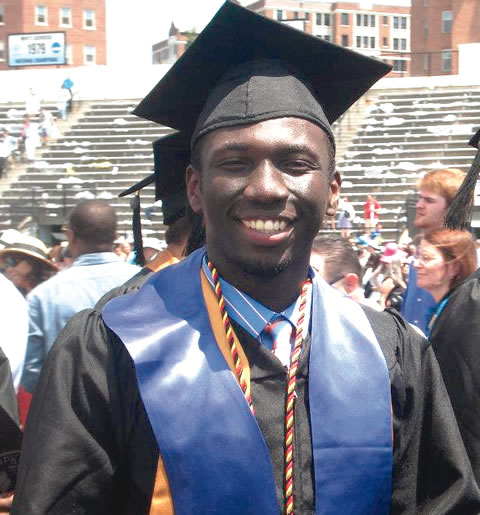
22-Year-Old Nigerian Student Breaks GPA Record at Johns Hopkins University
Emmanuel Ohuabunwa not only graduated from Johns Hopkins University with a degree in neuroscience, but he did so with a 3.98 GPA.
That’s an academic record!
Ohuabunwa who hails from Abia State, has been able to make the nation proud and with his efforts has won himself a scholarship to Yale University to get a degree in Medicine.
He has also become a member of Phi Beta Kappa Society, a prestigious honor group that features membership of 17 US Presidents, 37 US Supreme Court Justices, and 136 Nobel Prize winners.
Read more at Channels
Ohuanbunwa will attend Yale University Medical School in the fall.
Congratulations to Emmanuel Ohuabunwa on this phenomenal achievement!
Source: http://www.blackyouthproject.com/2012/06/22-year-old-nigerian-student-breaks-gpa-record-at-johns-hopkins-university/
Monday, July 1, 2013
19 Year-Old Britney Exline Is Youngest African American Engineer in the U.S.
At 19 years-old, Britney Exline has already graduated from the University of Pennsylvania.
She is the youngest engineer to ever graduate from Penn, and our nation’s youngest African American engineer!
Exline was working on Wall Street at 16, speaks 5 languages, and “has a passion for volunteering to help others, having traveled to Cameroon with the One Laptop program.”
Impressive!
From NewsOne:
In an interview with Ebony magazine, Chyrese said of her parenting,”I made sure they remained committed even when they wanted to quit. They learned you can’t quit an activity just because it’s hard. Sometimes you need to stick with something. That’s the only way to learn how to persevere and overcome true obstacles. Eventually, it becomes a part of you. I believe this.”
Just imagine the potential this young lady has. With her youth and advanced study, she has the chance to do something great.
But the best part about Exline might be her humility.
“I don’t think of myself as extraordinary,” she said.
Source: http://www.blackyouthproject.com/2012/12/britney-exline-youngest-african-american-engineer/
She is the youngest engineer to ever graduate from Penn, and our nation’s youngest African American engineer!
Exline was working on Wall Street at 16, speaks 5 languages, and “has a passion for volunteering to help others, having traveled to Cameroon with the One Laptop program.”
Impressive!
From NewsOne:
In an interview with Ebony magazine, Chyrese said of her parenting,”I made sure they remained committed even when they wanted to quit. They learned you can’t quit an activity just because it’s hard. Sometimes you need to stick with something. That’s the only way to learn how to persevere and overcome true obstacles. Eventually, it becomes a part of you. I believe this.”
Just imagine the potential this young lady has. With her youth and advanced study, she has the chance to do something great.
But the best part about Exline might be her humility.
“I don’t think of myself as extraordinary,” she said.
Source: http://www.blackyouthproject.com/2012/12/britney-exline-youngest-african-american-engineer/
Monday, March 11, 2013
Physics Wiz Graduates From College at 18
Polite Stewart Jr.
Making a mark in physics research
Age: 19
School: Southern University
Hometown: Baton Rouge, La.
Gender: Male
Category: Science and Technology
Polite was 3 years old when his parents pulled him out of day care and his father began teaching him at home. He loved learning science -- and he clearly had an aptitude for it. At the young age of 14, he enrolled full time as a student at Southern University, majoring in physics. At Southern, Polite spent a summer looking for ways to mark specific proteins in cancer cells using fluorescent dye. The objective was to more easily find the cells so they could be destroyed. During a summer spent at North Carolina State University, he was part of a research team that worked to create self-cleaning, anti-glare glass that would repel vast amounts of water and oil through the use of a concept called hydrophobicity.
Polite graduated in December 2012 at 18 and is believed to be the youngest to do so in the history of Southern University. His plan is pursue a career in which he can apply the science he loves to the real world. "I just love learning," Polite said. "It doesn't matter what. That's why I like science so much. There is always something new to be discovered."
Saturday, February 16, 2013
Henry Sampson (inventor)
Henry T. Thomas Sampson, Jr. (born in Jackson, Mississippi in 1934) is an African-American inventor.
He graduated from high school in 1951 from Lanier High School in Jackson, Mississippi. He then attended Morehouse College for a couple of years before transferring to Purdue University where he became a member of the Omega Psi Phi fraternity. He received a Bachelor's degree in science from Purdue University in 1956. He graduated with an MS degree in engineering from the University of California, Los Angeles in 1961. Sampson also received his MS in Nuclear Engineering from the University of Illinois Urbana-Champaign in 1965, and his PhD in 1967.
He is the first African American to earn a Ph.D.in Nuclear Engineering in the United States. Some of his accomplishments include being a member of the United States Navy between the years 1962 and 1964 and earning an Atomic Energy Commission honor between 1964 and 1967. Later he was awarded the Black Image Award from Aerospace Corporation in 1982. He was awarded the Blacks in Engineering, Applied Science Award, and prize for education, by the Los Angeles Council of Black Professional Engineers in 1983. In June 2007, Sampson was married to Laura Howzell Young in St. Thomas, U.S. Virgin Islands. Young-Sampson is a professor in the College of Education at California State University San Bernardino.
Sampson was employed as a research chemical engineer at the U.S. Naval Weapons Center, China Lake, California, in the area of high energy solid propellants and case bonding materials for solid rocket motors. Sampson also served as the Director of Mission Development and Operations of the Space Test Program at the Aeropace Corporation in El Segundo, California. His patents included a binder system for propellants and explosives and a cse bonding system for cast composite propellants. Both inventions are related to solid rocket motors.
On July 6, 1971 he was awarded a patent, with George H. Miley, for a gamma-electrical cell, a device that produces a high voltage from radiation sources, primarily gamma radiation, with proposed goals of generating auxiliary power from the shielding of a nuclear reactor. Additionally, the patent cites the cell's function as a detector with self power and construction cost advantages over previous detectors.
Sampson is a writer and film historian. He wrote the book "Blacks in Black and White: A Source Book on Black Films," which examines often overlooked African American film makers and entertainers from the first half of the 20th Century. In addition he authored "The Ghost Walks: A Chronological History of Blacks in Show Business, 1865-1910." Sampson produces documentary films on African American film makers. In 2005 he published "Singin' on the Ether Waves: a Chronological History of African Americans in Radio and Television Programming, 1925-1955" (two vols, 1270 pages), Scarecrow Press, Lanham, Maryland, and Oxford, UK, 2005.
Sampson is associated with the Board of Directors of Los Angeles Southwest College Foundation, as well as a technical consultant to the Historical Black Colleges and Universities Program.
Source: http://en.wikipedia.org/wiki/Henry_Sampson_(inventor)
Labels:
Did You Know?,
Inventors,
Morehouse College,
Scientist
Wednesday, February 13, 2013
African American Women Chemists
The book contains sketches of the lives of African America women chemists from the earliest pioneers up until the late 1960's when the Civil Rights Acts were passed and greater career opportunities began to emerge. In each sketch, Brown will explore women's motivation to study the field and detail their often quite significant accomplishments. Chapters focus on chemists in academia, industry, and government, as well as chemical engineers, whose career path is very different from that of the tradition chemist. The book concludes with a chapter on the future of African American women chemists, which will be of interest to all women interested in science.
About The Author:
Ms. Jeannette E. Brown is a former Faculty Associate in the department of Pre-College Programs at the New Jersey Institute of Technology. She previously held the position of Research Chemist and worked at Merck & Co. Inc for twenty-five years in that capacity. She started her industrial career at CIBA Pharmaceutical Co. as a junior chemist and worked there for eleven years. She has a research MS degree from the University of Minnesota and a BS degree in the Field of Chemistry from Hunter College. She was elected to the Hunter College Hall of Fame for her work as a mentor for young students . She is the 2004 Société de Chimie Industrielle (American Section) Fellow of the Chemical Heritage Foundation. She also received the Ullyott Fellowship from the Chemical Heritage Foundation to work on her book. She studied the History of African American women chemist and has lectured and written this book about her work. This fellowship was from May to July 2009.
She is a member of the first class of American Chemical Society Fellows 2009.
She is a member of the Oral History Association and will collect oral histories of contemporary African American women chemists to be included in a future book.
Friday, March 2, 2012
James McLurkin
"Understanding nature is the key to unlocking the secrets of intelligence," said MIT graduate student James McLurkin. Intrigued by the behavioral patterns of swarm reproductive labor groups, McLurkin developed 'swarm' microrobots based on the principles of nature to carry out cooperative, real-world tasks. An inventor who has pushed the frontier of microrobotics, McLurkin was named the 2003 winner of the $30,000 Lemelson-MIT Student Prize.
Measuring 4.5 inches, McLurkin's swarm robots are programmed to emulate the behavior of bees, with capabilities to cluster, disperse, follow and orbit. Equipped with bump sensors, a self-charger, a radio modem and an audio system, they are autonomous yet travel in a fleet. When one robot makes a discovery, it signals the group to execute the task together.
The swarm robots were originally built under a team McLurkin managed at iRobot in Massachusetts. As part of his doctoral research at MIT, McLurkin focused on complex group behavior through continued development of the largest swarm of robots. His research concentrated on writing software to implement behavioral attributes for the swarm and examine how the robots respond to one another, while increasing their collective power. Potential uses of the swarm include organizing groups of 20,000 robots to detect land mines, search through earthquake rubble, or explore Mars.
For McLurkin's undergraduate thesis, he invented 12 cubic-inch robotic ants—the world's smallest self-contained autonomous robots, based on the characteristics of an ant colony. During the project, he kept a large container of ants on his desk to observe their roles and interactions. His robotic ants were programmed to hunt for food, send messages to each other and even play tag.
Inventing since the age of three, McLurkin's inspirations sprung from Lego® bricks, model trains, video games, BMX bicycles and his parents—who were key role models. During the course of his graduate work at MIT, McLurkin stepped into the role model position as a teacher in The Saturday Engineering Enrichment and Discovery Academy (a college preparatory program at MIT). Riding into class on his BMX bike for a physics lesson was one of the many ways he incorporated his favorite toys into activities and demonstrations. According to McLurkin, "It is important that teens truly understand how much fun and exciting inventing can be."
McLurkin received his S.B. in Electrical Engineering from MIT, his M.S. in Electrical Engineering from the University of California, Berkeley, and his S.M. and Ph.D. in computer science from MIT. McLurkin began his post doc at the University of Washington in 2008; he is using probabilistic models for algorithm development. His words of advice to aspiring inventors: "Empowerment and go."
Source: http://web.mit.edu/invent/a-winners/a-mclurkin.html
Measuring 4.5 inches, McLurkin's swarm robots are programmed to emulate the behavior of bees, with capabilities to cluster, disperse, follow and orbit. Equipped with bump sensors, a self-charger, a radio modem and an audio system, they are autonomous yet travel in a fleet. When one robot makes a discovery, it signals the group to execute the task together.
The swarm robots were originally built under a team McLurkin managed at iRobot in Massachusetts. As part of his doctoral research at MIT, McLurkin focused on complex group behavior through continued development of the largest swarm of robots. His research concentrated on writing software to implement behavioral attributes for the swarm and examine how the robots respond to one another, while increasing their collective power. Potential uses of the swarm include organizing groups of 20,000 robots to detect land mines, search through earthquake rubble, or explore Mars.
For McLurkin's undergraduate thesis, he invented 12 cubic-inch robotic ants—the world's smallest self-contained autonomous robots, based on the characteristics of an ant colony. During the project, he kept a large container of ants on his desk to observe their roles and interactions. His robotic ants were programmed to hunt for food, send messages to each other and even play tag.
Inventing since the age of three, McLurkin's inspirations sprung from Lego® bricks, model trains, video games, BMX bicycles and his parents—who were key role models. During the course of his graduate work at MIT, McLurkin stepped into the role model position as a teacher in The Saturday Engineering Enrichment and Discovery Academy (a college preparatory program at MIT). Riding into class on his BMX bike for a physics lesson was one of the many ways he incorporated his favorite toys into activities and demonstrations. According to McLurkin, "It is important that teens truly understand how much fun and exciting inventing can be."
McLurkin received his S.B. in Electrical Engineering from MIT, his M.S. in Electrical Engineering from the University of California, Berkeley, and his S.M. and Ph.D. in computer science from MIT. McLurkin began his post doc at the University of Washington in 2008; he is using probabilistic models for algorithm development. His words of advice to aspiring inventors: "Empowerment and go."
Source: http://web.mit.edu/invent/a-winners/a-mclurkin.html
Sunday, February 12, 2012
Forgotten Genius
"Forgotten Genius" is a fascinating and largely unknown story of scientific triumph and racial inequality. It covers the extraordinary life journey of Percy Julian, one of the great chemists of the 20th century.
The grandson of Alabama slaves, Julian met with every possible barrier in a deeply segregated America. He was a man of genius, devotion, and determination. As a black man he was also an outsider, fighting to make a place for himself in a profession and country divided by bigotry—a man who would eventually find freedom in the laboratory. By the time of his death, Julian had risen to the highest levels of scientific and personal achievement, overcoming countless obstacles to become a world-class scientist, a self-made millionaire, and a civil-rights pioneer.
NOVA reveals Julian's remarkable story in this special two-hour presentation. Tony Award-winner Ruben Santiago-Hudson stars as Julian; actor Courtney B. Vance narrates. Through dramatic period re-enactments, archival footage, and interviews with those who knew him best, Julian's science and gripping biography come to life onscreen.
Percy Julian won worldwide acclaim for his work in organic chemistry, and as the first black director of an industrial chemistry research lab. He broke the color barrier in American science more than a decade before Jackie Robinson did so in Major League Baseball. A brilliant chemist, his career was marked by many scientific breakthroughs that improved lives (see Career Milestones). He converted soybeans into synthetic steroids on an industrial scale, and his innovative approach helped make drugs like cortisone affordable and available to millions.
For all his tremendous achievements, Percy Julian's legacy is largely unknown. Scholars have neither studied him nor written his biography. To tell his story, NOVA filmmakers launched one of the most ambitious research projects in the series' 34-year history, poring over thousands of pages of documents from dozens of sources, and traveling around the nation to interview more than 60 of Julian's friends, coworkers, family members, and former students. The resulting documentary chronicles Julian's life from childhood to his death in 1975, at age 76.
His professional and personal journey was a tumultuous ride of highs and lows. Julian was born into a world ruled by Jim Crow segregation. His parents, both trained as teachers, believed education offered the path to a better life. But academia did not welcome Julian with open arms. As a sophomore at DePauw University, he already dreamed of a graduate education, though only one African-American at the time had ever earned a doctorate in chemistry. He went on to earn his Masters at Harvard, even while black students were banned from the dorms in Harvard Yard and white researchers argued that blacks did not have the intellectual capacity to master the sciences. Julian received his Ph.D. from the University of Vienna, where he studied under one of Vienna's leading chemists, Ernst Späth.
As a scholar, Julian taught at Howard University, Fisk University, and back at DePauw. Early in his career he put himself on the map with a high-stakes research project that pitted him against the premier organic chemist of the time. It was one of many races he would win on his way to publishing scores of papers and pursuing groundbreaking science. But even national acclaim in his field could not sweep aside prejudice.
Finding too many doors closed to black men in academia, Julian leapt into the private sector as Director of Research, Soya Products Division, for the Glidden Company. In 1936 it was a rare opportunity for a black man in America, and one that Julian made the most of, filing more than 100 patents during his tenure. Julian and his team of chemists turned the soybean inside out, isolating parts of the bean that would serve as key ingredients in a vast and varied range of new household and industrial products, including food oils, latex paint, plastics, linoleum, plywood glue, high-protein livestock feed, and fire-fighting foam. This was chemistry that changed the way we live.
It was also chemistry that healed. Just a few years before Julian arrived at Glidden, scientists in Europe and America had discovered that chemicals called steroids played a number of roles in the human body. But steroids drawn from animal sources were scarce and expensive; if these compounds were ever to have a significant role in the treatment of human disease, someone would have to find a way to make them from plants.
Julian realized that in the soybean he had a perfect starting material for making steroids on a commercial scale. He seized on that opportunity, making Glidden the first American company to make progesterone, a female sex hormone, available in large quantities at reasonable prices. His inventiveness helped lay the groundwork for the entire field of steroid medicine, whose products would include not only artificial sex hormones like progesterone and testosterone but also cortisone, so critical to alleviating the crippling pain of rheumatoid arthritis, and later the birth control pill.
His own business, Julian Laboratories, would eventually make Julian one of the wealthiest black businessmen in America and allow him to open doors for other African-American scientists. He hired scores of talented black chemists who could not find employment elsewhere, and by showing that African-Americans could do chemistry at the highest level, he inspired many more students to enter a career field that had previously seemed closed to them (see Julian the Trailblazer).
Still, neither wealth nor fame could insulate Julian from bigotry. His son, Percy Julian Jr., tells NOVA how in the upscale suburb of Oak Park, Illinois, his family faced racist arson and bomb threats. But with success came the chance to do something about it, and in his later years, Julian embraced the fight for racial equality that was commanding the attention of the nation.
Julian's crowning honor came when he was elected to the National Academy of Sciences. The year was 1973, and Julian was only the second African-American member. Even in the shadow of society's prejudice, his drive, intelligence, and mastery of chemistry often prevailed. In a more enlightened era, his colleagues argue, he could have been a Nobel laureate.
Source: http://www.pbs.org/wgbh/nova/julian/
The grandson of Alabama slaves, Julian met with every possible barrier in a deeply segregated America. He was a man of genius, devotion, and determination. As a black man he was also an outsider, fighting to make a place for himself in a profession and country divided by bigotry—a man who would eventually find freedom in the laboratory. By the time of his death, Julian had risen to the highest levels of scientific and personal achievement, overcoming countless obstacles to become a world-class scientist, a self-made millionaire, and a civil-rights pioneer.
NOVA reveals Julian's remarkable story in this special two-hour presentation. Tony Award-winner Ruben Santiago-Hudson stars as Julian; actor Courtney B. Vance narrates. Through dramatic period re-enactments, archival footage, and interviews with those who knew him best, Julian's science and gripping biography come to life onscreen.
Percy Julian won worldwide acclaim for his work in organic chemistry, and as the first black director of an industrial chemistry research lab. He broke the color barrier in American science more than a decade before Jackie Robinson did so in Major League Baseball. A brilliant chemist, his career was marked by many scientific breakthroughs that improved lives (see Career Milestones). He converted soybeans into synthetic steroids on an industrial scale, and his innovative approach helped make drugs like cortisone affordable and available to millions.
For all his tremendous achievements, Percy Julian's legacy is largely unknown. Scholars have neither studied him nor written his biography. To tell his story, NOVA filmmakers launched one of the most ambitious research projects in the series' 34-year history, poring over thousands of pages of documents from dozens of sources, and traveling around the nation to interview more than 60 of Julian's friends, coworkers, family members, and former students. The resulting documentary chronicles Julian's life from childhood to his death in 1975, at age 76.
His professional and personal journey was a tumultuous ride of highs and lows. Julian was born into a world ruled by Jim Crow segregation. His parents, both trained as teachers, believed education offered the path to a better life. But academia did not welcome Julian with open arms. As a sophomore at DePauw University, he already dreamed of a graduate education, though only one African-American at the time had ever earned a doctorate in chemistry. He went on to earn his Masters at Harvard, even while black students were banned from the dorms in Harvard Yard and white researchers argued that blacks did not have the intellectual capacity to master the sciences. Julian received his Ph.D. from the University of Vienna, where he studied under one of Vienna's leading chemists, Ernst Späth.
As a scholar, Julian taught at Howard University, Fisk University, and back at DePauw. Early in his career he put himself on the map with a high-stakes research project that pitted him against the premier organic chemist of the time. It was one of many races he would win on his way to publishing scores of papers and pursuing groundbreaking science. But even national acclaim in his field could not sweep aside prejudice.
Finding too many doors closed to black men in academia, Julian leapt into the private sector as Director of Research, Soya Products Division, for the Glidden Company. In 1936 it was a rare opportunity for a black man in America, and one that Julian made the most of, filing more than 100 patents during his tenure. Julian and his team of chemists turned the soybean inside out, isolating parts of the bean that would serve as key ingredients in a vast and varied range of new household and industrial products, including food oils, latex paint, plastics, linoleum, plywood glue, high-protein livestock feed, and fire-fighting foam. This was chemistry that changed the way we live.
It was also chemistry that healed. Just a few years before Julian arrived at Glidden, scientists in Europe and America had discovered that chemicals called steroids played a number of roles in the human body. But steroids drawn from animal sources were scarce and expensive; if these compounds were ever to have a significant role in the treatment of human disease, someone would have to find a way to make them from plants.
Julian realized that in the soybean he had a perfect starting material for making steroids on a commercial scale. He seized on that opportunity, making Glidden the first American company to make progesterone, a female sex hormone, available in large quantities at reasonable prices. His inventiveness helped lay the groundwork for the entire field of steroid medicine, whose products would include not only artificial sex hormones like progesterone and testosterone but also cortisone, so critical to alleviating the crippling pain of rheumatoid arthritis, and later the birth control pill.
His own business, Julian Laboratories, would eventually make Julian one of the wealthiest black businessmen in America and allow him to open doors for other African-American scientists. He hired scores of talented black chemists who could not find employment elsewhere, and by showing that African-Americans could do chemistry at the highest level, he inspired many more students to enter a career field that had previously seemed closed to them (see Julian the Trailblazer).
Still, neither wealth nor fame could insulate Julian from bigotry. His son, Percy Julian Jr., tells NOVA how in the upscale suburb of Oak Park, Illinois, his family faced racist arson and bomb threats. But with success came the chance to do something about it, and in his later years, Julian embraced the fight for racial equality that was commanding the attention of the nation.
Julian's crowning honor came when he was elected to the National Academy of Sciences. The year was 1973, and Julian was only the second African-American member. Even in the shadow of society's prejudice, his drive, intelligence, and mastery of chemistry often prevailed. In a more enlightened era, his colleagues argue, he could have been a Nobel laureate.
Source: http://www.pbs.org/wgbh/nova/julian/
Subscribe to:
Posts (Atom)