Cleveland Avenue, the investment group and accelerator founded by former McDonald's CEO Don Thompson, offers VC funding to support food and beverage business concepts
McDonald’s former top executive Don Thompson has begun a second act in his career, this time as venture capitalist. Crain’s Chicago Business reports that Thompson has launched Cleveland Avenue, an investment group and accelerator, which focuses on building new food, beverage, and restaurant concepts.
By profession, Thompson, 53, is an electrical engineer. He joined McDonald’s in 1990 after working for a military aircraft manufacturer that is now part of Northrop Grumman, and quickly climbed the corporate ladder at the golden arches.
Thompson had an illustrious, 25-year career at McDonald’s, which included serving for nearly three years as CEO of the restaurant chain. Approximately a month after announcing his retirement, McDonald’s agreed to continue to work with Thompson as a consultant, paying him $3 million.
Cleveland Avenue quietly opened an office last fall in a three-story building. The firm is reportedly named after the Chicago street where Thompson grew up. According to Crain’s Chicago Business, the company announced the opening of its first restaurant concept, a non-alcoholic beverage bar called Drink.
Developed in partnership with the clothing retailer, Drink serves a rotating list of 20 non-alcoholic beverages made by startups and entrepreneurs, ranging from organic slushies to fresh fruit sodas on tap. The bar is located inside the American Eagle Outfitters flagship store in Chicago’s Times Square.
Crain’s Chicago Business reports that Cleveland Avenues has also invested in a Washington, D.C., fast-casual restaurant called HalfSmoke, along with other undisclosed investments in the food and beverage industry.
Last year, Thompson joined the board of directors of vegan, meat-alternative company Beyond Meat. He is also on the board of directors for the Chicago-based financial services provider Northern Trust, making him the third black board member at the company.
Likewise, The Cleveland Avenue Foundation for Education, a nonprofit charity led by Thompson’s wife Liz, sponsors efforts and make grants to organizations offering career support, education, and mentoring to urban students and young professionals of color. This is significant because nowhere is the diversity issue more evident than in the venture capital sphere, which is dominated by white men who fund very few startups founded by women and minorities: African American men receive 2% of the VC funding other startups get, while black women get a fraction of that.
Thompson has also been listed on Black Enterprise’s 100 Most Powerful Executives in Corporate America list. At the time of his departure from McDonald’s, Editor-in-Chief of Black Enterprise magazine, Derek Dingle, appeared on Roland Martin to discuss Thompson’s legacy:
“Thompson leaves a legacy of the value of diversity at the top in fueling innovation and inclusion. He has created a pipeline of African American and minority managers—50% of McDonald’s managers are minorities and women—that will ascend to the top of corporate America. That’s the primary reason McDonald’s has consistently made our 40 Best Companies for Diversity.”
Source: http://www.blackenterprise.com/small-business/mcdonalds-don-thompson-launches-venture-capital-group/
What is the African American empowerment blog? The AAEB is a blog focusing on news, music, poetry, art, quotes, facts, books, movies and people that uplift, empower, and motivate African Americans.
Showing posts with label Financial Empowerment. Show all posts
Monday, December 18, 2017
Friday, July 22, 2016
Why Banking Black Is Good For The Black Community
#bankingblack
By Robert Stitt
In 1865, the Freedman’s Savings and Trust Company was created by Congress to help Black men and women after the end of the Civil War. Despite the efforts of such notable benefactors as Fredrick Douglas, the bank would close in 1874, taking with it much of the $57 million that over 100,000 African Americans had deposited. While there was mismanagement, and a number of bad investments took place, the bank’s demise was mostly due to bad luck. After all, the first major U.S. depression started when the Panic of 1873 led to financial devastation throughout the country.
While the Freedman’s Bank may have gone under, the FDIC notes that “there were over 130 African-American owned banks between 1888 and 1934.” Today, there are just 22.
OneUnited Bank is the largest Black-owned bank in America. The CEO of One United is Teri Williams. She notes, “Part of what we realized is there were a lot of Black banks with a great mission, but they didn’t have the economies of scale to invest in new technology.” Yet, she told the Atlanta Black Star that it was not just Black banks that had problems keeping up with the technology, increased federal regulation, and compliance. “There has been a decline in banks in general. There also has been a decline in community banks that were the size of a lot of the Black banks that went out of business.”
Not all Black banks went under, however. OneUnited saw the struggle of several smaller Black banks and rescued them. “We acquired four banks and combined them into one,” Williams explained.
The struggle of minority banks goes beyond issues with technology and the government, though. The biggest problem is public perception. Even though many big banks just went through very rough times and had to be bailed out by the federal government, people still trust them more. “If you ask the Black community, ‘Where do you put your dollars?’ most will say they put it in the larger banks,” Williams says, adding, “It is difficult for black banks to attract dollars from their own community.”
According to Williams, the key to bettering the situation is to improve knowledge in the Black community about the role of the bank. She feels that most Blacks do not understand that the primary purpose of a bank is to recycle money. “What that means is people place deposits into the bank, and the role of the bank is to take those funds to the community, to build wealth or for buying a home. That, in turn, results in additional deposits that go into the bank, and the recycling goes on.”
Instead of investing in their own community, however, Blacks put their dollars in banks that invest outside of the Black community. Maggie Anderson once noted during her TED talk, “In the African-American community, our dollars leave the community in 6 hours.” She accented the tragedy of those numbers by explaining, “If black people were to increase spending within our own community from 2 percent to 10 percent, we would create 1 million new jobs.”
Williams says there is no reason not to invest in a Black bank. Speaking of OneUnited, she states, “Our rates are higher, our fees are lower, and we have 25,000 ATMs where you can get your money for free. So, in fact, we have better services than national banks, and we have more services that are targeted to meet the needs of our community than national banks.”
Source: http://financialjuneteenth.com/banking-black-good-black-community/
List of African American Banks
http://www.blackenterprise.com/career/career-advice/top-black-banks-bring-next-paycheck/
By Robert Stitt
In 1865, the Freedman’s Savings and Trust Company was created by Congress to help Black men and women after the end of the Civil War. Despite the efforts of such notable benefactors as Fredrick Douglas, the bank would close in 1874, taking with it much of the $57 million that over 100,000 African Americans had deposited. While there was mismanagement, and a number of bad investments took place, the bank’s demise was mostly due to bad luck. After all, the first major U.S. depression started when the Panic of 1873 led to financial devastation throughout the country.
While the Freedman’s Bank may have gone under, the FDIC notes that “there were over 130 African-American owned banks between 1888 and 1934.” Today, there are just 22.
OneUnited Bank is the largest Black-owned bank in America. The CEO of One United is Teri Williams. She notes, “Part of what we realized is there were a lot of Black banks with a great mission, but they didn’t have the economies of scale to invest in new technology.” Yet, she told the Atlanta Black Star that it was not just Black banks that had problems keeping up with the technology, increased federal regulation, and compliance. “There has been a decline in banks in general. There also has been a decline in community banks that were the size of a lot of the Black banks that went out of business.”
Not all Black banks went under, however. OneUnited saw the struggle of several smaller Black banks and rescued them. “We acquired four banks and combined them into one,” Williams explained.
The struggle of minority banks goes beyond issues with technology and the government, though. The biggest problem is public perception. Even though many big banks just went through very rough times and had to be bailed out by the federal government, people still trust them more. “If you ask the Black community, ‘Where do you put your dollars?’ most will say they put it in the larger banks,” Williams says, adding, “It is difficult for black banks to attract dollars from their own community.”
According to Williams, the key to bettering the situation is to improve knowledge in the Black community about the role of the bank. She feels that most Blacks do not understand that the primary purpose of a bank is to recycle money. “What that means is people place deposits into the bank, and the role of the bank is to take those funds to the community, to build wealth or for buying a home. That, in turn, results in additional deposits that go into the bank, and the recycling goes on.”
Instead of investing in their own community, however, Blacks put their dollars in banks that invest outside of the Black community. Maggie Anderson once noted during her TED talk, “In the African-American community, our dollars leave the community in 6 hours.” She accented the tragedy of those numbers by explaining, “If black people were to increase spending within our own community from 2 percent to 10 percent, we would create 1 million new jobs.”
Williams says there is no reason not to invest in a Black bank. Speaking of OneUnited, she states, “Our rates are higher, our fees are lower, and we have 25,000 ATMs where you can get your money for free. So, in fact, we have better services than national banks, and we have more services that are targeted to meet the needs of our community than national banks.”
Source: http://financialjuneteenth.com/banking-black-good-black-community/
List of African American Banks
http://www.blackenterprise.com/career/career-advice/top-black-banks-bring-next-paycheck/
Tuesday, May 7, 2013
Black Startup
Our platform is a new tool to generate financial resources to fund ideas and to address systemic social problems facing African-Americans on the local, national, and international level. Clearly, a platform that is operated by an honest broker will facilitate trust. But our platform will also lower transaction costs associated with raising capital. We will be the meeting place where those with good ideas can expose themselves to thousands/millions of potential investors at almost no monetary cost. Also, investors will have the opportunity to contribute to projects that they would have never known about without visiting our website. Finally, the affinity and commonality amongst the online community on our platform will lead to substantial activity and transactions on our platform as opposed to platforms that are not targeted towards a specific community.
Our crowdfunding platform specifically dedicated to the African-American community addresses the lack of African-Americans that are participating in the crowdfunding market because we can market directly to the community. Furthermore, we can take advantage of established networks/groups to build our online minority investing community. The idea is for our online community to be as reflective of the “on-ground” African-American community as possible.
Crowdfunding is beginning to move from a marketplace dominated by “one size fits all” style platforms (indiegogo.com/wefunder.com) to more dedicated, topic-orieted/industry focused platforms. The idea is that by targeting the audience, the marketplace becomes more efficient because of group affinity. Essentially, crowdfunding works partially because it allows one to leverage social networking to get ideas funded through one’s existing relationships, one’s extended network, and the extended network of those one is connected to. Therefore, the more closely one is tied to the network of someone that is seeking funding, the more likely one is to give.
Our platform will be aligned with a network of people that already have a shared group identity, but it will additionally be able to tie into existing groups, organizations, and networks that already exist in the African-American community (both on the ground and online). This is what we mean when we assert that targeting can lead to increased activity and efficiency on a crowdfunding platform. Currently, there is a crowdfunding platform that is targeted to focus on ideas started by Jewish people or designed to advance Jewish interests. However, there is no platform for African-Americans. By focusing on a particular demographic group we will benefit from the efficiency that targeting allows for.
Our platform/project can be used as a tool to increase education in the community on the benefits of investing, which addresses the over consumption of consumer goods and underuse of investing vehicles within the African-American community. To reach many of these goals, our group will benefit from partnerships with key organizations in the minority business landscape such as Black Enterprise magazine and the National Black MBA Association.
Finally, we address the unmet needs related to the changing dynamics of the regulation of the crowdfunding industry by designing an internet funding portal that can take advantage of the JOBS Act reforms.
Labels:
Did You Know?,
Entrepreneur,
Financial Empowerment
Tuesday, February 26, 2013
Ninety Days to Start Gaining Wealth
Who wants to be rich? Is it possible to gain wealth in these times of economic turmoil, where uncertainty and disillusionment prevail?
For Veronica, a person worthy to be placed in every success story book, what you need is a head start. In every page of her book to financial freedom, she provided the secrets of becoming a millionaire or even a billionaire in a step-by-step procedure that starts in the first ninety days of seriously pursuing your financial goals.
About the Author
A native of Albuquerque, NM, Mrs. Veronica Brooks was appointed in the Department of Defense in 2000 and appointed in Acquisition field in 2005 through the NAVFAC Professional Development Center (PDC) program. She completed an Associate Arts Degree in Political Science from Florida State College, Bachelors Degree in Business Administration, and Dual Masters Degree in Business Administration Management and Human Resource Management. Presently, she is serving as the Supervisory Contracting Officer at Naval Air Facility, Atsugi, Japan.
Her previous assignments include: Fleet Industrial Supply Command(FISC) Naval Regional Contracting Center in Manama, Bahrain that consist of contacts that are essential to meet Central Command (CENTCOM) requirements throughout the Middle East, Southwest Asia, East Africa, the Indian subcontinent, and Department of Defense (DoD) activities in the United States. Resident Officer in Charge of Construction (ROICC) and Integrated Product Team (IPT) at Naval Air Station Jacksonville, FL, Secretary for Naval Air Depot Jacksonville, FL and Department of Dependent Schools (DoDDs) Office Automation Assistant in Zama American High Schools, in Japan.
Veronica M. Brooks is Defense Acquisition Workforce Improvement Act (DAWIA) Level III certified. Member of National Contract Management Association (NCMA), African American Federal Executive Association (AAFEA), Voluntary Leader of non-profit organizations that is gear toward mentoring women, children, and families. Her personal decorations include the Presidental/Congressional Recognition Award for Business Woman of the Year from 03-07 Published in the Wall Street Journal for Businesswomen of the year Award 01-07 Published in the Wall Street Journal for Outstanding Leadership Award of Business Advisory Council 11-06. Special Act Award of outstanding performance (6 Awards).
She is married to AMEC Glen E. Brooks (retired USN), Oklahoma City, Oklahoma and has three young men Joe, Eugene and Quintail.
Hobbies: Having fun with the family; Horseback Riding, Creating Wealth, and Traveling.
Labels:
Author,
Books,
Financial Empowerment,
Women That Inspire
Friday, February 22, 2013
Friday, December 21, 2012
The Wealth Cure: Putting Money in Its Place
Hill Harper is uniquely poised to guide readers through tough times and offers bestselling advice for reaping the rewards of a truly happy life. With The Wealth Cure, he does more than that: He presents a revolutionary new definition of wealth; motivating readers to not only build financial security but to achieve wealth in every aspect of their lives.
Applying a parable approach, Harper instills practical nuts-and-bolts explanations for laying a sound financial foundation and also focuses on how to recognize the worth of your relationships and increase the value of your interactions with the people in your life.
Drawing on personal recollections and true stories from family and friends, Harper has created an inspiring guide. Readers will begin to see money as energy and a freedom for following their passions. Far from a get-rich-quick primer, The Wealth Cure brims with inspired wisdom for building a lasting bounty from the experiences, loved ones, and achievements that really matter.
Labels:
Books,
Financial Empowerment,
Men That Inspire,
Motivation
Tuesday, November 13, 2012
Beating the Odds: Eddie Brown's Investing and Life Strategies
Brown delves into the profound heartbreak and disorientation upon the death of his beloved grandmother – who was his surrogate mother -- and recounts how Brown's moonshine-running Uncle Jake subsequently became the dominant adult figure in Brown's life. His unflinchingly honest, easy-to-read memoir details how intellectual curiosity, abiding self-belief, hard work and divine providence helped Brown earn an electrical engineering degree, become an Army officer, and later a civilian IBM engineer. Readers will learn of the strife that ensued when Brown quit IBM to earn an MBA, leading to investment jobs that prepared him to start his own money management company in 1983.
http://en.wikipedia.org/wiki/Eddie_C._Brown
Saturday, October 27, 2012
Mansa Musa Of Mali Named World's Richest Man Of All Time; Gates And Buffet Also Make List
You've probably never heard of him, but Mansa Musa is the richest person ever.
The 14th century emperor from West Africa was worth a staggering $400 billion, after adjusting for inflation, as calculated by Celebrity Net Worth. To put that number into perspective -- if that's even possible -- Net Worth's calculations mean Musa's fortune far outstrips that of the current world's richest man Carlos Slim Helu and family.
According to Forbes, the Mexican telecom giant's net worth is $69 billion. Slim edges out the world's second wealthiest man, Bill Gates, who is worth $61 billion, according to Forbes.
Some of the oldest fortunes in question date back 1,000 years. No. 7 on the list, for example, is William the Conqueror. The illegitimate son of the Duke of Normandy, William lived between 1028-1087 and gained infamy for invading and seizing England in 1066.
According to the Encyclopedia Brittanica, when Musa died sometime in the 1330s, he left behind an empire filled with palaces and mosques, some of which still stand today. But the emperor really turned historic heads for the over-the-top extravagances of his 1324 pilgrimage to Mecca.
The trip, which he embarked up on during the 17th year of the monarch's glittering reign, was hosted by the leaders of both Mecca and Cairo and apparently was so brilliant, it "almost put Africa’s sun to shame."
Musa's wealth was a result of his country's vast natural resources. The West African nation was responsible for more than half of the world's salt and gold supply, according to Net Worth. Of course, the entry also notes that the fortune was also fleeting. Just two generations later, his net worth was gone -- wasted away by invaders and infighting.
As The Independent points out, while the numbers bandied about by this newest list are shocking, many aspects of the run-down aren't surprising: there are no women included, for example, and only three of the richest men are still alive today. Americans dominate the list, however, taking 14 of the 26 spots, including slots two and three.
The "poorest" man on the list is Warren Buffet, who had a peak net worth of $64 billion. Buffet, a noted philanthropist, has since given billions of his fortune away, and Forbes now lists his net worth at closer to $44 billion.
Source: http://www.huffingtonpost.com/2012/10/17/mansa-musa-worlds-richest-man-all-time_n_1973840.html#slide=1653415
Friday, October 5, 2012
Top Black Entrepreneurs of the 2012 Inc. 500
These 10 fast-growing, private companies are led by black entrepreneurs, most of whom are forging a decisive path working with the government. Many take lessons they learned in the military and apply them to running a successful business. --Abigail Tracy
Tabatha Turman, Founder and CEO

Integrated Finance and Accounting Solutions (IFAS)
Woodbridge, Va.
No. 705
2011 Revenue: $4.1 million
Three-Year Growth: 501%
A former financial officer in the military, Tabatha Turman always envisioned herself as her own boss and became a consultant right after her service. She took the next big step in 2007 when she launched IFAS, which uses finance and accounting strategies to help companies build business models. She has commercial and government clients, including the U.S. Air force. "I needed to do what the army had trained me to do," says Turman. "Provide services to the war fighter and the federal government."
Woodbridge, Va.
No. 705
2011 Revenue: $4.1 million
Three-Year Growth: 501%
A former financial officer in the military, Tabatha Turman always envisioned herself as her own boss and became a consultant right after her service. She took the next big step in 2007 when she launched IFAS, which uses finance and accounting strategies to help companies build business models. She has commercial and government clients, including the U.S. Air force. "I needed to do what the army had trained me to do," says Turman. "Provide services to the war fighter and the federal government."
Devon Henry, Founder and CEO

Team Henry Enterprises
Newport News, Va.
No. 688
2011 Revenue: $10.6 million
Three-Year Growth: 517%
Devon Henry has always had the entrepreneurial itch: "It started out small, but before I knew it—it was a rash," he jokes. In 2006, Henry founded Team Henry Enterprises, a multi-disciplinary contracting firm specializing in construction management and environmental, marine, and emergency response services. To him, operating as a team has been one of the most important determinants of his company’s success.
Newport News, Va.
No. 688
2011 Revenue: $10.6 million
Three-Year Growth: 517%
Devon Henry has always had the entrepreneurial itch: "It started out small, but before I knew it—it was a rash," he jokes. In 2006, Henry founded Team Henry Enterprises, a multi-disciplinary contracting firm specializing in construction management and environmental, marine, and emergency response services. To him, operating as a team has been one of the most important determinants of his company’s success.
Leonard Boyd, Founder and CEO

Lux Consulting
Silver Spring, Md.
No. 649
2011 Revenue: $12.3 million
Three-Year Growth: 561%
Back in 1999, Leonard Boyd first started his company with eyes on the music industry. Since its inception, Lux Consulting Group, which previously ranked No. 630 on the 2011 Inc. 5000 list, has evolved to IT and grants management to federal agencies. "A company takes on your identity and as your company grows so does your influence," says Boyd. "You need to make sure that that influence is consistent with who you really are."
Silver Spring, Md.
No. 649
2011 Revenue: $12.3 million
Three-Year Growth: 561%
Back in 1999, Leonard Boyd first started his company with eyes on the music industry. Since its inception, Lux Consulting Group, which previously ranked No. 630 on the 2011 Inc. 5000 list, has evolved to IT and grants management to federal agencies. "A company takes on your identity and as your company grows so does your influence," says Boyd. "You need to make sure that that influence is consistent with who you really are."
Jason Hinton, Founder and CEO

Concepts and Strategies
Washington, D.C.
No. 613
2011 Revenue: $20 million
Three-Year Growth: 598%
Jason Hinton always saw himself as an attorney, and even worked in litigation for a few years. Eventually Hinton became frustrated by the limitations of the industry and opted for starting his own business working with the U.S. government. Launched in 2005, Concepts and Strategies specializes in research and providing communications strategies and services to government agencies and non-government organizations—both domestically and internationally.
Washington, D.C.
No. 613
2011 Revenue: $20 million
Three-Year Growth: 598%
Jason Hinton always saw himself as an attorney, and even worked in litigation for a few years. Eventually Hinton became frustrated by the limitations of the industry and opted for starting his own business working with the U.S. government. Launched in 2005, Concepts and Strategies specializes in research and providing communications strategies and services to government agencies and non-government organizations—both domestically and internationally.
Fiona Gathright, Founder and CEO

Wellness Corporate Solutions
Cabin John, Md.
No. 535
2011 Revenue: $4.8 million
Three-Year Growth: 719%
After taking a few years off from business to stay with her children, Fiona Gathright was itching to get back into the entrepreneurial game and in 2004 founded Wellness Corporate Solutions, which designs health screenings, risk assessments, wellness challenges, and exercise and weight loss programs. "What really keeps me going is that I actually think we are making a difference in this country," says Gathright.
Cabin John, Md.
No. 535
2011 Revenue: $4.8 million
Three-Year Growth: 719%
After taking a few years off from business to stay with her children, Fiona Gathright was itching to get back into the entrepreneurial game and in 2004 founded Wellness Corporate Solutions, which designs health screenings, risk assessments, wellness challenges, and exercise and weight loss programs. "What really keeps me going is that I actually think we are making a difference in this country," says Gathright.
Phillip Walker, Founder and CEO

Network Solutions Provider
El Segundo, Calif.
No. 376
2011 Revenue: $6.1 million
Three-Year Growth: 1,001%
Phillip Walker founded Network Solutions Provider, which ranked No. 297 on the 2011 Inc. 5000 list, in 2005. The company acts as a telecommunications or IT integrator—bringing all the different aspects of telecommunications together. Knowing that Network Solutions Provider will never be able to beat other competitors in marketing and advertising, Walker focuses on service and cutting IT costs for customers. "I created a company not only to sell products, but to fill in the gaps as well," he says.
El Segundo, Calif.
No. 376
2011 Revenue: $6.1 million
Three-Year Growth: 1,001%
Phillip Walker founded Network Solutions Provider, which ranked No. 297 on the 2011 Inc. 5000 list, in 2005. The company acts as a telecommunications or IT integrator—bringing all the different aspects of telecommunications together. Knowing that Network Solutions Provider will never be able to beat other competitors in marketing and advertising, Walker focuses on service and cutting IT costs for customers. "I created a company not only to sell products, but to fill in the gaps as well," he says.
Mariama Levy, Founder and CEO

Verdi Consulting
McLean, Va.
No. 322
2011 Revenue: $4.2 million
Three-Year Growth: 1,181%
Mariama Levy never imagined herself as an entrepreneur, but in 2002, she founded Verdi Consulting. The company, which moves up the list from No. 409 last year, provides auditing, federal accounting, and systems support to large companies. Surprised at her own success, Levy keeps her "small but nimble" company growing through unrelenting hard work. "As a small business owner, you are always working," says Levy. "Nothing is impossible, you just have to get it done."
McLean, Va.
No. 322
2011 Revenue: $4.2 million
Three-Year Growth: 1,181%
Mariama Levy never imagined herself as an entrepreneur, but in 2002, she founded Verdi Consulting. The company, which moves up the list from No. 409 last year, provides auditing, federal accounting, and systems support to large companies. Surprised at her own success, Levy keeps her "small but nimble" company growing through unrelenting hard work. "As a small business owner, you are always working," says Levy. "Nothing is impossible, you just have to get it done."
Indigo Johnson, Founder and CEO

Careers In Transition
Tucker, Ga.
No. 239
2011 Revenue: $ 5.2 million
Three-Year Growth: 1,500%
After years of working within companies and creating unusual programs, Indigo Johnson developed entrepreneurial skills and, in 1995, founded her own company—Careers In Transition. The company offers training, staff augmentation and project management to federal agencies, universities, and corporations. "Getting to this point in my career was a progression and it was never planned," says Johnson. "There were a lot of stumbling blocks along the way but I learned from them."
Tucker, Ga.
No. 239
2011 Revenue: $ 5.2 million
Three-Year Growth: 1,500%
After years of working within companies and creating unusual programs, Indigo Johnson developed entrepreneurial skills and, in 1995, founded her own company—Careers In Transition. The company offers training, staff augmentation and project management to federal agencies, universities, and corporations. "Getting to this point in my career was a progression and it was never planned," says Johnson. "There were a lot of stumbling blocks along the way but I learned from them."
William Bailey, Founder and CEO

Rapier Solutions
Matthews, N.C.
No. 142
2011 Revenue: $3.6 million
Three-Year Growth: 2,336%
While on active duty, William Bailey decided he wanted to start an IT company. So after 13 years on active duty and 13 years in the reserves, Bailey founded Rapier Solutions in 2002—a consulting and outsourcing company for information technology and logistics services. Veterans like Bailey make up 50% of Rapier's workers.
Matthews, N.C.
No. 142
2011 Revenue: $3.6 million
Three-Year Growth: 2,336%
While on active duty, William Bailey decided he wanted to start an IT company. So after 13 years on active duty and 13 years in the reserves, Bailey founded Rapier Solutions in 2002—a consulting and outsourcing company for information technology and logistics services. Veterans like Bailey make up 50% of Rapier's workers.
Janice Adams, Founder and CEO

JMA Solutions
Washington, D.C.
No. 128
2011 Revenue: $10.6 million
Three-Year Growth: 2,546%
After 23 years of service in the Air force, Janice Adams went into the consulting business and in 2003 founded her own company, JMA Solutions, which provides financial management, IT service, and systems and concept engineering to the federal government. The service-disabled vet credits her military experience with her management skills. She works with a team of fellow veterans and describes JMA solutions as a family. The company dropped from its No. 45 rank on the 2011 Inc. 5000 list.
Washington, D.C.
No. 128
2011 Revenue: $10.6 million
Three-Year Growth: 2,546%
After 23 years of service in the Air force, Janice Adams went into the consulting business and in 2003 founded her own company, JMA Solutions, which provides financial management, IT service, and systems and concept engineering to the federal government. The service-disabled vet credits her military experience with her management skills. She works with a team of fellow veterans and describes JMA solutions as a family. The company dropped from its No. 45 rank on the 2011 Inc. 5000 list.
© 2010 Mansueto Ventures LLC. All Rights Reserved.
Inc.com, 7 World Trade Center, New York, NY 10007-2195
Source: http://www.inc.com/ss/inc5000/abigail-tracy/top-black-entrepreneurs-2012-inc-5000#7
Sunday, September 2, 2012
Money Matters:: The Get It Done in 1 Minute Workbook
Finally, a workbook that makes money management simple! This easy-to-read workbook from personal financial literacy coach and professional speaker Shay Olivarria explains topics such as savings, goal setting, credit reports, credit scoring, net worth and retirement vehicles for the everyday person. As the old saying goes, "time is money" and with this workbook you can save quite a bit of both. The enclosed worksheets help you understand your financial situation and provide the necessary guidance to get your finances under control. In these tough times we must be proactive with our own futures and take control of our money; with Money Matters: The Get It Done in 1 Minute Workbook we can do just that.
Sunday, August 5, 2012
All My Mistakes: Money lessons for emancipating youth
Sunday, July 22, 2012
10 Things College Students Need to Know About Money
This simple book provides clarity in understanding the 10 things every college student needs to know about money, including money attitude, compound interest, credit unions, retirement accounts, credit, the CARD Act and net worth, with humor and brevity. A glossary of common personal finance terms is included. Shay Olivarria is the most dynamic financial education speaker working today, a foster care alumni, and the author of three books on personal finance. She’s been quoted at Bankrate.com, FoxBusiness.com, The Credit Union Times, Redbook, and Essence, among others. Visit her at www.BiggerThanYourBlock.com.
Friday, May 18, 2012
Your First Home: The Smart Way to Get it and Keep it
About the Author Lynnette Khalfani-Cox, The Money Coach, is a personal finance expert, television and radio personality, and the author of numerous books, including the New York Times bestseller Zero Debt: The Ultimate Guide to Financial Freedom. Lynnette has appeared on such national TV programs as The Oprah Winfrey Show, Dr. Phil, The Tyra Banks Show and Good Morning America. She has also been featured in top newspapers including the New York Times, Wall Street Journal, Washington Post, and USA Today, as well as magazines ranging from Essence and Redbook to Black Enterprise and Smart Money. For more information about Lynnette, or to sign up for her free personal finance newsletter, visit her website at: TheMoneyCoach.net.
Monday, April 2, 2012
Perfect Credit: 7 Steps To A Great Credit Rating
Perfect Credit is the definitive guide to getting and keeping outstanding credit. Think of this book as a roadmap for anyone hoping to establish picture-perfect credit, make improvements to have stellar credit, or simply maintain a fantastic credit standing. Right now, roughly 220 million Americans have credit files maintained by the "Big Three" credit bureaus: Equifax, Experian, and TransUnion. Of those individuals, about 40 million Americans (roughly 1 out of 5), have very poor credit, or "deep subprime scores," according to Experian. Another 50 million adults in the U.S. have no credit files - either because they've never used traditional forms of credit, or because their credit files are "too thin" to generate a credit score. Perfect Credit offers all these consumers an easy-to-follow blueprint on how to get superb credit - and how to sidestep numerous credit traps and pitfalls along the way.
Thursday, March 22, 2012
Zero Debt: The Ultimate Guide to Financial Freedom 2nd edition
Would you like to be free from financial worries, rest at night knowing your bills are paid, and have peace of mind when it comes to money matters? Then you need Zero Debt - a 30-day action plan to fix your finances.
In Zero Debt, you'll discover:
* How to get annoying creditors off your back
* Insider secrets to reduce interest rates or eliminate credit card late fees
* Your legal rights – and what bill collectors can and can not do under the law
* The best strategies to clean up your credit report or fix errors in your credit file
* How to make lifestyle changes that will save you money for decades to come!
If you want to be debt-free and achieve financial freedom, you need an action plan to guide you. This book is your step-by-step plan. It’s simple. It’s easy to understand. And it works.
Labels:
Books,
Financial Empowerment,
Women That Inspire
Sunday, February 19, 2012
The Money Coach's Guide to Your First Million: 7 Smart Habits to Building the Wealth of Your Dreams
As seen on CNBC, “Dr. Phil,” “Starting Over,” and “Tavis Smiley”
Each day, nearly 25,000 people in the U.S. become millionaires….
Why not you? All it takes is smart planning, shrewd investing, and a little personal coaching-from the world-renowned Money Coach, Lynnette Khalfani. She's living proof that you can go from rags to riches if you follow a few simple guidelines. Believe it or not, Lynnette managed to dig herself out of $100,000 of credit card debt, turn her life around, and become a millionaire herself. Even more amazing: You can do it, too.
The Money Coach's Guide to Your First Million tells you exactly what to do. First you'll formulate an easy-to-follow budget that fits your lifestyle. Then you'll be able to construct a plan to get out of debt, establish perfect credit, and save a bundle, using the same strategies the wealthy do to manage the money they have-and to keep making more.
Soon you'll learn how to invest in stocks and bonds (without losing your shirt) and make a fortune in real estate (without becoming a landlord if you don't want to.) You'll learn the financial benefits of entrepreneurship and discover the SMART way to set goals (Specific, Measurable, Action-oriented, Realistic, and Time-bound.) You'll avoid the most common financial pitfalls and come out on top every time. In fact, you're just 7 steps away from your first million!
The Money Coach's “Millionaire Success Formula” will show you how to:
Make a personal prosperity plan
Invest first, last, and always in your reputation
Live like a lender, not a borrower
Leverage the power of property
Increase your fortune with proven methods not shortcuts
Overcome setbacks and minimize risks to your financial health
Never forget the next generation
From the Back Cover
The New York Times Bestselling Author
Reveals Her Success Formula to Financial Security!
"The Money Coach's Guide to Your First Million will make you financially healthy, wealthy, and wise. It's seven-step plan is worth its weight in gold."--Tavis Smiley, Author, Television & Radio Host
"Lynnette Khalfani's The Money Coach's Guide to Your First Million is compelling for wanna-be millionaires, making you a millionaire-in-training upon opening the cover! It gives you basics for getting your house in order from which to launch your financial future. Anyone can get started toward financial freedom with this book."--Kenneth L. Fisher, Founder and CEO, Fisher Investments and 22-year Forbes "Portfolio Strategy" columnist
"Just starting out in the world of money? Khalfani's patient and prudent approach is the kick in the pants you need to get on the road towards financial freedom."--Jonathan Hoenig, Portfolio Manager, Capitalistpig Hedge Fund LLC and Fox News Channel personality
"Lynnette Khalfani has written a great little book with many gems to guide you toward your first milion. It's got terrific material on planning, paying down your debt, understanding real estate investments, and even how to avoid the obstacles that could kill off your efforts."--Dr. Van K. Tharp, Trading Coach and Author of the New York Times bestseller Safe Strategies for Financial Freedom
Friday, February 3, 2012
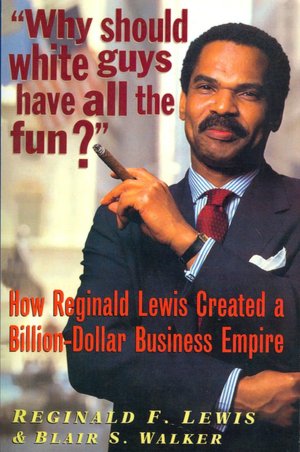
Why Should White Guys Have All the Fun?: How Reginald Lewis Created a Billion-Dollar Business Empire
When six-year-old Reginald Lewis overheard his grandparents discussing employment discrimination against African Americans, he asked, “Why should white guys have all the fun?" This self-assured child would grow up to become the CEO of Beatrice International and one of the most successful entrepreneurs ever. At the time of his death in 1993, his personal fortune was estimated in excess of $400 million and his vast commercial empire spanned four continents. Despite the notoriety surrounding Lewis's financial coups, little has been written about the life of this remarkable man. Based on Lewis's unfinished autobiography, as well as scores of interviews with family, friends, and colleagues, the book cuts through the myth and media hype to reveal the man behind the legend. What emerges is a vivid portrait of a proud, fiercely determined individual with a razor-sharp tongue — and an intellect to match — who would settle for nothing less than excellence from himself and others.
Saturday, November 5, 2011
A Quitter For All The Right Reasons: Ash Cash Teaches You About Your Money
Nationwide (October 10, 2011) -- During one of the worst economic times in the country's history, 30-year old Ash Cash has decided to take a leap of faith and quit his six figure job as a bank manager to pursue a dream of becoming an entrepreneur and teaching financial literacy. Born and raised in a single parent household in the St. Nicholas projects in Harlem, it was believed by Ash and most of his peers that they would be dead or in jail by the age of twenty-five. Somehow through faith, family support, hard work and sacrifice he was able to avoid both.
Ash believes that the biggest problem in the community, as it pertains to money, is that "we spend money we don't have to buy things we don't need to impress people we don't like."
He continues, "As a people, we are so used to not having money that we can't really grasp the concept of saving for the future and spending our money wisely. Couple that with the fact that a lot of us have low self-esteem and use expensive material things to make us feel better. Some of us would rather spend money on cars, jewelry and clothes than to become homeowners, save for emergencies or fix our credit. Our issues are deeply rooted and they become a cycle that is passed down from generation to generation making it more difficult to break. The good news is that there's a movement going on; people are starting to wake up and take more responsibility. We are seeing more of our people excel in positions that in the past didn't seem possible. This movement is what is spearheading the paradigm change and forcing many of us to put the first things first."
This is what led Ash to writing his book. Mind Right, Money Right: 10 Laws of Financial Freedom, is a book designed to teach readers how to effectively manage their personal finances. It shows, how with the right mental attitude and laser sharp focus, anyone can have anything they desire in life. It's an easy to read book that anyone, at any level, can understand. This book is especially geared towards those who are tired of having a dependency on money and are ready to take some practical steps in order to correct it.
Ash comments, "This is our generation's 'Think and Grow Rich'. Starting with the power of self confidence the book discusses in detail how having a positive mental attitude, paying yourself first, budgeting and planning for the future are all ways to immediately change your financial situation."
Mind Right, Money Right demonstrates how a person's mindset plays a tremendous role in creating financial abundance. By using examples of successful people such as Sean Combs, Tyler Perry, Oprah Winfrey, Shawn Carter, Curtis Jackson, Chris Lighty and many others, the reader is given a real life account of how these laws have worked for others and how it can work for you. It's important to point out that the title is "Mind Right, Money Right" and not the other way around.
"Once we are able to control the way we look at money, the way we feel about money and the way we think about money, then it will become easier for us to keep and grow our money... To sum it up simply: This book will change your life," he says.
Mind Right, Money Right: 10 Laws Of Financial Freedom (Revised Edition) is now available on Kindle for $0.99 or in paperback on Amazon for $9.99. Pick up your copy today!
For more information on Ash Cash, visit www.IamAshCash.com
For bookings, speaking engagements, and book signings please contact: Amina Phelps at admin@IamAshCash.com or 877-853-0493
For press releases, pictures, press kits, media and PR please email press@IamAshCash.com
Source: http://www.blacknews.com/news/ash_cash_mind_right_money_right101.shtml
Monday, June 15, 2009
Saving With Limited Funds
Five Basic Steps Toward Financial Independence
by Zakiyyah El-Amin - April 15, 2008
Not only is April tax-filing season, but it’s also Financial Literacy Month. Most Americans are clueless about issues such as credit management, taxes, banking, and saving and investing for the future, reports FinancialLiteracyQuiz.com. In addition to not knowing enough about saving and investing, too many people aren’t doing enough to prepare for their financial future.
According to the 10th annual Ariel-Schwab Black Investor Survey, African Americans continue to save far less money than white people and are no more likely to be investors today than they were a decade ago. The 2007 survey of African Americans and white people earning at least $50,000 annually also showed that the median amount of money saved by black people is $48,000 compared with $100,000 for white people. On a monthly basis, median savings is $182 for black people versus $261 for white people.Also, 40% of consumers live beyond their means, and half are living paycheck to paycheck. If this sounds like you, putting aside extra cash for a rainy day may seem impossible, especially when funds are tight and you’re on a fixed income.
But given the current economic slowdown, it’s an ideal time to take the cost-cutting measures necessary to achieve financial security. "The key to saving money with limited funds is training your mind to know how much money you are working with and making a conscious decision to stay within that framework of available cash," says Gil Michel, president and founder of BlackMoneyMatters.com, a personal finance Website geared to the African American online community. "Unless you change your mindset, the spending habits that you form based on say, a $25,000 salary will be the same even if you were to make $100,000." Michel adds.
An effective savings plan takes discipline to reach specific financial goals. Regardless of your income, here are five steps to help eliminate debt and to start saving:
- Create a budget. Neglecting to keep track of your day-to-day finances is a challenge that can lead to unintentional overspending. A budget will show exactly how much money is coming in, how much money is going out, and where it’s going. Set limits on the amount of money you spend each month and make small adjustments in areas where money can be freed–such as café lattes and junk food. Also, Black Enterprise’s Wealth Building Guide offers some ideas on how you can grow your income to save more. (See the "Wealth Building"portion of BlackEnterprise.com for more information.) You want to put aside at least 10% of your after-tax income to use towards an emergency fund, investments and education.
- Invest in your company’s 401(k) plan. If you aren’t investing in your company’s employer-sponsored retirement plan, then don’t procrastinate any longer. A 401(k) is an effortless savings tool (it automatically comes out of your paycheck) that can provide significant income for retirement. If your employer even matches a portion of your contributions, it is allowing more money to work for you faster. If you’re not offered this plan at work, contribute to an IRA (Individual Retirement Account) or some other tax-free or tax-deferred vehicle.
- Refinance your home. If you had an adjustable rate mortgage, the Federal Reserve’s recent cut in a key interest rate makes it an opportune time to refinance at a fixed rate. It may also be a way to lower your monthly mortgage payment and have access to more cash to invest or pay down debt. Consider all costs associated with going down a percentage point or two in your interest rate to ensure that refinancing balances out with the amount you save on interest. For those who rent and have an extra room, consider bringing in a trusted friend to share the expenses. This is an economical alternative for those who live in big cities where they are paying premiums for rent.
- Eliminate credit card debt. The convenience of buying with plastic instead of cash has created an epidemic of excessive credit card debt. A smart solution begins with making cash-only purchases. Call your credit card company and requesting a lower interest rate. If you own more than one credit card, first make additional payments on the card that carries the highest rate and then work your way down to the card that has the lowest rate until all debt is satisfied. Once you pay off that debt, use that monthly amount you would have paid for those bills toward your savings.
- Be diligent when paying off balances. Do your homework if you decide to close your accounts because it can have an adverse affect on your credit history and credit score. Credit is beneficial if you spend wisely and pay off the entire balance at the end of the month. Living without debt will help you to save more.
Friday, June 12, 2009
How to Avoid Foreclosure
Resources are available to help homeowners prevent repossession
by Aisha I. Jefferson - June 18, 2008
tags: Foreclosure . Real Estate
With home foreclosures reaching record highs and circulating news reports about heavyweight boxing champion Evander Holyfield and iconic TV host Ed McMahon fighting to keep their multimillion-dollar dwellings from reaching the courthouse steps, housing industry experts say borrowers can avoid a similar fate.
The rate of foreclosure starts and the percent of loans in the process of foreclosure are the highest recorded since 1979, according to the Mortgage Bankers Association (MBA), a national real-estate finance industry organization that tracks mortgage delinquencies and foreclosures.The delinquency rate, which includes loans that are at least one payment past due—but doesn’t include loans in the process of foreclosure—was at 6.35% at the end of March, up 1.51% from the year before, according to the MBA. During the same timeframe, the percentage of loans in the foreclosure process was 2.47%, nearly double the 1.28% from the previous year. California, Florida, Nevada, Arizona, Texas, Michigan, Ohio, and Indiana are among the states hardest hit by foreclosure rates.
The amount of foreclosures began accelerating during the latter half of 2006 due to defaults on high-cost loans, such as subprime and adjustable-rate mortgages, or ARMs, made to high-risk borrowers, causing the U.S. housing bubble to burst and a credit crunch to ensue. With ARMs, the interest rate resets from a lower introductory, or teaser, rate to a higher percentage rate, causing a spike in the house payments.
Thirty-nine percent of foreclosure starts in this country involved subprime ARMs; 23% involved prime ARMs; 19%, prime fixed-rate laons; 11%, subprime fixed-rate loans; and 7%, FHA loans, according to the MBA.
By some estimates, 61% of the people who got subprime loans would’ve qualified for a cheaper, conventional, 30-year, fixed-rate loan, says Kathleen Day of the Center for Responsible Lending, a nonprofit consumer group, adding that a disproportionate number of black and Hispanic families received subprime loans.
Jeffery R. Hayward, a senior vice president at Fannie Mae, says some homeowners facing financial challenges dig themselves deeper by avoiding their mortgage lender.
“There’s a myth out there that if you run into trouble, don’t call the bank,” Hayward says. “[Not calling] is the worst thing you could do. If you run into trouble, you should call your mortgage servicer immediately,” Hayward says. “The servicer is really going to want to try to work your loan out. In some cases they won’t be able to, but you’re really not going to know until you call them.”
Given the volume of exotic loans in the marketplace, practicing diligence and patience is a must when contacting lenders. “Keep calling until you get somebody,” Hayward says.
Once making contact, lenders could offer to spread the defaulted payment over future payments, reduce the interest rate or loan balance, he says.
“If you have a bad subprime loan, a repayment is not going to help you. What you need is a workout plan,” says Day, explaining that a workout plan would reduce the loan to a fair market value or freeze the interest rate either permanently or semi-permanently for about five years. On the other hand, a repayment would take the amount owed and spread it out on top of the current payments. Day says repayment plans work best for people who’ve gone into trouble because of a one-time event such as illness, job loss, death, or divorce.
“If the fundamental problem is the loan itself then you need a workout plan and not a repayment plan,” Day says.
Since July 2007, nearly 1.6 million homeowners have avoided foreclosure through workouts which include loan modifications and repayment plans, according to HOPE NOW, the private sector alliance of mortgage servicers, counselors, and investors working to help prevent foreclosures.
If the loan can’t be worked out Hayward suggests doing a deed in lieu of foreclosure where the mortgage lender will accept ownership of the home in place of the money owed on the note, or a short sale, which requires the homeowner to sell the home for less than the outstanding balance of the loan with the mortgage lender forgiving the remaining debt owned. Either of these options will help homeowners have a more orderly and planned exit of their property, Hayward says.
If borrowers aren’t getting any satisfaction from their lender’s decision, seek advice at a legal aid clinic, Day suggests. “It may be that you can challenge the term that you were given,” she says.
For first-time homebuyers, Hayward suggests taking a homeownership mortgage or financial counseling course where counselors would conduct a budget overview and examine potential buyers’ spending patterns to ensure they’ll end up in a home they can afford. He also suggests first-timers make sure everyone involved in the process is trustworthy and reliable.
“This is the most important financial decision people will make in their lifetime. You should feel good about when you do it,” Hayward says.
In an effort to help lending partners and communities survive this economic climate, Fannie Mae, which has a federal charter and operates in America’s secondary mortgage market to ensure that mortgage bankers and other lenders have enough funds to lend to home buyers at low rates, has established its Keys to Recovery Initiative and foreclosure prevention for existing and first-time homebuyers.
If Fannie Mae owns the loan, borrowers who owe more than the amount their home has been appraised will have the opportunity to refinance their property up to 120% of its appraised value, Hayward says. Another measure formed through a partnership Fannie Mae has with Durham, N.C.-based nonprofit, Self-Help Credit Union (http://www.self-help.org/), would allow families on the brink of foreclosure the opportunity to remain in their homes on a rent-to-own basis. The 70-year-old mortgage funding giant also renewed its partnership with the National Council of State Housing Agencies to provide up to $10 billion in financing through the end of 2009 for qualified first-time homebuyers.
Source: http://www.blackenterprise.com
Subscribe to:
Posts (Atom)