Showing posts with label Music. Show all posts

Monday, May 9, 2016

The First African-American Piano Manufacturer

At the Mid-Atlantic Jazz Festival in February, one couldn't help but notice the striking new grand piano on the main stage, emblazoned with the name SHADD. When the many accomplished pianists that wee­­kend sat down to strike those keys, it was equally easy to spot their delight in the instrument.

That piano was the product of a trailblazer in his field. The Shadd in question is jazz drummer Warren Shadd, the first African-American piano manufacturer. That makes him the first large-scale commercial African-American instrument manufacturer, period.

For Shadd, piano making is part of his birthright. His grandparents were musicians: His grandmother was a ragtime pianist in the South in the '30s, and his grandfather invented (and performed on) a collapsible drum set. (He never patented it, a lesson his grandson learned.) Shadd's father was himself a piano technician, restorer, builder and performer — as well as a trombonist. And Shadd's aunt was the NEA Jazz Master pianist and vocalist Shirley Horn. A child prodigy, young Warren made his own concert debut at age 4.

Shadd Pianos are now in churches and concert venues across the U.S. — including the set of American Idol, where house keyboardist Wayne Linsey will play it on Wednesday night's episode. On a recent visit to Warren Shadd's home in a suburb of Washington, D.C. — a home that doubles as the Shadd Piano showroom — he spoke about his life and work.

Willard Jenkins: What sparked your original interest in pianos?

Warren Shadd: My father was the exclusive piano technician for the Howard Theatre, so I would go down there with him four times a week and see James Brown, Count Basie, [Duke] Ellington, Pearl Bailey, Peggy Lee, Art Blakey and the Jazz Messengers ... rehearsing. I'd see this all day long, every day. From the time I woke up, there were band rehearsals. Shirley Horn rehearsing in my basement with Billy Hart and Marshall Hawkins ... We had pianos everywhere in my house, from the garage to the basement, sometimes even one of the upright pianos sitting in the kitchen, [Laughs.] And musicians would come over to our house after the gig and play all night: Dude Brown, Bernard Sweetney, Steve Novosel, Roberta Flack ...

My father would have me do little repairs on the piano. When he went on these piano [repair] jobs, he would take me with him to see what the whole thing was about ... and I would never want to go. I just wanted to stay home and play the drums; just wanted to be Warren Shadd the drummer. Except when he said he was going to the Howard Theatre — I was in the car before he got there! I wanted to see all these cats rehearse, see the show ... I met Grady Tate when I was about 6 years old, playing with Jimmy Smith, then went full circle and played with Jimmy Smith myself.

Warren Shadd at age 13.
Courtesy of Warren Shadd
As I progressed and learned more about piano technology, I never aspired to; I just knew how to do it. I would say, 'Piano is what I know, drums is who I am.' As I went out there and toured with different acts, did a bunch of Broadway shows and got a little tired of the road, I learned how to tune, rebuild and restore pianos. I would take these pianos down to the nuts and bolts and build them back up just for fun, just for a hobby. I would take whole grand or upright pianos apart, build them back up with everything refinished — new strings, new soundboard, new keys, new ivories — for fun. And then my father would sell the piano. [Laughs.] I was about 12, 13 when I started doing this.

The record player was always going, from Sonny Stitt's Low Flame album, to Count Basie, to Buddy Rich, to Miles, to Wilson Pickett, Otis Redding, the James Gang, Iron Butterfly — I had a real potpourri and understanding of all genres of music. While I was doing this piano thing just for the heck of it, I was also performing with a bunch of folks. After I got through high school, I went to Howard University and was in the big band with Wallace Roney, Geri Allen, Gary Thomas, Noble Jolley Sr., Carroll Dashiell and Paul Carr.

When my father passed in 1993, I took over the piano business full tilt, because he had all of these clients for tuning, rebuilding and restoring. He pretty much had Washington, D.C., totally sewn up with all the church pianos. So when I took it over, I already had a client base — it wasn't like I had to start over fresh. We had all these contracts with churches. Coming in as the second generation of this business was phenomenal for me. Secure from being a musician on tour, it was a built-in job.

As the industry changed a bit, I found that rebuilding pianos was not so much what I really wanted to do financially. I would take these pianos and beautifully restore them ... and somebody would say 'OK, I'll give you $600 for it...' [Laughs.] I'm like, 'Dude, even the new strings I put on this cost four times that much!' So I kind of migrated out of that restoration business into doing tunings and repair work.

I would also exchange parts. I'd take a soundboard out of a Steinway and put it in a Baldwin to see what kind of reaction it would give, understanding the engineering, understanding which side vibrates the most. I'd exchange strings, put on heavier strings, lighter strings, to achieve a certain type of sound. Being a musician, I have an advantage of understanding what musicians want and what they want to hear. If I can compare here — Mr. Steinway doesn't play piano, Yamaha no, Kawai no, Bosendorfer no, Fazioli a little bit ... They are engineers and businessmen; I'm a musician and an engineer and businessman. I have somewhat of a musical advantage. What I'm crafting is a musical instrument and all those different components that go into that, especially the musical parts.

At what point did you decide to actually manufacture pianos?

From churches and especially symphonic tunings, you understood that the piano had a disadvantage in terms of the pianists especially being able to hear themselves play, because in church you're in total competition with the Hammond B-3 organ or the pipe organ, the drums, the bass, the percussion, the choir and the congregation. They would put microphones in the piano, but they weren't placed right to give you the most opulent sound of the piano. You would have to totally jack up that sound for the pianist to feel really comfortable. In the symphony, there'd be a floor monitor, but you're totally surrounded by all these string instruments and you're still at a disadvantage ... and you just play the part.

My first notion was enhancing the volume of the acoustic piano by itself, without any kind of electronics. Even if you add electronics, you'll have more sound, because the origin of the piano will have more sound, more volume to it without distorting it — which is important, too. There's a piano on the market that is somewhat loud, but as you play it louder, it has distortion. The soundboard is not made so well that it can take that kind of pounding. My pianos: You can stand on them and you will not get any kind of distortion.

I studied and researched in the library and wrote a dissertation. I went back to some of those old pianos I restored, and I would experiment with the soundboard. I wrote this stuff on sheets of notebook paper and just put it away, didn't really think that much about it. One day, I was tuning a piano at this old man Mr. Tucker's house. As I'm tuning his old upright piano, he started whimpering. I said 'Mr. Tucker, what's going on?' He said, 'It's all right, Shadd, it's all right.' So I go on tuning the piano, then he really starts crying a lot. 'What's wrong, Mr. Tucker?' He said, 'Shadd, see that piano? See that name on the front of it? That should say Shadd, because you're the only one!' I said, 'OK, Mr. Tucker, I've got these ideas, I'm gonna go back and study.' He pretty much planted the seed.

I went back and blew the dust off of these old ideas that had been sitting in a cabinet, and I started trying to engage some of these parts and put some of these old ideas I had together. And then I said, 'Why not try to do some of this stuff electronically?' So I built this prototype piano. It took me two summers and there it is [pointing to a high-tech grand piano in the adjoining room]. I put an audio system in the piano where speakers are right in front of the piano, so the sound would come right to the pianist and the pianist can hear themselves play. And I put speakers under the piano and a subwoofer so you can get the full gamut of the piano and control the volume and graphic equalize each section of the piano — bass, alto, tenor and treble — so you could go to each section of the piano and customize it just like that. I went another step and made it MIDI, so you could play all of your electronic synthesizer sounds on the piano.

For educational purposes, I made this piano interactive. I put a computer under the piano and I built this 24" touchscreen on the front and a 13" screen on the left and encompassed video cams throughout the piano. So on the other side, interactively, your piano teacher can see you, you can see your piano teacher, they can see our face, torso, left hand, right hand, pedal movement, and teach intelligently anywhere in the world ... distance learning right there at the piano.

From that point, you can also have your band on the other screen, so you can even cut tracks with your band live and in real time. You can teach and you can score on your touchscreen as you're watching that, so it's like a total workshop right in front of the piano. Now you can compete in a church environment, in a symphonic environment, because now you have the volume right in your face. But even taking it to another level ... I have a [piano] bench that has surround sound; it has a subwoofer in it. So now, you don't only just hear the music; you feel the music, so that every little nuance that you play on the piano down to the triple pianissimo ... you feel everything that you're playing.

From there, I said, 'Let me go back to the acoustic piano and see how I can apply some of that stuff to these new pianos.' So I incorporated a lot of the soundboard technology that I invented — and I have patents on all of this technology, unlike my grandfather with the collapsible drum set. I assembled an A team of piano manufacturers around the world and sort of cherry-picked the best of the best. I said I want you to make this ... in accordance to my patents and designs.

My first piano, I sold to the Setai Hotel in New York, now called the Langham Place Hotel, and they play jazz there on this piano — seven days a week. I was trying to get a particular piano company to build my pianos. When I called, they said, 'We'll build your pianos if you bring us 1,000 signatures of people who would buy your pianos.' A friend of mine suggested going to the Gospel Workshop of America, the big convention of all the ministers of music and trustees. It happens annually, and I'm thinking at that time all I had was paperwork: I had a provisional patent, but no prototype piano.

How am I going to go there without a piano? Hammond Organ, Yamaha are going to be there, and they're going to have instruments. So I'm just going to be there selling a piano without a piano? I had these big posters made to put on easels and put all this stuff into an SUV and traveled up to Detroit. I bought a corner booth because people were going to be coming to you on both sides as opposed to being in the middle of a straight line in the exhibit hall. I had these banners made that said, 'First African-American piano manufacturer.' I made a video of all the proposed technology. But I still didn't have a piano. [Laughs.]

I've got a lot of family in Detroit, so I got a couple cousins with clipboards to stand outside of my booth to get these signatures — the name of their church, their minister of music's name, what kind of piano they had in their church, how many pianos would they replace if they were able, and how many would they replace with the Shadd Piano based on the technology you see [in his booth presentation]? I ended up with 864 signatures in four days. I got the rest of them from DC Public Schools.

I had six people across and three deep the whole time. I had no idea there was going to be this much interest. This little church lady with a pillbox hat points up to the poster and says, "You mean, we've got a piano!" When she said that, it was like the whole place stopped — it went silent to me, I did not hear a word. At that moment, I knew that this wasn't about me; this was much bigger than me. I'm thinking I'm a conduit, being the first African-American piano manufacturer, and some would say the first African-American musical instrument maker — we don't make trumpets, trombones, tubas...

What's been the reaction of the players to your piano?

Pianist Christian Sands stands with a Shadd Piano at the Mid-Atlantic Jazz Festival in 2014.i
Pianist Christian Sands stands with a Shadd Piano at the Mid-Atlantic Jazz Festival in 2014.
Courtesy of Warren Shadd
It was kind of tough initially to get cats to come out here and play the piano. One cat — after he came out and played the piano and was overwhelmed — said 'You know, I've got to apologize. I didn't come out at first because I didn't want to be disappointed!'

How are you going about connecting with piano players?

One player at a time. I call folks, they come over, they play the piano, and they're wowed. Barry Harris was here three weeks ago and he's brought some attention to some other folks about this piano. Church musicians are in here all the time now. I do know there's a responsibility with this, to make the best piano — not one of the best — the best piano, period, in the world, and that's what I believe I've done. As a people, we can't be parallel; we've got to be three times as good. I'm a perfectionist, so every nuance that goes into this piano has to be the very best.

Source: http://www.npr.org/sections/ablogsupreme/2014/05/07/309881323/the-first-african-american-piano-manufacturer

Friday, February 12, 2016

Nas is like...half man, half venture capitalist


@nas

In the world of hip-hop, rappers turned businessmen — Shawn "Jay Z" Carter, Andre "Dr. Dre" Young and Curtis "50 Cent" Jackson being the most recognizable names — have become fairly commonplace. Nowadays, most artists have side ventures in music (of course), apparel, food and beverages. Yet however impressive their individual business prowess, few of them are able to call themselves full-fledged investors in Silicon Valley start-ups.

Count Nasir Jones, the multiplatinum-selling rapper better known by his stage moniker "Nas," among that elite group. The Queens, New York-bred artist who first hit the charts more than 20 years ago has quietly metamorphosed into a prolific angel investor — founding the venture capital firm QueensBridge Venture Partners. The firm (not to be confused with the hip-hop supergroup Jones fronted back in the '90s) funnels cash into start-ups as varied as health care, financial technology and Bitcoin.

QueensBridge, based in Los Angeles, invests in more than 40 start-ups across a range of sectors like financial technology, health care and music production. That has helped put Jones in the same strata as Ashton Kutcher and U2 frontman Bono as the tech world's most influential celebrity investors.

Read MoreChina's tech elite like a new asset class: Start-ups

So in a complex sector where billions are harvested — and cash hungry start-ups are born and buried in the blink of an eye — how does one of rap's living legends define his investment philosophy? Jones' answer is surprisingly simple.

"People. That is the absolute No. 1," Jones told CNBC via email. "I love to bet on great people that inspire me and make me think or see things differently."

A big part of that has to do with the management team, Jones added, which "makes a huge difference in the kinds of companies that will stick out to me."

Some of the companies that have grabbed the artist's attention include Silicon Valley darlings like Lyft, Dropbox, Coinbase and Tradesy, all of which are part of QueensBridge's investment bailiwick.

The ride-sharing service and online storage provider are among technology's biggest "unicorns" — private startups valued at least $1 billion — and are poised to become publicly-traded companies once the current downturn subsides. One of QueensBridge's latest investments is LANDR, a start-up that uses big data and artificial intelligence to produce music. LANDR has raised more than $8 million from various sources in the last few years, including Jones' firm.

Silicon Valley is a long way from the rough and tumble world of the New York City neighborhood that's interwoven in the lore of Jones' musical mythology. The 42-year-old artist, an autodidact who dropped out of school after the eighth grade, told CNBC his affinity for learning led him to technology investing.

"I've always wanted to be surrounded by the smartest people in the world, and didn't want to limit that to just music," he wrote to CNBC.

"I want to meet the people who are innovating in all different fields, and investing lets me do that," Jones said. "I meet the people that are changing the game across all different industries, and I get to be there first at the ground level. It's helped me to progress tremendously in my business."


"It's not easy to find the projects that are going to generate a return, and you have to invest your time and energy — not just your money — into researching the companies that are going to do big things."
-Nasir "Nas" Jones, Rapper and angel investor
Despite the recent downturn in the market, it's been a lucrative time to be a technology investor. Last year was a record for venture capital, with more than $128 billion finding their way to a range of companies worldwide, according to data from KPMG Enterprise and CB Insights. Funds for small start-ups, otherwise known as angel investments, have boomed into a $24 billion market by itself, the Center for Venture Research says.

QueensBridge is pitched by more than 100 companies per month, and invests in only a small fraction of them. Anthony Saleh, Jones' manager and partner at QueensBridge, told CNBC in a recent interview that the firm invests from $100,000 to $500,000 in a company, and has done more than 100 deals in the last six years.

Overall, QueensBridge invests in about 20 per year, Saleh said, adding that the firm is "much more top-down than bottom-up as investors. We concentrate on idea or the product, how big the market is and how the founding team is."

Read MoreTech firms face funding 'Hunger Games'

The due diligence process, Saleh told CNBC, can be at least as qualitative as quantitative. Investing in a potential company can include intangibles like "experience, grit, life motivation … those are keys to what we look at. Then we look at how those things kind of mesh."

Even in the freewheeling world of tech companies, corporate governance is a critical ingredient, he added.

"Nas' biggest fear is investing in a company" where the leadership may be unethical, Saleh told CNBC. "He tends to ask more questions about that."

Helping musicians make music

QueensBridge, along with a clutch of other firms such as Warner Music Group, Real Ventures and YUL Ventures, recently invested in LANDR, where CEO Pascal Pilon fused his training in software engineering with business.

LANDR is Pilon's second start-up, and the post music-production service helps master music for more than 300,000 musicians. Mastering is the final step in music production that happens after you record all of the parts and mix them together.

"We felt there was lots of room for musicians to embrace this thing," Pilon told CNBC in a recent interview.

Given the expense and cumbersome effort involved in creating music masters, "Some musicians have never felt the instant gratification of completing a song, and don't have the money to release more songs," and LANDR helps them get there.

That argument cuts to the heart of the notion embraced by Jones and his team at QueensBridge: that a start-up investment is more than just about financial gain.

"I think anyone can be involved with investing if they have the means, but I'd advise anyone who wants to invest to be careful. You have to study it," Jones said. "It's not easy to find the projects that are going to generate a return, and you have to invest your time and energy — not just your money — into researching the companies that are going to do big things."

Source: http://www.cnbc.com/2016/02/06/nas-is-likehalf-man-half-venture-capitalist.html

Tuesday, May 13, 2014

Misty Copeland - Life in Motion: An Unlikely Ballerina


As the only African American soloist dancing with the prestigious American Ballet Theatre, Misty Copeland has made history. But when she first placed her hands on the barre at an after-school community center, no one expected the undersized, anxious thirteen-year-old to become a ground­breaking ballerina.

When she discovered ballet, Misty was living in a shabby motel room, struggling with her five siblings for a place to sleep on the floor. A true prodigy, she was dancing en pointe within three months of taking her first dance class and performing professionally in just over a year: a feat unheard of for any classical dancer. But when Misty became caught between the control and comfort she found in the world of ballet and the harsh realities of her own life (culmi­nating in a highly publicized custody battle), she had to choose to embrace both her identity and her dreams, and find the courage to be one of a kind.

With an insider’s unique point of view, Misty opens a window into the life of a professional bal­lerina who lives life center stage: from behind the scenes at her first auditions to her triumphant roles in some of the most iconic ballets. But in this beautifully written memoir, she also delves deeper to reveal the desire and drive that made her dreams reality.

Life in Motion is a story of passion and grace for anyone who has dared to dream of a different life.

Source: http://www.amazon.com/Life-Motion-An-Unlikely-Ballerina/dp/1476737983

Thursday, December 19, 2013

Wow!! Drake Looks Out For Philly In A HUGE Way!

Photo Credit: Getty Images

In May, Strawberry Mansion High School was featured in a segment from World News with Diane Sawyer. In the piece, Diane covered the principal of the school, Linda Cliatt-Wayman as well as the students of Strawberry Mansion, which was dubbed one of the most "dangerous" high schools in America. The principal and kids rebuked the stereotype by showing the progress they have made as well as the postive aspects of the school.

It turns out that even celebrities were deeply affected by the special. Drake saw the piece and decided to build a full sized recording studio inside of the school for aspiring artists of all kinds. He announced this in person to some students from the school as well as Principal Cliatt-Wayman backstage at his postponed tour stop here in Philly in October. To see the reactions on the childrens' faces watch the video below!!


Read more: http://www.power99.com/pages/CosmicKev.html?article=11885152#ixzz2mgXVrVdk

Wednesday, November 20, 2013

Positive Black Male News: Big Sean Kicks Off Official Launch of Sean Anderson Foundation by Giving Back!

Big-SeanAward Winning G.O.O.D. Music and Def Jam recording artist Big Sean celebrates the official launch of his non- ‐profit, the Sean Anderson Foundation, with a new campaign on Prizeo, the premier celebrity charity fundraising digital platform to raise funds to help bring P’Tones Records, a free afterschool recording studio music program, to Sean’s hometown of Detroit.  The campaign is live on Prizeo today and end will on August 19th with the winner announced and notified on August 20th.
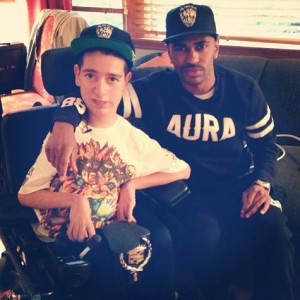
big-sean-fanBig Sean is really in the giving spirit recently he showed up as a surprise with MTV in tow to one of his biggest fans home, who is paralyzed to play him his new album Hall of Fame. While sitting on the couch in his living room, he gave him a first listen to the August 27 release.


“I just wanted to give him that experience,” said Sean. “I wish my favorite rapper would’ve come to my house and played their album for me. I just wanted to make that moment happen and make his family proud.”

Back to the giving which also includes some MTV Love. For micro- ‐donations starting at only $3, fans will be entered into the grand- ‐prize drawing. The grand- ‐prize winner, chosen at random, will accompany Big Sean to the MTV Video Music Awards on August 25th in Brooklyn, NY.

The Sean Michael Anderson Foundation is a Michigan non- ‐profit corporation aimed at assisting in the education, health, safety and well- ‐being of Detroit Area school- ‐ age youth as well as disadvantaged youth in other areas across the nation.

P’Tones Records is an organization that opens studios nationwide and provides teens from disadvantaged neighborhoods the opportunity to partake in a hands- ‐on afterschool music program, running a mini- ‐record label set in a recording studio environment.

“My vision for the Sean Anderson Foundation is simply to make the lives of young people better, “ says Big Sean. “We are excited to partner with Prizeo for our first fundraising campaign designed to help bring P’Tones Records, an afterschool music program that I really believe in, to my hometown of Detroit”


“We are delighted to partner with Big Sean to raise both funds and awareness of the mission of the Sean Anderson Foundation and P’Tones Records,” says Leo Seigal, Co- ‐founder of Prizeo.

As extra incentive, Big Sean will reward fans of certain, stipulated donation levels with a range of exclusive rewards including his highly anticipated new album Hall of Fame which will be released on August 27th, autographed Aura Gold merchandise and Hall of Fame Sol Republic Headphones. And the campaign’s top sharer —the donor who shares a personalized link to Sean’s Prizeo page on Facebook and Twitter and gets the most friends and family to contribute to the cause—will win a pair of the new and exclusive Big Sean designed Adidas Sneakers, as well as a follow by Big Sean on Twitter and Instagram. Congrats to Big Sean on the launch of his foundation and to our friends at P-Tones on this endeavor. Be sure to support it BCG Family, Giving is Good!

Source: http://theblackmancan.org/2013/08/10/source-big-sean-kicks-off-official-launch-of-sean-anderson-foundation-by-giving-back/

Monday, June 24, 2013

Dr. Dre, Jimmy Iovine to give $70 million to USC for new academy


Hip-hop star Dr. Dre and music mogul Jimmy Iovine are donating $70 million to USC for a new academy that they say will give students the tools they need to break into the rapidly changing music industry.

Scheduled to be announced by Dre (whose given name is Andre Young) and Iovine on Wednesday in Santa Monica, the gift will establish the USC Jimmy Iovine and Andre Young Academy for Arts, Technology and the Business of Innovation. The academy will open with an inaugural class of 25 students in fall 2014.

"The vision and generosity of Jimmy Iovine and Andre Young will profoundly influence the way all of us perceive and experience artistic media," USC President C.L. Max Nikias said in a statement. "Our goal is to ensure that the academy is the most collaborative educational program in the world."


USC receives $5-million gift to endow community service program

Gift to USC continues a legacy of mentoring

Beats by Dr. Dre will move headquarters to Culver City

Dr. Dre tops Forbes' highest-paid musicians list

Dr. Dre, Jimmy Iovine give $70 million to create new USC academy
Ads by Google

Dre, Iovine and Nikias declined to be interviewed before the announcement, a USC spokesman said.

An unspecified portion of the $70-million donation will go toward construction of facilities that will house the academy. Students, who can earn an undergraduate degree from the academy, will use existing facilities while new ones are being built.

The four-year program will feature four core curriculum areas: arts and entrepreneurship; technology, design and marketability; concept and business platform; and creating a prototype. It aims to foster entrepreneurship that brings students' entertainment, technology and business skills into play. Instruction will involve engineering, computer science, fine arts, graphic design, business and leadership training.

That training will come from faculty at USC's Thornton School of Music, Roski School of Fine Arts, Marshall School of Business and Viterbi School of Engineering, as well as "industry icons and innovators as visiting faculty and guest speakers," according to USC's statement.

"Academy students will have the freedom to move easily from classroom to lab, from studio to workshop individually or in groups, and blow past any academic or structural barriers to spontaneous creativity," Erica Muhl, dean of the fine arts school, said in a statement. Muhl will serve as the first director of the new academy.

The outline of the program appears to create an academic counterpart to the street-smart path Iovine and Young have traveled in building their careers.

As Dr. Dre, Young first came to fame as a member of the Compton hard-core rap group N.W.A and went on to become one of hip-hop's most respected performers and producers, mentoring Eminem as well as 50 Cent, the Game and other rappers.

Before Iovine founded Interscope Records in 1990, he also was an in-demand producer and engineer for hit recordings by John Lennon, Bruce Springsteen and other rock and pop acts. At Interscope, which became Interscope Geffen A&M Records, of which he is now chairman, Iovine has been at the helm of the label behind such music-world successes as U2, the Black Eyed Peas and Lady Gaga. Iovine remains a co-owner of Interscope with its parent company, Universal Music Group.

When Dre asked Iovine several years ago whether he should endorse a line of high-end athletic shoes, Iovine famously replied, "Speakers — not sneakers."

That led them to create the Beats by Dr. Dre line of headphones that now accounts for more than half the consumer market for high-end headphones. Their Santa Monica-based Beats Electronics company has since expanded with the Dre Beats laptop, high-quality ear buds, speakers for car stereo systems and other products. The company's annual sales in 2011 were $500 million.

Forbes put Dre's current net worth at $350 million, ranking him third — behind Sean "Diddy" Combs and Jay-Z — on the magazine's 2013 list of the wealthiest hip-hop stars.

Celebrity NetWorth puts Iovine, a regular guest judge in recent seasons of "American Idol," at $700 million. Forbes in 2011 estimated Iovine's net worth at $400 million.

USC has a history of cultivating strategic relationships with the entertainment industry and a number of its leading practitioners. In 2009, for example, George Lucas' Lucasfilm Foundation gave $75 million toward construction of new facilities for the USC School of Cinematic Arts, plus $100 million for the school's endowment. Warner Bros., 20th Century Fox and Disney have also donated to the school.

Sunday, February 24, 2013

Beyoncé Knowles Charity Work, Events and Causes

Beyoncé Knowles – the 26-year-old soulstress from Destiny’s Child – is not only one of the great survivors of the music industry, but also someone who cares deeply about people.

The list of charities she supports is both long and varied, but perhaps the greatest contribution she has made is the Survivor Foundation, an organization she founded with fellow Destiny’s Child Kelly Rowland to help victims of Hurricane Katrina. The foundation’s accomplishments are many, including the Music World Cares Christmas Carnival that enabled over 300 low-income households to enjoy a fun-filled day of food, entertainment, a visit from Santa Claus and free toys from the toy giveaway. The singer also held a series of food drives before her concerts in 2006 to collect the food that was so desperately needed by victims.

Beyoncé was also an Ambassador for the 2005 World Children’s Day, and released “Stand Up For Love,” the anthem for the event which takes place annually around the world on November 20 to raise awareness and funds for children’s causes.

Beyoncé donated a handbag to an auction benefitting Women's Fund for Scotland. But her concern for people is sometimes more discreet, as was shown when she visited two people who were injured during a fireworks accident at one of her concerts, arriving at the hospital shortly after the concert ended. Head nurse Darryl Williams said, “She was just very concerned about the people injured in the audience. It was unannounced and we kept it very low-key so that she could spend time with them.”


Beyoncé Knowles has supported the following charities:

46664
American Foundation for AIDS Research
Artists for Peace and Justice
Barbara Davis Center for Childhood Diabetes
Candie's Foundation
Clinton Bush Haiti Fund
Clothes Off Our Back
Entertainment Industry Foundation
Feeding America
Food Bank For New York City
Kids Wish Network
Love Our Children USA
Miami Children's Hospital Foundation
MusiCares
Music Rising
Oxfam
Phoenix House
Save The Music Foundation
Stand Up To Cancer
Survivor Foundation
The Lunchbox Fund
The Samburu Project
Women's Fund for Scotland


Read more: http://www.looktothestars.org/celebrity/beyonce-knowles#ixzz2L9ssZPm1
Follow us: @looktothestars on Twitter | looktothestarsorg on Facebook

Thursday, November 22, 2012

Will Smith - Quote Image: Smiling

"Smiling is the best way to face every problem, to crush every fear and to hide every pain"
Will Smith

Rapper 50 Cent Thinks Like a Harvard Businessman


Curtis Jackson broke into the music industry in 2002 and became the multiplatinum rapper 50 Cent. Today, he's also an entrepreneur and philanthropist. He talks with WSJ's Lee Hawkins about his latest ventures and whether he will become a billionaire.

Watch Mario Lopez talk Ryan Seacrest HERE: http://bit.ly/KYZknO

Watch Manny Pacquiao's exclusive WSJ interview HERE: http://bit.ly/KZyiNj

Lee Hawkins interviews Soulja Boy, John Elway, Cee Lo Green and more HERE: http://bit.ly/LWstNg

Subscribe to WSJ Live HERE: http://bit.ly/Kpz7Ab

WSJ Live brings you original programming from The Wall Street Journal. Get news directly from The Wall Street Journal's 2,000 reporters across the globe. With exclusive video and daily live programming, you can stay on top of the latest in news, elections, markets, tech, opinion and lifestyle.

For more video, visit WSJ Video: http://on.wsj.com/sOC4N

Monday, November 12, 2012

Tyrese Gibson: Dream with your eyes open


5MK, Los Angeles Launch featuring Tyrese Gibson, Singer and Actor

Sunday, November 4, 2012

John Legend Charity Work, Events and Causes


When Grammy Award-winning soulster John Legend first read The End of Poverty by Earth Institute director Dr. Jeffrey Sachs, he was so inspired that he traveled straight to Ghana to learn more about the problems faced by African countries. The book made him realize how it could be possible to set impoverished villages onto the road of self sufficiency and progress, and the trip showed him how he himself could make a difference to the lives of millions.

Legend established the Show Me Campaign to raise the required funds soon after his fact-finding mission, and partnered with Sachs’ Millennium Promise Alliance to serve needy African villages. In 2008, both Legend and Sachs made a tour of universities all over the US to encourage social, economic, personal, and educational growth. Called the Poverty Action Tour, the sessions challenged people to support the fight against poverty, and promote the charities and groups that champion the cause.

Rather than giving out money to destitute villages, the Show Me Campaign and Millennium Promise are more practical. They provide mosquito nets to curb the millions of avoidable deaths from malaria, free meals to children attending school which raises attendance rates and health, safe water points, local clinics and fertilizer to improve crop production and eradicate food shortages.

“Some people will say with some justification that we have a lot of problems here at home that we still need to solve,” said the 29-year-old singer. “But I don’t believe you have to choose. I think every life is valuable and poverty anywhere is something we should address.”

John also raises awareness and support for The Gentlemen's Fund and is a spokesperson for Tide Loads of Hope, for which he spent a day folding the laundry of those affected by Hurricane Katrina.

Legend performed at a concert benefitting the Jason Collier Memorial Scholarship Fund.

John made an ad supporting the GAP (PRODUCT) RED (Two Weeks) Campaign. Proceeds from the sale of the campaign’s T-shirts benefit the Global Fund.


Charities & foundations supported (30)

John Legend has supported the following charities:


more: http://www.looktothestars.org/celebrity/john-legend#ixzz2AqDqqPow

Saturday, November 3, 2012

Miles Davis - Quote Image: Fear

"Do not fear mistakes. There are none." 
Miles Davis

Friday, November 2, 2012

Usher Charity Work, Events and Causes


Usher established the Usher's New Look Foundation to empower young people from underserved neighborhoods around the world to create change in their communities.

Please also see our 58 past articles about Usher


Charities & foundations supported (12)

Usher has supported the following charities:


more: http://www.looktothestars.org/celebrity/usher#ixzz2AqCtenPq

Thursday, October 25, 2012

Will.I.AM: Charity Work


Will.i.am created the i.am.home Fund to help prevent struggling families in the United States from losing their homes. He also created the i.am scholarship Fund to bring educational opportunities to young people in need of financial assistance.

Will.i.am teamed up with REM’s Michael Stipe for a charity single to continue aid for Hurricane Katrina victims; proceeds benefit Mercy Corps. The CD, In the Sun, is available for purchase on iTunes.

Charities & foundations supported (13)

will.i.am has supported the following charities:

Common Ground Foundation
GRAMMY Foundation
Green For All
i.am.home Fund
i.am scholarship Fund
League of Conservation Voters
MASSIVEGOOD

Read more: http://www.looktothestars.org/celebrity/will-i-am#ixzz29MrpfmLA

Monday, October 22, 2012

Positive Black Male News: Luda Day Weekend Uplifts the City of Atlanta with Three Days of Community Events!


Christopher Ludacris Bridges’ Luda Day Weekend was keynote event of a weekend with Gay Pride and various other Labor Day weekend around the city of Atlanta. On Friday Ludacris made a visit to Dobbs Elementary School in Atlanta with NBA philanthropist Josh Powell.  Ludacris said giving back is one of his proudest moments of Luda Day Weekend.

“Supporting our youth includes educating and empowering them about the benefits of a healthy lifestyle-responsible dating, greener communities, and healthy eating habits. Eating right and exercise promote good habits, both mentally and physically. We want to show young people that physical activity and eating well can be fun and a part of your everyday life.”

Project S.L.I.D.E. pumped up the students for Ludacris’s arrival by teaching them an easy dance routine and a fun two-step of the Wobble. “The teaching garden that we planted in the spring was a big hit we wanted to continue the teaching moments. Students, teachers, parents and grandparents particpated in the learning, growing and harvesting” said Roberta Shields, President of the Ludacris Foundation.”

Once the students finished getting their heart rates up, Ludacris faced his toughest media interview; the students. Two students from Dobbs Elementary had the opportunity to interview Ludacris, asking him everything from what he thinks about the U.S. Government to why he started the Ludacris Foundation. Throughout his interview he stressed the importance of following through with Michelle Obama’s plan of raising healthy and smart kids, and how his foundation strives to make a difference in the communities that have been a direct influence on his life and career.

Ludacris brought with him his personal chef Willie Box, who picked herbs and vegetables from the school’s garden, to prepare students with a yummy yet nutritious snack. Chef Box made the students aware that not only were they eating from their garden, but that snacks and food in general can taste great without all the extra sugars and toxins that some processed foods contain. His special treat–sweet potato cupcakes,which were a hit among students–and teachers!

Source: Tastmakermag.com & Blackcelebritygiving.com

Photo’s by Chanda M. Scott

theblackmancan.org wants to provide you with news stories from across the world that promote a positive black male image. Many of the stories featured here may not be on the front page of your local newspaper, but we believe that it is our job to inform you on all the positive black male news circulating the world.

Source: http://theblackmancan.org/?p=3239

Sunday, October 21, 2012

Jay-Z: Charity Work


Jay-Z sent more than $2,500 worth of designer street wear to the Spring Hill Campaign for Adolescent and University Student Empowerment (CAUSE) in appreciation of their community efforts.

His November 2006 concert in New York city raised over $250,000 for PlayPumps International.

On August 9, 2006, he met with UN Secretary General Kofi Annan at the organization’s headquarters in New York. The rapper pledged to use his upcoming world tour to raise awareness of–and combat–global water shortage.

Also in 2006, he visited Africa and produced a documentary entitled Diary of Jay-Z: Water for Life.

He pledged $1 million to the American Red Cross' relief effort after Hurricane Katrina.

Please also see our 48 past articles about Jay-Z

Charities & foundations supported (7)

Jay-Z has supported the following charities:

Artists for Peace and Justice
Boys & Girls Clubs of America
Broadway Cares/Equity Fights AIDS
GRAMMY Foundation
Music for Relief
PlayPumps
Red Cross


Read more: http://www.looktothestars.org/celebrity/jay-z#ixzz29MqYAKjm

Source: http://www.looktothestars.org/celebrity/jay-z

Tuesday, October 2, 2012

Bob Marley: Positively


"The greatness of a man is not in how much wealth he acquires, but in his integrity and his ability to affect those around him positively."
Bob Marley

Tuesday, September 25, 2012

Fame Or Juliet-Dreams Of Reality

Download this song here: http://itunes.apple.com/us/album/dreams-of-reality/id500743296?i=500743415 Download the "Dreams of Reality" Mixtape" for Free here: http://www.datpiff.com/Fame-or-Juliet-Dreams-Of-Reality-mixtape.342465.html Subscribe to our page and let us know what you think. Follow us on Twitter @fameorjuliet and Like our Page on Facebook! http://www.facebook.com/fameorjuliet

Monday, August 20, 2012

Nas - I Know I Can