Plan is a global partnership of caring people founded in 1937 to bring hope and help to the world’s poorest children.
Plan began as a child sponsorship organization. Today, we are one of the oldest and largest organizations of our kind—our grassroots, self-help programs assist more than 10 million children and their families in poor communities around the world.
We are proudly private, not for profit, and respectful of local religions and cultures—we have no agenda other than helping kids. Plan USA is one of more than 60 national organizations bearing the renowned Plan logo.
Your donations to help children through Plan USA are tax deductible and greatly appreciated.
Plan USA is proud to have met the standards of the Better Business Bureau's Wise Giving Alliance.
Source: http://www.planusa.org/
Sunday, December 28, 2008


Wednesday, December 24, 2008
John Legend's Charity Work

Charity biography
When Grammy Award-winning soulster John Legend first read The End of Poverty by Earth Institute director Dr. Jeffrey Sachs, he was so inspired that he traveled straight to Ghana to learn more about the problems faced by African countries. The book made him realize how it could be possible to set impoverished villages onto the road of self sufficiency and progress, and the trip showed him how he himself could make a difference to the lives of millions.
Legend established the Show Me Campaign to raise the required funds soon after his fact-finding mission, and partnered with Sachs’ Millennium Promise Alliance to serve needy African villages. In 2008, both Legend and Sachs made a tour of universities all over the US to encourage social, economic, personal, and educational growth. Called the Poverty Action Tour, the sessions challenged people to support the fight against poverty, and promote the charities and groups that champion the cause.
Rather than giving out money to destitute villages, the Show Me Campaign and Millennium Promise are more practical. They provide mosquito nets to curb the millions of avoidable deaths from malaria, free meals to children attending school which raises attendance rates and health, safe water points, local clinics and fertilizer to improve crop production and eradicate food shortages.
“Some people will say with some justification that we have a lot of problems here at home that we still need to solve,” said the 29-year-old singer. “But I don’t believe you have to choose. I think every life is valuable and poverty anywhere is something we should address.”
John also raises awareness and support for The Gentlemen’s Fund and is a spokesperson for Tide Loads of Hope, for which he spent a day folding the laundry of those affected by Hurricane Katrina.
Legend performed at a concert benefitting the Jason Collier Memorial Scholarship Fund.
John made an ad supporting the GAP (PRODUCT) RED (Two Weeks) Campaign. Proceeds from the sale of the campaign’s T-shirts benefit the Global Fund.
Tuesday, December 23, 2008
Donate: Keep A Child Alive
Keep a Child Alive is dedicated to providing life-saving anti-retroviral treatment, care and support services to children and their families with HIV/AIDS in Africa and the developing world by directly engaging the global public in the fight against AIDS.

Desperate to obtain the anti-retroviral drugs her three-year-old son Brine needed to survive, Anne walked in to Mombasa's AIDS Research and Family Care Clinic in 2002...read more
Source: http://www.keepachildalive.org/
Desperate to obtain the anti-retroviral drugs her three-year-old son Brine needed to survive, Anne walked in to Mombasa's AIDS Research and Family Care Clinic in 2002...read more

Keep a Child Alive is a registered 501(c)3 charity in the US. All public donations fund our programs, while corporate donations fund our operating and fundraising costs.
Click for a pdf of our 2007 Annual Report
2007 Audited Financial Statement // 2007 IRS form 990

Founder and President Leigh Blake
Co-Founder and Global Ambassador Alicia Keys
Global Ambassadors Iman and Padma Lakshmi
Our Board of Directors and Staff
Our Corporate Sponsors
Source: http://www.keepachildalive.org/
Sunday, December 21, 2008
Donate: FARM - Africa
 |
 FARM-Africa works at a grassroots level with rural communities in eastern Africa, providing long term solutions to poverty. By working with farmers and herders to introduce new and innovative ways to increase food production and manage natural resources, we aim to improve their food security in a sustainable way. Over the past twenty years, we have become experts in rural farming in Africa – and are enabling more communities than ever before to access the benefits of our knowledge and experience. Focusing on those who need our help the most, our flexible approach is easily adapted to suit the different individuals and communities that we work with.
Source: http://www.farmafrica.org.uk/ |
 Most Africans are
  The 12 million
  An increased population and demands on natural resources has led to a huge depletion of East Africa’s natural forest. FARM-Africa is working with
 Saturday, December 20, 2008
DECLARATION OF FINANCIAL EMPOWERMENT
TODAY IS THE DAY I TAKE CONTROL OF MY FINANCIAL DESTINY. DECLARATION OF FINANCIAL EMPOWERMENT
In order to attain a measure of success, power and wealth, I shall uphold the principles of saving and investing as well as controlled spending and disciplined consumerism. I vow to fully participate in the capital markets and make a solid commitment to a program of wealth accumulation. Determination and consistency will serve as my guides, and I shall not allow external or internal forces to keep me from reaching my goals. By adjusting my course and embracing a new mandate that stresses planning, education and fortitude, I lay a strong, unbreakable foundation for the preservation and enrichment of my family, children and children's children.
I, _______________________,from this day forward, declare my vigilant and life-long commitment to financial empowerment. I pledge the following:
1. To use homeownership to build wealth
2. To save and invest 10% to 15% of my after-tax income
3. To commit to a program of retirement planning and investing
4. To engage in sound budget, credit, and tax management practices
5. To measure my personal wealth by net worth, not income
6. To be proactive and knowledgeable about investing, money management, and consumer issues
7. To provide access to programs that will educate my children about business and finance
8. To support the creation and growth of profitable, competitive black-owned enterprises
9. To use a portion of my wealth to strengthen my community
10. To ensure that my wealth is passed on to future generations
I have committed to this unwavering, personal covenant as a means of bolstering myself, my family and my community. In adopting this resolution, I intend to use all available resources, wisdom and power to gain my share of the American Dream.
Agreed and signed: _____________________ Date:______
Printable Version: Declaration of Financial Empowerment
Source: http://www.blackenterprise.com/Investing/20.htm
In order to attain a measure of success, power and wealth, I shall uphold the principles of saving and investing as well as controlled spending and disciplined consumerism. I vow to fully participate in the capital markets and make a solid commitment to a program of wealth accumulation. Determination and consistency will serve as my guides, and I shall not allow external or internal forces to keep me from reaching my goals. By adjusting my course and embracing a new mandate that stresses planning, education and fortitude, I lay a strong, unbreakable foundation for the preservation and enrichment of my family, children and children's children.
I, _______________________,from this day forward, declare my vigilant and life-long commitment to financial empowerment. I pledge the following:
1. To use homeownership to build wealth
2. To save and invest 10% to 15% of my after-tax income
3. To commit to a program of retirement planning and investing
4. To engage in sound budget, credit, and tax management practices
5. To measure my personal wealth by net worth, not income
6. To be proactive and knowledgeable about investing, money management, and consumer issues
7. To provide access to programs that will educate my children about business and finance
8. To support the creation and growth of profitable, competitive black-owned enterprises
9. To use a portion of my wealth to strengthen my community
10. To ensure that my wealth is passed on to future generations
I have committed to this unwavering, personal covenant as a means of bolstering myself, my family and my community. In adopting this resolution, I intend to use all available resources, wisdom and power to gain my share of the American Dream.
Agreed and signed: _____________________ Date:______
Printable Version: Declaration of Financial Empowerment
Source: http://www.blackenterprise.com/Investing/20.htm
Friday, December 19, 2008
NAACP Special Contribution Fund
| Focused on protecting and advancing civil rights by eliminating the disparity within target areas: criminal justice, education, employment, emergency relief, health advocacy, housing, legal assistance. | 4805 Mount Hope Drive Baltimore, MD 21215 Phone: (410) 580-5777 Fax: (410) 602-9310 EIN/Tax ID: 13-1998814 http://www.naacp.org/ |

Detailed Description of NAACP Special Contribution Fund
The Programs of the NAACP are designed to provide help and hope for anyone in need! Education - The NAACP continues its focus on education issues working to ensure equal access and quality, integrated education opportunities. Back-To-School/ Stay-in-School programs are geared towards drop-out prevention and the NAACP ACT-SO program (Academic, Cultural, Technical and Scientific Olympics), promotes artistic and academic excellence for minority high school students. Youth Outreach - Future leaders must be trained today and through 500 youth units across the nation with over 67,000 youth, we provide guidance, counsel and assistance. Economic Empowerment- The NAACP continues to promote the growth of minority entrepreneurship, equal employment opportunities in both the public and private sectors, and housing options for all socio-economic levels. Health - Education programs, counseling for seniors; health fairs and screenings provide a guide to healthy living. Civil Rights and Civil Liberties - Legal assistance by NAACP lawyers seeking justice through the courts. The NAACP also sponsors a variety of ongoing programs including Armed Services and Veterans Affairs assistance, Emergency/ Disaster Relief, Housing assistance and Prison Outreach. The NAACP provides help across the nation and overseas. Within the 50 states, we are as near as your telephone. Please write or call for further information.Source: https://www.charities.org/memberdir/index.cfm?fa=MembrInfo&id=1907
Thursday, December 18, 2008
Hopkins and an even tougher fighter
You won’t find Shaun Negler’s name in the FightFax database, the official record-keeping service of professional boxing.
There are no tapes of any of his memorable wins or stories of epic triumphs left behind. That’s because they don’t exist. He was robbed of a career in the sport he loved.
But none other than Bernard Hopkins, one of the greatest fighters of this or any generation, will tell you that he hasn’t met a tougher, or more courageous, fighter than Shaun Negler.
The improbable friendship between the long-time middleweight champion and the 18-year-old who worshipped him officially ended at 12:15 p.m. EDT on Oct. 23, 2008, when Negler could fight no more and succumbed to a 2½ year battle with cancer.
But Hopkins, who first met Negler in 2006 when he learned that the then-16-year-old had a deadly form of cancer, isn’t ready to accept that his friend is gone.
“This kid’s soul is still with us,” said Hopkins, who served as a pall bearer at Negler’s funeral in Philadelphia on Oct. 29. “His spirit lives inside of me and inside a lot of the people I met over these last couple of years.”
Negler’s mother, Renee, remembered sitting in a doctor’s office. It seemed as if she were watching the world on a black-and-white television. Everything seemed so dark.
Several weeks earlier, in a Philadelphia gym in May 2006, her youngest son injured his left ankle as he was preparing for his first fight.
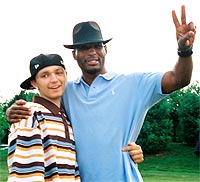 Shaun Negler greatly touched the life of Bernard Hopkins. “He was a winner his whole life and I think he’s still a winner,” Hopkins said.
 (Images courtesy Negler family)
The injury didn’t respond to treatment. An MRI was done and on May 30, Shaun and his parents were sitting in a doctor’s office, waiting to hear why this ankle was taking so long to heal.
“I just remember it being such a dark room and now, looking back on it, it seems so surreal,” said Renee Negler, a 41-year-old loan manager. “There were two doctors there and they came in and seemed to have very solemn looks on their faces. I was looking at Shaunie and he was looking at me. It was the doctors, my husband and Shaunie and I. They said, ‘We need to take him to Children’s Hospital right away. We found a large mass in his leg.’ There was no crying and Shaunie was like, ‘OK. No problem. Let’s come up with a plan.’ He wanted to figure a way to live right away.”
He had Ewing’s sarcoma, a rare form of cancer which seems mainly to attack teenaged males. Once the cancer begins to metastasize, the survival rate is around 10 percent.
It wasn’t good, and everyone in the family, including Shaun, knew it. But no one would cry or moan about his fate, because Shaun would have none of it. He planned a lot of things, including becoming rich and famous. A horrible, grisly death at 18 was not part of the plan.
“This was a guy who was facing death every day but he didn’t talk about dying or feel sorry for himself or ask you, ‘Why is this happening to me?’ ” Hopkins said. “I was in camp getting ready to fight [Kelly] Pavlik and I was getting all these text messages from him, encouraging me and pushing me. And this was a guy who had so many problems, that whoever wins or loses a fight should be the last thing he is thinking about.”
As death hovered on his doorstep, though, Negler, was, indeed, thinking about a fight. He was fighting to live, but he was also fighting to stay alive to see Hopkins box one last time. A little more than five months earlier, the Negler family attended Hopkins’ split decision loss to Joe Calzaghe at the Thomas & Mack Center in Las Vegas on April 19, 2008.
It was an excruciatingly tight match and the Neglers, who by that point had all grown close with Hopkins, had felt he’d won. But after the fight, they were anxious to go out and see the town.
This was Las Vegas, after all, and they didn’t get this opportunity often.
All of them, that is, but one were hoping to go.
“They announced the decision and we all knew Bernard had won that fight. There was no doubt,” said Shaun’s father, Mike Negler, a 42-year-old Philadelphia police officer. “As the fight was going on, Shaun was pointing out how Calzaghe was throwing a lot of punches, but how they weren’t landing and he was showing us how good Bernard’s defense really was. When they announced the score, Shaun was absolutely miserable. He was just as upset and as angry as you can imagine.
“He said, ‘Oh no, they took it from him. They stole it from him.’ And then he didn’t want to do anything else. Here we are in Las Vegas. How many people would do anything to be in Vegas like we were and get to go out on a Saturday night and have a good time? And Shaun said, ‘Take me to the room.’ He wouldn’t do anything else. He was so upset.”
Hopkins signed to fight Pavlik, the unbeaten middleweight champion, in a bout Oct. 18 at Boardwalk Hall in Atlantic City, N.J. Shaun talked of being at the fight, but his condition had long since worsened to the point where that kind of travel, an hour or so from his home, was not possible.
“You have to understand, they gave this kid two, three weeks to live, and it’s 12 weeks and he’s still here saying, ‘I want to see you beat Kelly Pavlik,’ ” Hopkins said. “This kid was just amazing. He had a will to live like I’ve never seen.”
Before Hopkins left to begin his training camp, the family had a reunion of sorts. All the family and friends were invited over for what was a chance to essentially say goodbye to Shaun.
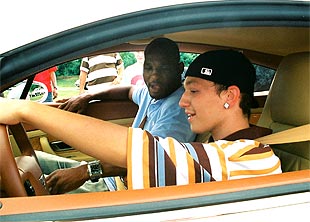
He was on borrowed time and was expected to live only for a matter of a few days, if not a couple of weeks. Hopkins, who knew of Shaun’s love of cars, attended the outing and brought over his $150,000 Bentley.
But he didn’t just park it. He grabbed Shaun, brought him to the car and put him in the front seat. Then he closed the door and turned on the engine.
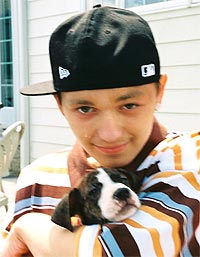 Shaun Negler named his pit bull puppy “Champ,” a name suggested by Bernard Hopkins.
 (Images courtesy Negler family)
The two were sitting there, the 43-year-old finely tuned athlete and the 18-year-old whose body was ravaged by cancer, blind in one eye, with a leg amputated because of his disease.
“What the hell you doing?” Hopkins said in mock indignation. “Drive!”
And so Negler began to drive.
“I thought he’d take it down to the bottom of the driveway, turn around and come back,” Mike Negler said.
Hopkins, though, knew that wouldn’t fulfill the kid’s dream. He wanted to take the car onto the road. So, again, Hopkins urged him to drive. Shaun hit the accelerator, believing the car to be in drive.
It was in reverse, however, and landed up on a curb, damaging Hopkins’ rims. To this day, the rims are not fixed on the otherwise pristine car, Hopkins’ memory of his now-departed friend.
Soon after, Hopkins left for camp and Negler’s condition worsened by the hour. But he wanted to see the fight so badly and he talked about it incessantly with his family.
“Shaun was a diehard fan of all the Philadelphia teams,” Mike Negler said. “He just was in love with all of them, but Bernard, he fell 1,000 percent for Bernard. He loved boxing and then here’s this great fighter from Philadelphia with this incredible story.”
Hopkins trained in Miami knowing each day he might get the call he would dread receiving.
On Oct. 18, the day of the bout he was literally staving off death to see, Negler was in excruciating pain – “bone pain,” as his mother calls it.
A few months earlier, on the first day he got his prosthesis, he had the therapists put it on and he began walking without any physical therapy. He didn’t want it adjusted and demanded that he be driven to his mother’s place of work in Delaware.
Normally, it takes weeks of grueling rehabilitative work for someone who had an amputation to be able to walk. On the first day, Negler, whose left leg was amputated at the knee, was driven to his mother’s office, walked down the aisle and ambled up to her desk.
“There was something in his body and his spirit made him hang around so he could see me that one last time.”
– Bernard Hopkins
on Shaun Negler.
– Bernard Hopkins
on Shaun Negler.
“It took my breath away when I saw him,” she said. “He had this big grin on his face and I couldn’t breathe.”
But now, hours before his friend and idol was to climb into the ring for the fight he so desperately wanted to watch, Negler’s pain was so bad, he took the prosthesis off. He was given more drugs to ease the pain.
When the pay-per-view broadcast on HBO began at 9 p.m., he was helped out of bed and literally crawled downstairs on his hands and knees to sit in front of the television.
But he was only able to stay awake for short periods of time.
“At that point, it was like 10, maybe 15 minutes at most,” Renee Negler said.
He demanded they wake him up when Hopkins came to the ring. Hopkins’ bout began near midnight Eastern time. As Hopkins made his ring walk, the family roused Shaun, who instantly became as alert as he had been at any time in days.
“There was something in his body and his spirit made him hang around so he could see me that one last time,” Hopkins said. “As a human being, can you imagine how that makes me feel?”
There were about 20 or 30 people in the house watching the fight. As Hopkins was being introduced, Renee Negler turned toward her son, who had a wan smile across his face and had formed an “X” with his arms, a tribute to Hopkins, whose nickname is “The Executioner.”
Hopkins went on to win in a rout in the performance of his life. For one night, he was better than he had ever been. And Shaun Negler, who had been able only to stay awake for 10 minutes at a time, was suddenly alive and vibrant as the fight went on.
He was shouting at the television as Hopkins pounded Pavlik with powerful punches, cheering his hero on to victory.
Unbeknownst to anyone, Renee Negler had turned on a video camera on her son and captured his reaction during the fight.
He was gleeful throughout as Hopkins performed brilliantly. When the fight ended, Negler needed to go back to sleep.
He turned to his pit bull puppy, whom Hopkins had suggested he named “Champ,” and kissed it on the head. He crawled back upstairs and was helped into bed. A few minutes later, he lapsed into unconsciousness and never opened his eyes again.
He died a few days later, in his home. Hopkins, who served a stint in the Pennsylvania penal system on a strong-armed robbery conviction, was torn apart.
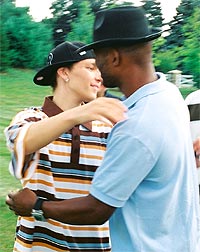 “There was a bond between the two of them despite all the differences between them and they loved each other,” said Renee Negler, Shaun’s mother, on her son and boxer Bernard Hopkins.
 (Images courtesy Negler family)
But because of his time in prison, he learned to control his emotions. He never cried publicly because of what he learned while he was in prison.
Hopkins was, however, stung by the loss of someone he considered more than just a friend. He not only served as a pall bearer, he spent hours with the Negler family that day and put the gloves he wore the night he defeated Pavlik into the casket with Shaun.
“It’s breathtaking the kindness that is in this man’s heart, because it would have been easy for him to meet Shaun, say the right things and move on,” Renee Negler said. “But what he did, he did because he cared. And he did because Shaunie and he had some kind of a connection. There was a bond between the two of them despite all the differences between them and they loved each other.”
Hopkins said that for as much as he may have given to Shaun and the Neglers, he received much more in return.
“This was a kid who had every reason to feel sorry for himself, who had every reason to give up, and he never once would give in and he never once looked at the dark side of anything,” Hopkins said. “He looked at death and said, ‘I want to live. And I’m going to make the most of what I have.’ And that’s what we have to do while we’re here on this Earth. Take what you have and do the best you can with it. Look at what this kid was dealt and look what he did with it.
“Cancer did not beat him. He beat cancer, because cancer needed his body to live. He’s probably smiling somewhere saying, ‘You know, Bernard, I did it. I beat cancer.’ This kid wasn’t a loser. He was a winner his whole life and I think he’s still a winner.”
By Kevin Iole, Yahoo! Sports
Source: http://sports.yahoo.com/box/news;_ylt=An5smQlN6L6AL7ou_RO347k5nYcB?slug=ki-negler110208
Subscribe to:
Comments (Atom)