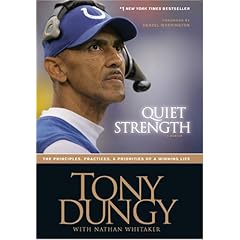
 Tony Dungy's words and example have intrigued millions of people, particularly following his victory in Super Bowl XLI, the first for an African American coach. How is it possible for a coach--especially a football coach--to win the respect of his players and lead them to the Super Bowl without the screaming histrionics, the profanities, the demand that the sport come before anything else? How is it possible for anyone to be successful without compromising faith and family? In this inspiring and reflective memoir, Coach Dungy tells the story of a life lived for God and family--and challenges us all to redefine our ideas of what it means to succeed. Includes a foreword by Denzel Washington and a 16-page color photo insert.
Sunday, November 15, 2009
Quiet Strength: The Principles, Practices, & Priorities of a Winning Life - Wal-Mart
Tony Dungy's words and example have intrigued millions of people, particularly following his victory in Super Bowl XLI, the first for an African American coach. How is it possible for a coach--especially a football coach--to win the respect of his players and lead them to the Super Bowl without the screaming histrionics, the profanities, the demand that the sport come before anything else? How is it possible for anyone to be successful without compromising faith and family? In this inspiring and reflective memoir, Coach Dungy tells the story of a life lived for God and family--and challenges us all to redefine our ideas of what it means to succeed. Includes a foreword by Denzel Washington and a 16-page color photo insert.

Tuesday, November 10, 2009
Ten9Eight: Shoot For the Moon

In America, a kid drops out of high school every nine seconds. Imagine if they didn’t. This is the compelling question behind award-winning filmmaker Mary Mazzio’s newest project TEN9EIGHT, a thought provoking film which tells the inspirational stories of several inner city teens (of differing race, religion, and ethnicity) from Harlem to Compton and all points in between, as they compete in an annual business plan competition run by the Network for Teaching Entrepreneurship (NFTE).
In theaters: November 13, 2009
Monday, November 9, 2009
The biggest lies about Black male and female relationships
THE "happy Black couple." To some, that phrase seems like the ultimate oxymoron. That's because so many people buy into the notion that the battles between Black men and Black women are so fierce that maintaining a stable, committed relationship is virtually impossible. True enough, Brothers and Sisters often find themselves staring across a great divide that makes coupling up a challenge. Still, countless Black folks are hooking up and staying hooked up, defying the stereotypes and the mythology that says Black couples can't make it.
In fact, as Black and White scholars have demonstrated, Black family relationships were as stable and strong as Southern White households and Northern White ethnic households until the 1930s. Since that time, the situation has changed, primarily because of a lethal combination of racism, urbanization, unemployment and drugs. "What is astonishing under these circumstances," as one historian noted, "is not that some Black couples have problems, but that so many Black couples still love and give." These couples are all around us, and we can learn from them and from Black history how to identify--and how to defy--the biggest lies about Black male/female relationships.
On the following pages are some of the biggest myths associated with Black male/female relationships and some ways in which you can avoid falling into the emotional and mental traps that make these pitfalls seem too big to steer clear of.
1. Black Relationships/Marriages Don't Last
Advertisement
Many people accept this notion as fact despite the contrary evidence presented by the thousands of Black couples who each year celebrate marriages that have lasted 50 years or more. Jet magazine features them each week. They are couples like Lurline and Wendell Cotton of Garland, Texas. The Cottons, both 80, celebrated their 59th wedding anniversary on February 6.
Not only have the Cottons lived together for most of their lives, they worked together for nearly 40 years in Wendell Cotton's dental practice in California. Lurline Cotton served as her husband's office manager until the couple retired and moved to Texas in 1984. What's the key to their marital longevity? "Mutual respect," says Lurline Cotton, who had three sisters, each of whom also was married over 50 years. "You've got to have that respect for the other person. There are going to be hard times and some disagreements in a marriage. But when you have that respect, then you are allowed to be who you are and your partner is allowed to be who he is, and you can work through anything."
2. Black Male/Female Relationships Are Only About Sex
It's true that sex is a critical component in any marriage or committed relationship, but its significance as the only thing that cements Black male/female relationships is highly exaggerated. "Sex is important; every man will tell you that," says Dr. George Smith, a Chicago psychotherapist who has counseled more than 2,000 couples in relationship trouble. "But if sex is all you have holding your relationship together, you're in trouble because you don't have a true relationship."
Smith says he tries to show the couples he works with how to communicate and trust and support each another so that their relationship is about more than sex. More often than not, he's successful. He helps couples find the bonds and mutual goals that make their sexual relationship a sustainable partnership. "Any relationship of substance has to be based on trust and commitment and respect," he says. "If you have those things, you'll not only have a true partnership, you'll have great sex."
3. All Black Male/Female Relationships Are Filled With Arguments, Hardship And Pain
Love may hurt, but it doesn't have to, the experts say. Many Black couples in healthy and stable relationships can and do disagree without becoming disagreeable.
But the image of the constantly bickering Black couple has taken over popular thought to such a degree that most people assume it is the norm, says Tiy-E Muhammad, assistant professor of psychology at Clark Atlanta University. "Many people believe that couples must have dramatic occurrences--cursing at one another, being put out of the house, keying somebody's car--in order to appreciate one another," Muhammad says. "WRONG! It is very possible--in fact, it's the norm--for a couple to have a nice, respectful relationship without all of the drama that society is starting to make us believe is normal."
The way to avoid having your relationship dispute degenerate into screaming matches is to learn how to fight fair. Don't choose the moment of a dispute about money to hit your partner with a "low blow" about sexual performance or inattention to your emotional needs. "Make sure that what you're fighting about is really what you're mad about [at the time]," says Kathy Grant, a Miami marriage counselor. "When arguments blow up into huge, dramatic fights, there's more at work there than what people say they're arguing about. That's why constant communication is important."
4. All Black Men Cheat On Their Partners
This is such a widely accepted belief, many Black men won't even dispute it. But while monogamy can be hard, it's a behavior many Black men conform to with the love and support of strong Black women.
But due to the myriad social and environmental forces that have not been supportive of strong, Black male role models, "a lot of Black men don't know how to be a husband or father," says Dr. Smith. "But if you work with him, nurture him, talk to him, you can help him to be the husband and father you want and need him to be."
Smith also cautions Black men not to allow ego and insecurity to push them to live up to the myth of the Black superstud at the expense of their relationships. "A lot of times, as Black men, our huge egos are all we bring to the table in a relationship, and when that ego gets hurt, we strike out with the one weapon we think we have," Smith says. "But a lot of Black men, with the help of their women, are learning to open up. They're learning how to deal with frustrations in their relationships in other ways besides having a woman on the side."
But women also bear some responsibility for the promulgation of the belief that all Black men cheat. "A lot of women withhold sex as a form of behavior modification or punishment when they're angry with their spouse or boyfriend," says Dr. Grant. "That's not only not healthy, it doesn't work. It's the surefire way to send a man looking elsewhere, especially since society is conditioning him to believe that's what is expected of him."
Advertisement
Both Grant and Smith say communication and maintaining an active sex life are essential to keep a man from straying. "It can be tough," says Grant. "Especially for the working mother, who on top of her job, still takes the lead role in caring for the kids and home. She's often just too tired for sex. But you've got to find ways to make that a priority in your relationship. Help him see how sharing in the housework and taking care of the children will also help in the bedroom. Don't withhold sex if he doesn't do those things. But help him to see how rewarding it can be when he does."
5. Black Women Can't Hold Relationships Together Because They Are Too Domineering And Demanding
It is ironic that the strength and determination for which Black women are revered as mothers and stalwart family supporters are also the qualities around which a great deal of relationship mythology is centered.
Part of the problem is the ambivalence many men have about what they really want in a partner/mate. "Modern-day men enjoy having an independent woman," says Tiy-E Muhammad. "Most men will say, `I want a woman who's got it going on.' But after the relationship has begun, those same men will now want that woman to submit and be a part of his vision and his dream. He will want to be the dominant figure in the relationship in order to feel whole."
In relationships that work--those that endure for decades--the individuals who make up the couple take turns allowing the other to be "boss." "You don't have to be totally submissive," says Lurline Cotton, "but sometimes you go along with what he wants to do, even if it's not exactly what you want, and he goes along with what you want to do, even if it's not exactly what he wants."
This only works if there is trust in the relationship. "You have to be secure in the feeling that your mate is operating in your best interest," says Dr. Grant. "But a lot of Black women have had experiences that may lead them to believe that every guy is trying to get over on them, and that's a hard barrier to get over. So men have to work hard to show them that they're deserving of that trust. It may take time and a lot of effort on the man's part to get through that barrier, but a lot of couples manage it."
Advertisement
Black women also must relinquish some control, especially on the home front, which many women see as their dominion. "Just because he doesn't feed the baby exactly the way you would or make dinner exactly the way you would, you don't just take that away from him or degrade his approach," advises Dr. Smith. "If you nurture him and show appreciation for the way he does-things, you're showing him respect and building up that trust in the relationship."
The bottom line is that Black couples do make it--more make it, in fact, than our society ever really acknowledges. And if more people followed the examples of the couples whose relationships do endure, and the tips from the experts who help struggling couples get over the hump, perhaps the myths about Black male/female relationships would fade--replaced by more stories like those of Lurline and Wendell Cotton, whose 59-year marriage is still going strong.
"It takes a commitment to what you're trying to build together," Lurline Cotton says. "But if you have the respect and th,e love, the commitment is a lot easier to maintain."
COPYRIGHT 2002 Johnson Publishing Co.
COPYRIGHT 2002 Gale Group
In fact, as Black and White scholars have demonstrated, Black family relationships were as stable and strong as Southern White households and Northern White ethnic households until the 1930s. Since that time, the situation has changed, primarily because of a lethal combination of racism, urbanization, unemployment and drugs. "What is astonishing under these circumstances," as one historian noted, "is not that some Black couples have problems, but that so many Black couples still love and give." These couples are all around us, and we can learn from them and from Black history how to identify--and how to defy--the biggest lies about Black male/female relationships.
On the following pages are some of the biggest myths associated with Black male/female relationships and some ways in which you can avoid falling into the emotional and mental traps that make these pitfalls seem too big to steer clear of.
1. Black Relationships/Marriages Don't Last
Advertisement
Many people accept this notion as fact despite the contrary evidence presented by the thousands of Black couples who each year celebrate marriages that have lasted 50 years or more. Jet magazine features them each week. They are couples like Lurline and Wendell Cotton of Garland, Texas. The Cottons, both 80, celebrated their 59th wedding anniversary on February 6.
Not only have the Cottons lived together for most of their lives, they worked together for nearly 40 years in Wendell Cotton's dental practice in California. Lurline Cotton served as her husband's office manager until the couple retired and moved to Texas in 1984. What's the key to their marital longevity? "Mutual respect," says Lurline Cotton, who had three sisters, each of whom also was married over 50 years. "You've got to have that respect for the other person. There are going to be hard times and some disagreements in a marriage. But when you have that respect, then you are allowed to be who you are and your partner is allowed to be who he is, and you can work through anything."
2. Black Male/Female Relationships Are Only About Sex
It's true that sex is a critical component in any marriage or committed relationship, but its significance as the only thing that cements Black male/female relationships is highly exaggerated. "Sex is important; every man will tell you that," says Dr. George Smith, a Chicago psychotherapist who has counseled more than 2,000 couples in relationship trouble. "But if sex is all you have holding your relationship together, you're in trouble because you don't have a true relationship."
Smith says he tries to show the couples he works with how to communicate and trust and support each another so that their relationship is about more than sex. More often than not, he's successful. He helps couples find the bonds and mutual goals that make their sexual relationship a sustainable partnership. "Any relationship of substance has to be based on trust and commitment and respect," he says. "If you have those things, you'll not only have a true partnership, you'll have great sex."
3. All Black Male/Female Relationships Are Filled With Arguments, Hardship And Pain
Love may hurt, but it doesn't have to, the experts say. Many Black couples in healthy and stable relationships can and do disagree without becoming disagreeable.
But the image of the constantly bickering Black couple has taken over popular thought to such a degree that most people assume it is the norm, says Tiy-E Muhammad, assistant professor of psychology at Clark Atlanta University. "Many people believe that couples must have dramatic occurrences--cursing at one another, being put out of the house, keying somebody's car--in order to appreciate one another," Muhammad says. "WRONG! It is very possible--in fact, it's the norm--for a couple to have a nice, respectful relationship without all of the drama that society is starting to make us believe is normal."
The way to avoid having your relationship dispute degenerate into screaming matches is to learn how to fight fair. Don't choose the moment of a dispute about money to hit your partner with a "low blow" about sexual performance or inattention to your emotional needs. "Make sure that what you're fighting about is really what you're mad about [at the time]," says Kathy Grant, a Miami marriage counselor. "When arguments blow up into huge, dramatic fights, there's more at work there than what people say they're arguing about. That's why constant communication is important."
4. All Black Men Cheat On Their Partners
This is such a widely accepted belief, many Black men won't even dispute it. But while monogamy can be hard, it's a behavior many Black men conform to with the love and support of strong Black women.
But due to the myriad social and environmental forces that have not been supportive of strong, Black male role models, "a lot of Black men don't know how to be a husband or father," says Dr. Smith. "But if you work with him, nurture him, talk to him, you can help him to be the husband and father you want and need him to be."
Smith also cautions Black men not to allow ego and insecurity to push them to live up to the myth of the Black superstud at the expense of their relationships. "A lot of times, as Black men, our huge egos are all we bring to the table in a relationship, and when that ego gets hurt, we strike out with the one weapon we think we have," Smith says. "But a lot of Black men, with the help of their women, are learning to open up. They're learning how to deal with frustrations in their relationships in other ways besides having a woman on the side."
But women also bear some responsibility for the promulgation of the belief that all Black men cheat. "A lot of women withhold sex as a form of behavior modification or punishment when they're angry with their spouse or boyfriend," says Dr. Grant. "That's not only not healthy, it doesn't work. It's the surefire way to send a man looking elsewhere, especially since society is conditioning him to believe that's what is expected of him."
Advertisement
Both Grant and Smith say communication and maintaining an active sex life are essential to keep a man from straying. "It can be tough," says Grant. "Especially for the working mother, who on top of her job, still takes the lead role in caring for the kids and home. She's often just too tired for sex. But you've got to find ways to make that a priority in your relationship. Help him see how sharing in the housework and taking care of the children will also help in the bedroom. Don't withhold sex if he doesn't do those things. But help him to see how rewarding it can be when he does."
5. Black Women Can't Hold Relationships Together Because They Are Too Domineering And Demanding
It is ironic that the strength and determination for which Black women are revered as mothers and stalwart family supporters are also the qualities around which a great deal of relationship mythology is centered.
Part of the problem is the ambivalence many men have about what they really want in a partner/mate. "Modern-day men enjoy having an independent woman," says Tiy-E Muhammad. "Most men will say, `I want a woman who's got it going on.' But after the relationship has begun, those same men will now want that woman to submit and be a part of his vision and his dream. He will want to be the dominant figure in the relationship in order to feel whole."
In relationships that work--those that endure for decades--the individuals who make up the couple take turns allowing the other to be "boss." "You don't have to be totally submissive," says Lurline Cotton, "but sometimes you go along with what he wants to do, even if it's not exactly what you want, and he goes along with what you want to do, even if it's not exactly what he wants."
This only works if there is trust in the relationship. "You have to be secure in the feeling that your mate is operating in your best interest," says Dr. Grant. "But a lot of Black women have had experiences that may lead them to believe that every guy is trying to get over on them, and that's a hard barrier to get over. So men have to work hard to show them that they're deserving of that trust. It may take time and a lot of effort on the man's part to get through that barrier, but a lot of couples manage it."
Advertisement
Black women also must relinquish some control, especially on the home front, which many women see as their dominion. "Just because he doesn't feed the baby exactly the way you would or make dinner exactly the way you would, you don't just take that away from him or degrade his approach," advises Dr. Smith. "If you nurture him and show appreciation for the way he does-things, you're showing him respect and building up that trust in the relationship."
The bottom line is that Black couples do make it--more make it, in fact, than our society ever really acknowledges. And if more people followed the examples of the couples whose relationships do endure, and the tips from the experts who help struggling couples get over the hump, perhaps the myths about Black male/female relationships would fade--replaced by more stories like those of Lurline and Wendell Cotton, whose 59-year marriage is still going strong.
"It takes a commitment to what you're trying to build together," Lurline Cotton says. "But if you have the respect and th,e love, the commitment is a lot easier to maintain."
COPYRIGHT 2002 Johnson Publishing Co.
COPYRIGHT 2002 Gale Group
Monday, October 12, 2009
Obama wins 2009 Nobel Peace Prize
he Nobel Committee said he was awarded it for "his extraordinary efforts to strengthen international diplomacy and co-operation between peoples".
Source: http://news.bbc.co.uk/2/hi/europe/8298580.stm
The committee highlighted Mr Obama's efforts to strengthen international bodies and promote nuclear disarmament.
There were a record 205 nominations for this year's prize. Zimbabwe's prime minister and a Chinese dissident had been among the favourites.
The laureate - chosen by a five-member committee - wins a gold medal, a diploma and 10m Swedish kronor ($1.4m).
 | KEY RECENT WINNERS 2008: Martti Ahtisaari 2007: Intergovernmental Panel on Climate Change, Al Gore 2002: Jimmy Carter 2001: UN, Kofi Annan 1994: Yasser Arafat, Shimon Peres, Yitzhak Rabin 1993: Nelson Mandela, FW de Klerk 1991: Aung San Suu Kyi 1990: Mikhail Gorbachev 1989: Dalai Lama  |
"Only very rarely has a person to the same extent as Obama captured the world's attention and given its people hope for a better future," the Norwegian committee said in a statement.
"His diplomacy is founded in the concept that those who are to lead the world must do so on the basis of values and attitudes that are shared by the majority of the world's population."
Asked why the prize had been awarded to Mr Obama less than a year after he took office, Nobel committee head Thorbjoern Jagland said: "It was because we would like to support what he is trying to achieve".
"It is a clear signal that we want to advocate the same as he has done," he said.
He specifically mentioned Mr Obama's work to strengthen international institutions and work towards a world free of nuclear arms.
The statement from the committee also said the US president had "created a new climate in international politics".
"Multilateral diplomacy has regained a central position, with emphasis on the role that the United Nations and other international institutions can play," it said.
The committee added that the US was now playing a more constructive role in meeting "the great climatic challenges" facing the world, and that democracy and human rights would be strengthened.
Source: http://news.bbc.co.uk/2/hi/europe/8298580.stm
Friday, October 9, 2009
African American atheletes that make a difference. PT1
A.C. Green Youth Foundation
The mission of the A.C. Green Youth Foundation is to serve both youth and the communities in which they live by providing information about sexual abstinence and social issues that concern our young people and educating them to make responsible choices to prepare them for their future. PROGRAMS FOR YOUTH believes that young people must develop morally, ethically, educationally, physically, and mentally to fulfill their dreams and goals in life. The underlying theme throughout is to accept each person for who they are, in an unconditional atmosphere of love and respect. www.acgreen.com.
Adalius Thomas S.L.A.S.H. Fund
Adalius Thomas is one of the most active Ravens in the community, donating time and financial support to organizations that assist underprivileged children. Thomas annually hosts a group of 45 students from the Knights of Valor chess team to take part in a chess tournament against Ravens players and, for his work in the community, was honored as a finalist for the Byron "Whizzer" White Humanitarian Award in 2004, given to the NFL player who best represents dedication to team, community and country. Also in 2004, Thomas hosted his 1st Annual S.L.A.S.H. (Sportsmen Lifting Academics and Sponsoring Hope) Golf Tournament with proceeds benefiting the foundation.
Allen Rossum "Healthy Kids Klub"
The Allen Rossum "Healthy Kids Klub" works with entire families to provide education on healthy lifestyles. The Klub activities emphasize good eating habits (nutrition) combined with athletic programs (healthy activities). www.rossumshealthykids.org.
Alonzo Mourning Charities, Inc. (“AMC”)
Founded in 1997, Alonzo Mourning Charities, Inc. (“AMC”) is a non-profit 501(c)(3) organization that allows donors with valid interest in children’s issues the opportunity of giving to several charities from their one contribution. All benefiting organizations aid in the development of at-risk children and families, including those who have been abused, abandoned, and/or neglected. It is the goal of the AMC to improve the quality of life, enhance educational and economic opportunities for all minorities based on the percepts of respect for family, education, spirituality, justice and integrity. Together with donors, AMC makes it possible for young people to develop a better way of life and encourages them to dream and reach for a more positive future that might otherwise have been thought unattainable. AMC supports organizations and programs that provide human services and mentoring in several locations in addition to South Florida, such as Hampton Toads, VA and New Jersey. www.amcharities.org.
Amani Toomer Foundation
In 2001, Amani Toomer and his wife Dr. Yola Dabrowski, founded The Amani Toomer Foundation (TATF). TAFT if a not-for-profit organization dedicated to increasing the awareness of, and providing resources to after-school recreation programs in the New York metro area. The mission of TATF is to identify established after-school programs in these underserved communities and assist them in furthering their efforts. www.amanitoomer.com or www.amanitoomerfoundation.org.
Anthony Weaver Foundation
The Anthony Weaver Foundation was established in 2004 with the purpose of providing both financial and personal assistance to children living in the Greater Baltimore Area and Saratoga Springs, NY. In living up to his high school and college nickname, "Dream Weaver," the Anthony Weaver Foundation will assist in making the dreams of children become a reality.
Barry Stokes Foundation
The Barry Stokes Foundation offers "hope for a better tomorrow" for youth as they grow spiritually, athletically and academically. The Foundation does this by supporting The Make-A-Wish Foundation, Striving After Self Sufficiency (S.A.S.S.) and The Davison High School Athletic Scholarship Fund in his hometown of Davison, MI. www.barrystokesfoundation.org.
Charlie Batch – The Batch Foundation
Quarterback Charlie Batch launched the Best of the Batch Foundation in 2002 to help support educational and recreational opportunities for underprivileged children. Activities include Project C.H.U.C.K., a six-week summer youth basketball league for inner-city children in the Homestead, Pa., the Pittsburgh suburb where Charlie grew up. The program targets children ages 7-18 and provides a structured summer recreational activity for children, which takes place in the evening so parents can attend.
Chris McAlister Foundation
The Chris McAlister Foundation raises money for the Boys & Girls Club of Pasadena, CA and contributes food and money to Baltimore area churches so that they can provide support to needy families. In 2004, McAlister provided game tickets to the Echo House Multi Cultural Center in Baltimore, hosted a Halloween Extravaganza for over 300 area youth, donated food and supplies to 200 families for Thanksgiving and provided televisions and games to patients at the Johns Hopkins Pediatric Outpatient Center for Christmas.
The mission of the A.C. Green Youth Foundation is to serve both youth and the communities in which they live by providing information about sexual abstinence and social issues that concern our young people and educating them to make responsible choices to prepare them for their future. PROGRAMS FOR YOUTH believes that young people must develop morally, ethically, educationally, physically, and mentally to fulfill their dreams and goals in life. The underlying theme throughout is to accept each person for who they are, in an unconditional atmosphere of love and respect. www.acgreen.com.
Adalius Thomas S.L.A.S.H. Fund
Adalius Thomas is one of the most active Ravens in the community, donating time and financial support to organizations that assist underprivileged children. Thomas annually hosts a group of 45 students from the Knights of Valor chess team to take part in a chess tournament against Ravens players and, for his work in the community, was honored as a finalist for the Byron "Whizzer" White Humanitarian Award in 2004, given to the NFL player who best represents dedication to team, community and country. Also in 2004, Thomas hosted his 1st Annual S.L.A.S.H. (Sportsmen Lifting Academics and Sponsoring Hope) Golf Tournament with proceeds benefiting the foundation.
Allen Rossum "Healthy Kids Klub"
The Allen Rossum "Healthy Kids Klub" works with entire families to provide education on healthy lifestyles. The Klub activities emphasize good eating habits (nutrition) combined with athletic programs (healthy activities). www.rossumshealthykids.org.
Alonzo Mourning Charities, Inc. (“AMC”)
Founded in 1997, Alonzo Mourning Charities, Inc. (“AMC”) is a non-profit 501(c)(3) organization that allows donors with valid interest in children’s issues the opportunity of giving to several charities from their one contribution. All benefiting organizations aid in the development of at-risk children and families, including those who have been abused, abandoned, and/or neglected. It is the goal of the AMC to improve the quality of life, enhance educational and economic opportunities for all minorities based on the percepts of respect for family, education, spirituality, justice and integrity. Together with donors, AMC makes it possible for young people to develop a better way of life and encourages them to dream and reach for a more positive future that might otherwise have been thought unattainable. AMC supports organizations and programs that provide human services and mentoring in several locations in addition to South Florida, such as Hampton Toads, VA and New Jersey. www.amcharities.org.
Amani Toomer Foundation
In 2001, Amani Toomer and his wife Dr. Yola Dabrowski, founded The Amani Toomer Foundation (TATF). TAFT if a not-for-profit organization dedicated to increasing the awareness of, and providing resources to after-school recreation programs in the New York metro area. The mission of TATF is to identify established after-school programs in these underserved communities and assist them in furthering their efforts. www.amanitoomer.com or www.amanitoomerfoundation.org.
Anthony Weaver Foundation
The Anthony Weaver Foundation was established in 2004 with the purpose of providing both financial and personal assistance to children living in the Greater Baltimore Area and Saratoga Springs, NY. In living up to his high school and college nickname, "Dream Weaver," the Anthony Weaver Foundation will assist in making the dreams of children become a reality.
Barry Stokes Foundation
The Barry Stokes Foundation offers "hope for a better tomorrow" for youth as they grow spiritually, athletically and academically. The Foundation does this by supporting The Make-A-Wish Foundation, Striving After Self Sufficiency (S.A.S.S.) and The Davison High School Athletic Scholarship Fund in his hometown of Davison, MI. www.barrystokesfoundation.org.
Charlie Batch – The Batch Foundation
Quarterback Charlie Batch launched the Best of the Batch Foundation in 2002 to help support educational and recreational opportunities for underprivileged children. Activities include Project C.H.U.C.K., a six-week summer youth basketball league for inner-city children in the Homestead, Pa., the Pittsburgh suburb where Charlie grew up. The program targets children ages 7-18 and provides a structured summer recreational activity for children, which takes place in the evening so parents can attend.
Chris McAlister Foundation
The Chris McAlister Foundation raises money for the Boys & Girls Club of Pasadena, CA and contributes food and money to Baltimore area churches so that they can provide support to needy families. In 2004, McAlister provided game tickets to the Echo House Multi Cultural Center in Baltimore, hosted a Halloween Extravaganza for over 300 area youth, donated food and supplies to 200 families for Thanksgiving and provided televisions and games to patients at the Johns Hopkins Pediatric Outpatient Center for Christmas.
Monday, October 5, 2009
Rapper Ludacris gives away cars to contest winners
AP, Sep 7, 2009 6:09 am PDT
Talk about a one-man stimulus package: Grammy-winning rapper Ludacris has given away 20 cars to people who wrote about their struggles to keep their jobs for a lack of wheels of their own.
Ludacris said he was taken aback after reading thousands of essays by people struggling or unable to buy cars needed to get to and from work or find jobs. The 31-year-old rapper felt he could step in and move them ahead, partnering with a suburban Atlanta dealership for Sunday's giveaway.
"People are getting laid off, and now are looking for jobs," Ludacris said. "To be efficient, you need some transportation of your own to get there. That's why I wanted to give back to those who need it."
Each of the used vehicles included free gas for 30 days. Winning contestants were responsible for tags, registration, tax and insurance. About 4,000 contestants submitted a 300-word essay to the rapper's foundation, explaining why they deserved a car.
One of the most touching stories Ludacris read was by Mading Duor.
Duor described how he moved to the United States six years ago after his mother, father, and five brothers and sisters were killed in Sudan. The man also wrote that a son was killed by a drunken driver in Atlanta a few years back.
"His story touched my heart," Ludacris said. "He's endured so much in his life and he's still here standing. I'm very proud to have helped him."
Duor, 33, has been able to keep a steady job at a school, but each day he felt stressed about how he was going to get to work. No longer.
"I'm so happy, that I'm nervous," said Duor, who won a Nissan Maxima. "When I look at my new car, I say to myself, 'Is this really happening?'"
Crystal Beauford, a single mother who used to ride the bus to two jobs and school, now has a Saturn Ion. The 26-year-old college student doesn't know how to drive the stick-shift vehicle, but said she'll learn.
"This is going to help me out so much," Beauford said. "It's a blessing."
Ludacris won Grammys for Best Rap Album for "Release Therapy" and Best Rap Song for "Money Maker."
http://news.yahoo.com/s/ap/20090907/ap_on_en_mu/us_people_ludacris
Talk about a one-man stimulus package: Grammy-winning rapper Ludacris has given away 20 cars to people who wrote about their struggles to keep their jobs for a lack of wheels of their own.
Ludacris said he was taken aback after reading thousands of essays by people struggling or unable to buy cars needed to get to and from work or find jobs. The 31-year-old rapper felt he could step in and move them ahead, partnering with a suburban Atlanta dealership for Sunday's giveaway.
"People are getting laid off, and now are looking for jobs," Ludacris said. "To be efficient, you need some transportation of your own to get there. That's why I wanted to give back to those who need it."
Each of the used vehicles included free gas for 30 days. Winning contestants were responsible for tags, registration, tax and insurance. About 4,000 contestants submitted a 300-word essay to the rapper's foundation, explaining why they deserved a car.
One of the most touching stories Ludacris read was by Mading Duor.
Duor described how he moved to the United States six years ago after his mother, father, and five brothers and sisters were killed in Sudan. The man also wrote that a son was killed by a drunken driver in Atlanta a few years back.
"His story touched my heart," Ludacris said. "He's endured so much in his life and he's still here standing. I'm very proud to have helped him."
Duor, 33, has been able to keep a steady job at a school, but each day he felt stressed about how he was going to get to work. No longer.
"I'm so happy, that I'm nervous," said Duor, who won a Nissan Maxima. "When I look at my new car, I say to myself, 'Is this really happening?'"
Crystal Beauford, a single mother who used to ride the bus to two jobs and school, now has a Saturn Ion. The 26-year-old college student doesn't know how to drive the stick-shift vehicle, but said she'll learn.
"This is going to help me out so much," Beauford said. "It's a blessing."
Ludacris won Grammys for Best Rap Album for "Release Therapy" and Best Rap Song for "Money Maker."
http://news.yahoo.com/s/ap/20090907/ap_on_en_mu/us_people_ludacris
Saturday, October 3, 2009
The Boy Who Harnessed the Wind

We seldom post about books at Gizmodo, but if this story of a self-taught Malawian boy using junkyard parts to build windmills and bring life-changing electricity to his village doesn't make you misty-eyed, then you must be one cold-hearted bastard.
Nothing in this world can take the place of persistence, and William Kamkwamba has it in spades. At age fourteen, while many of us were sneaking out of classrooms, William was struggling to sneak into them—his family was unable to afford the $80 annual tuition. As is bound to happen to most students, he was caught. But instead of being sent to detention, he was barred from the school. In a show of the driven man he would become, he didn't allow that to hinder him and instead started spending his days in the local library. While there, he encountered a book called Using Energy:
Using Energy described how windmills could be used to generate electricity. Only two percent of Malawians have electricity, and the service is notoriously unreliable. William decided an electric windmill was something he wanted to make. Illuminating his house and the other houses in his village would mean that people could read at night after work. A windmill to pump water would mean that they could grow two crops a year rather than one, grow vegetable gardens, and not have to spend two hours a day hauling water. "A windmill meant more than just power," he wrote, "it was freedom."
This book is what changed his life. And I don't mean that as an exaggeration. It was truly what made a difference in his life. Because of that book, and the potential he saw in its ideas, William began to build:
William scoured trash bins and junkyards for materials he could use to build his windmill. With only a couple of wrenches at his disposal, and unable to afford even nuts and bolts, he collected things that most people would consider garbage-slime-clogged plastic pipes, a broken bicycle, a discarded tractor fan-and assembled them into a wind-powered dynamo. For a soldering iron, he used a stiff piece of wire heated in a fire. A bent bicycle spoke served as a size adapter for his wrenches.
Imagine that. A young boy being so motivated by ideas and the sheer need to build something life-changing that he discovered materials and uses for them which most of us wouldn't even dream of. As Mark Frauenfelder put it:
For an educated adult living in a developed nation, designing and building a wind turbine that generates electricity is something to be proud of. For a half-starved, uneducated boy living in a country plagued with drought, famine, poverty, disease, a cruelly corrupt government, crippling superstitions, and low expectations, it's another thing altogether. It's nothing short of monumental.
After completing his first windmill, William "went on to wire his house with four light bulbs and two radios, installing switches made from rubber sandals, and scratch-building a circuit breaker to keep the thatch roof of his house from catching fire." His project had the attention of village locals early on, but at this point he gained the attention of TED, Technology Entertainment Design, through whom he was introduced to individuals willing to contribute to his plans to "electrify, irrigate, and educate his village, as well as pay his tuition at the prestigious African Leadership Academy in Johannesburg."
In short: A young man struggled to educate himself, to build something his village needed, and in the end made a difference to the entire locale and gained the education he'd always wanted. Yes, it's a fluffy, feel-good story with a happy ending. What should you take from the it? Maybe that there's hope in the bleakest of situations, maybe that your teachers and parents were right about the power of education, maybe just that I'm a sappy bookworm with a soft spot for happy endings. No matter, if you wish to learn more, you can read the recently released The Boy Who Harnessed the Wind, check out William's blog, or peek at this video from before he ever wrote his autobiography.
Source: The Boy Who Harnessed the Wind: Persistence, Jury-Rigging, and Ingenuity Against All Odds - The Boy Who Harnessed the Wind - Gizmodo
Subscribe to:
Posts (Atom)